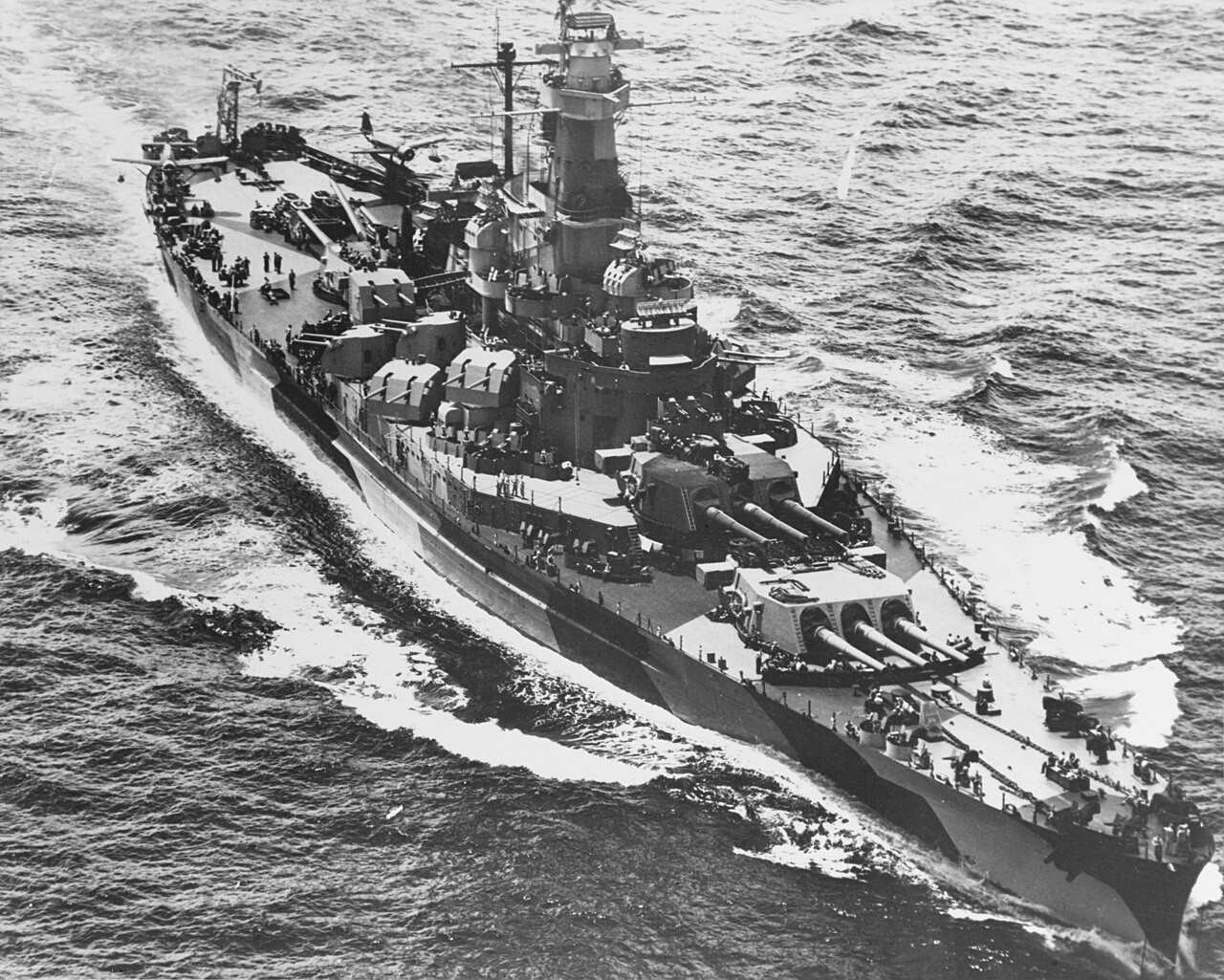
Building
Indiana, the second of the four South Dakota-class battleships, was authorized on 27 March 1934 under the Vinson-Trammell Act. President Roosevelt approved her name on 21 September 1938. The class was the first designed after the treaty system broke down. It used the "escalator clause" to mount nine 16-inch guns but kept close to the 35,000-ton limit, and armoring the ships against their own caliber of gun made them cramped. Newport News Shipbuilding laid her down on 20 November 1939. She was launched on 21 November 1941, two weeks before Pearl Harbor, christened by Margaret Robbins, daughter of Governor Henry F. Schricker of Indiana. She was commissioned on 30 April 1942, Captain Aaron S. "Tip" Merrill in command, in a ceremony attended by Navy Secretary Frank Knox. She flew the flag that the earlier battleship Indiana had flown at Santiago de Cuba in 1898.
Guadalcanal and the Solomons
She was sent to the Guadalcanal campaign to replace her sister South Dakota, which had been badly damaged in the Naval Battle of Guadalcanal. She gave gunfire support ashore, and from 1 to 4 January 1943 she covered seven transports carrying the 25th Infantry Division to the island. With North Carolina and Washington she formed Rear Admiral Willis Lee's Task Force 64 and covered convoys in the Solomons into 1943. Her radar was upgraded as a result of the Guadalcanal fighting.
The Central Pacific
She supported the Tarawa landings in November 1943. On 8 December she and four other battleships and twelve destroyers bombarded Nauru. On 29 January 1944 she attacked Maloelap with Washington, Enterprise and Yorktown, and on 30 January she, Massachusetts and Washington shelled Kwajalein. In the early hours of 1 February, with all ships blacked out, Indiana turned across Washington's bow. The collision tore some 200 feet of armor plate from her side and badly damaged Washington's bow, and both ships went to Majuro and then for repairs. She was back by April and steamed with Massachusetts for the strikes on Truk on 29–30 April. She sortied on 6 June for Saipan and defended the carriers in the Battle of the Philippine Sea on 19–20 June. Engine trouble kept her in Seeadler Harbor from 21 September to 4 October, so she missed Peleliu. She was overhauled at Puget Sound until 30 November 1944.
Iwo Jima, Okinawa and Japan
She rejoined the fleet at Saipan on 20 January 1945 and supported the Iwo Jima operation and the carrier strikes on Japan. Off Okinawa she helped repel the great 7 April counterattack. On 12 April a Zero and a Ki-43 tried to crash her, and her guns brought down both, though a fragment wounded a Marine aboard. Two days later she shot down another Zero and helped rescue a downed Hellcat pilot. The Third Fleet rode out the typhoon of 5 June south of Okinawa. In the summer of 1945 she bombarded the Japanese home islands with Battleship Division 8. She shelled the Japan Iron Company works and the Kamaishi Steel Works, fired on Hamamatsu alongside the British Task Force 37 led by HMS King George V, and returned to Kamaishi on 9 August, firing 270 shells between 12:46 and 14:45. She contributed men to the occupation force and entered Tokyo Bay on 5 September, three days after the surrender.
Fate
She returned to Puget Sound, was placed in reserve after a final refit, and was struck in 1962 and sold for scrap the following year. Pieces of her survive in her namesake state. One anchor is at the Allen County War Memorial Coliseum in Fort Wayne, her bell is at the Heslar Naval Armory in Indianapolis, and her wheel is at Shortridge High School. Her mainmast and a pair of antiaircraft guns, donated in 1966, stand at Indiana University's Memorial Stadium, and her bow section joined them there in 2013.
Sources
Wikipedia, "USS Indiana (BB-58)" (citing Friedman, Garzke & Dulin, DANFS, Frank's Guadalcanal).
NHHC/DANFS, "Indiana IV."