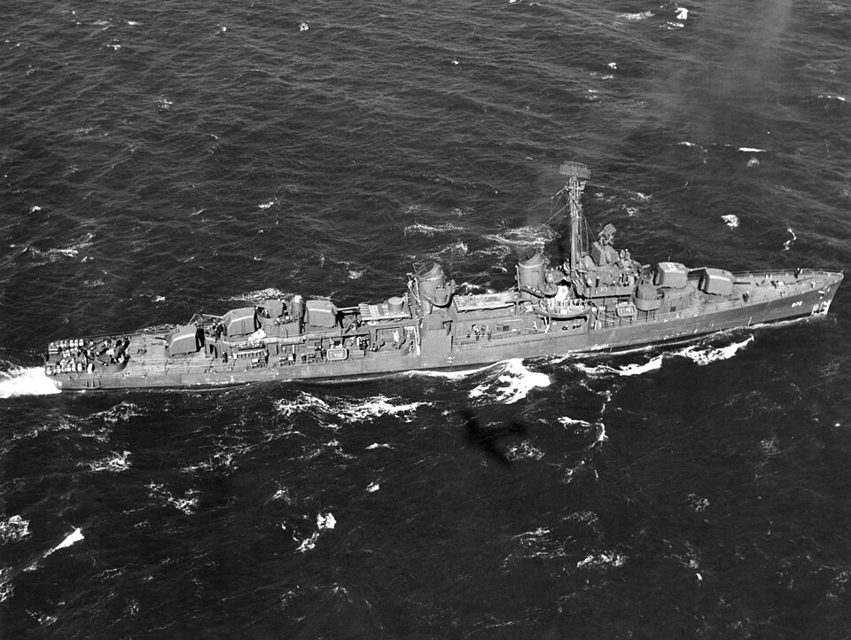
USS Lewis Hancock (DD-675) was a Fletcher-class destroyer of the United States Navy. She was launched on 1 August 1943 and commissioned on 29 September 1943, with Charles Huntington Lyman in command. After shakedown cruising from Bermuda, she left New York on 6 December beside the light carrier Langley and set out for the Pacific. On 25 December she anchored at Pearl Harbor and joined the fast carrier force under Vice Admiral Marc A. Mitscher, known as Task Force 58 while with the Fifth Fleet and later as Task Force 38 with the Third Fleet. That force was organized to break Japanese air strength and forward bases ahead of each American landing.
On 16 January 1944 she put to sea from Pearl Harbor in Task Group 58.2 for the Marshall Islands assault. The carriers with her were ordered to silence Japanese aviation at Kwajalein. On 29 January they wrecked the airfield at Roi and destroyed every Japanese airplane there. A second strike the next day battered defensive positions before the landings on the 31st, and for three days after that the planes stayed over the Marines who took the atoll. Lewis Hancock was back in Majuro Lagoon on 4 February. On 16 and 17 February she went with the force on its opening raid against Truk, Japan’s principal naval base in the central Pacific. In that operation Mitscher’s ships and aircraft destroyed several enemy warships, some 200,000 tons of merchant shipping, and about 275 planes.
William Marvin Searles relieved Lyman on 14 March 1944. The next day the destroyer left the Hawaiian Islands for five months in the forward areas. Rejoining Task Group 58.2, she screened the heavy ships during a late-March strike on the Palaus and during the capture of Hollandia in April. In May the group hit the Marcus-Wake area. On 11 June carrier aircraft began the preparatory pounding of Saipan, Tinian, Guam, and the other Mariana Islands. Her usual duties were antiaircraft and antisubmarine screening, and on 13 June she also bombarded Saipan. Japan answered the advance by sending the fleet. On 19 and 20 June, in the Battle of the Philippine Sea, the carriers she guarded smashed that fleet and covered the forces then taking the Marianas. The carriers kept up the Marianas fighting and in July raided the Bonins and the Palaus.
Two weeks at Pearl Harbor followed, after which she joined Task Force 38. Strikes on airfields in the Philippines, at Okinawa, and on Formosa came in rapid order. On 13 September, in her first raid on the Philippines, she shot down her first enemy plane. Those attacks wore down Japanese airpower and defenses before General Douglas MacArthur’s return and the landings on Leyte. Japan sent her fleet to stop the advance. In the Battle of Leyte Gulf, Lewis Hancock, on picket duty, helped sink an enemy destroyer. In February 1945 she joined the Fifth Fleet for raids on the home islands, striking Tokyo on the 16th and the 25th and the Kobe-Osaka area on 19 March. During the March raid she brought down her fifth and sixth enemy planes, the last credited to her. She supported the struggle for Okinawa from the landings on 1 April until she started home on 10 May. Searles was relieved on 15 May by Richard Edward Babb.
She finished sixteen months in the Pacific undamaged, with four casualties, and entered San Francisco on 6 July 1945. Drydock overhaul ended on 30 August. She was preparing to sail west again when Japan surrendered. San Diego received her on 7 September. Command turned over quickly that autumn: John B. Wilkes held the ship from 25 October to 1 November, Lieutenant Louis L. Lesesne from 1 November to 8 December, and Floyd Charles Lawrence from 8 December. Lewis Hancock decommissioned on 10 January 1946. Hugh Joseph Hannity, father of the author and commentator Sean Patrick Hannity, served aboard from 1943 to 1946 and left with the rate of radarman third class.
The Korean War brought her out of retirement. She recommissioned on Armed Forces Day, 19 May 1951, at the naval station in Long Beach, California. On 11 October she left San Diego for the east coast and reached Newport, Rhode Island, on 27 October for modernization. She sailed from Newport on 6 September 1952, passed through the Panama Canal, and arrived at Yokosuka, Japan, on 20 October. After further training she entered Korean waters early in December. A brief tour off the east coast of Korea ended on 18 December, when she moved to the west coast and operated with the British carrier Glory for the rest of the year. Late in January 1953 she departed Tokyo Bay for Newport by way of Southeast Asia, the Middle East, the Suez Canal, and the Mediterranean. Her arrival completed a voyage around the world.
She then alternated duty along the east coast with deployments to Europe. In October 1953 she sailed for four months in European waters and started home on 24 January 1954. Operations on the Atlantic coast continued until May 1955, when she returned to Europe for four months of joint work with the British Home Fleet and operations with the Spanish Navy, reaching Newport late in August. She stayed in the western Atlantic until rising tension in the Middle East sent her seaward again. Under way on 15 April 1956, she transited the Suez Canal on 9 May and operated in the Red Sea and the Persian Gulf. She came back to the Mediterranean among the last ships to pass the canal before it closed, and she arrived home on 14 August. After refresher training and plane-guard duty, she left Newport on 6 May 1957. Between Sixth Fleet exercises she spent five weeks in the Red Sea, the Gulf of Aden, and the Indian Ocean, and she closed this last overseas cruise at Newport on 31 August. She reached Philadelphia on 24 September, decommissioned there on 18 December 1957, and entered the Atlantic Reserve Fleet.
Taken from reserve and modernized, she was transferred to Brazil on 1 August 1967 and commissioned the same day in the Brazilian Navy as CT Piaui (D-31). Piaui was stricken and scrapped in 1989.