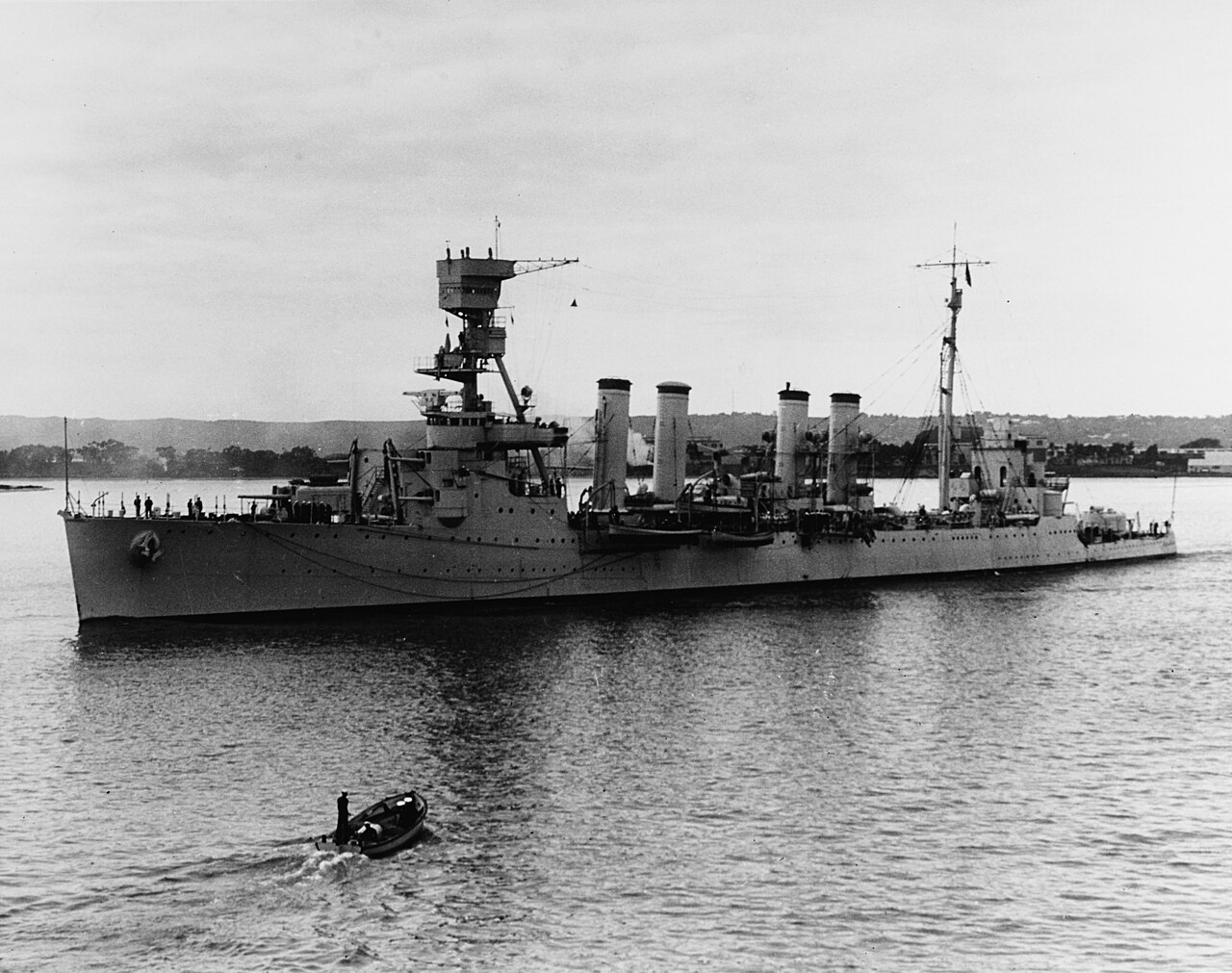
Marblehead, CL-12, was an Omaha-class light cruiser, the third Navy ship named for the Massachusetts port. William Cramp & Son of Philadelphia laid her down on 4 August 1920. She was launched on 9 October 1923, sponsored by Mrs. Joseph Evans, and commissioned on 8 September 1924 with Captain Chauncey Shackford in command. The hull line gives 7,050 tons, 555 feet 6 inches, a beam of 55 feet 4 inches, a draft of 13 feet 6 inches, 34 knots, a complement of 458, twelve 6-inch guns, four 3-inch guns, six 21-inch torpedo tubes, two catapults, and two aircraft.
She left Boston for a shakedown in the English Channel and the Mediterranean. In 1925 she visited Australia, stopping in the Samoan and Society Islands on the way out and in the Galapagos on the way home. Early in 1927 she cruised off Bluefields and Bragman's Bluffs, Nicaragua, while American officials tried to reconcile the factions fighting in that country. On 4 May 1927 the leaders, Sandino excepted, agreed to the Peace of Tipitapa, and the United States was asked to supervise elections in 1928. She sailed for Pearl Harbor, joined Richmond and Trenton, and went on to Shanghai. Through the summer of 1927 she was part of the show of force protecting foreign nationals in the international settlement during the fighting against that city. She spent two months up the Yangtze at Hankow, visited Japanese ports, and left the Far East in March 1928. Homeward bound she stopped at Corinto to help prepare the elections, and she reached Boston in August.
From August 1928 to January 1933 she served with the Atlantic Fleet, and from February 1933 to January 1938 with the Pacific. In January 1938 she was assigned temporarily to the Asiatic Fleet. Seven months later the assignment was permanent. Home ported at Cavite, she cruised the Sea of Japan and the South and East China seas while the crisis in the Far East sharpened.
About 24 November 1941, her war diary reported, the commander in chief of the Asiatic Fleet judged that relations between the United States and Japan had reached a state in which the movement of men-of-war was indicated. The next day Marblehead left Manila Bay with Task Force 5 on what were called routine weekly operations. She anchored at Tarakan, Borneo, on 29 November and waited. On 8 December, which was 7 December in the United States, the message arrived: Japan started hostilities; govern yourselves accordingly. With other American ships she then patrolled the waters around the Netherlands East Indies alongside the Royal Netherlands Navy and the Royal Australian Navy, and screened Allied shipping moving south from the Philippines.
On the night of 24 January 1942 she covered the withdrawal of Dutch and American warships after they had attacked, with devastating effect, an enemy convoy off Balikpapan. Six days later the force left Surabaja to intercept a convoy concentration at Kendari. The Japanese convoy had already sailed. The Allied ships changed course and anchored in Bunda Roads on 2 February.
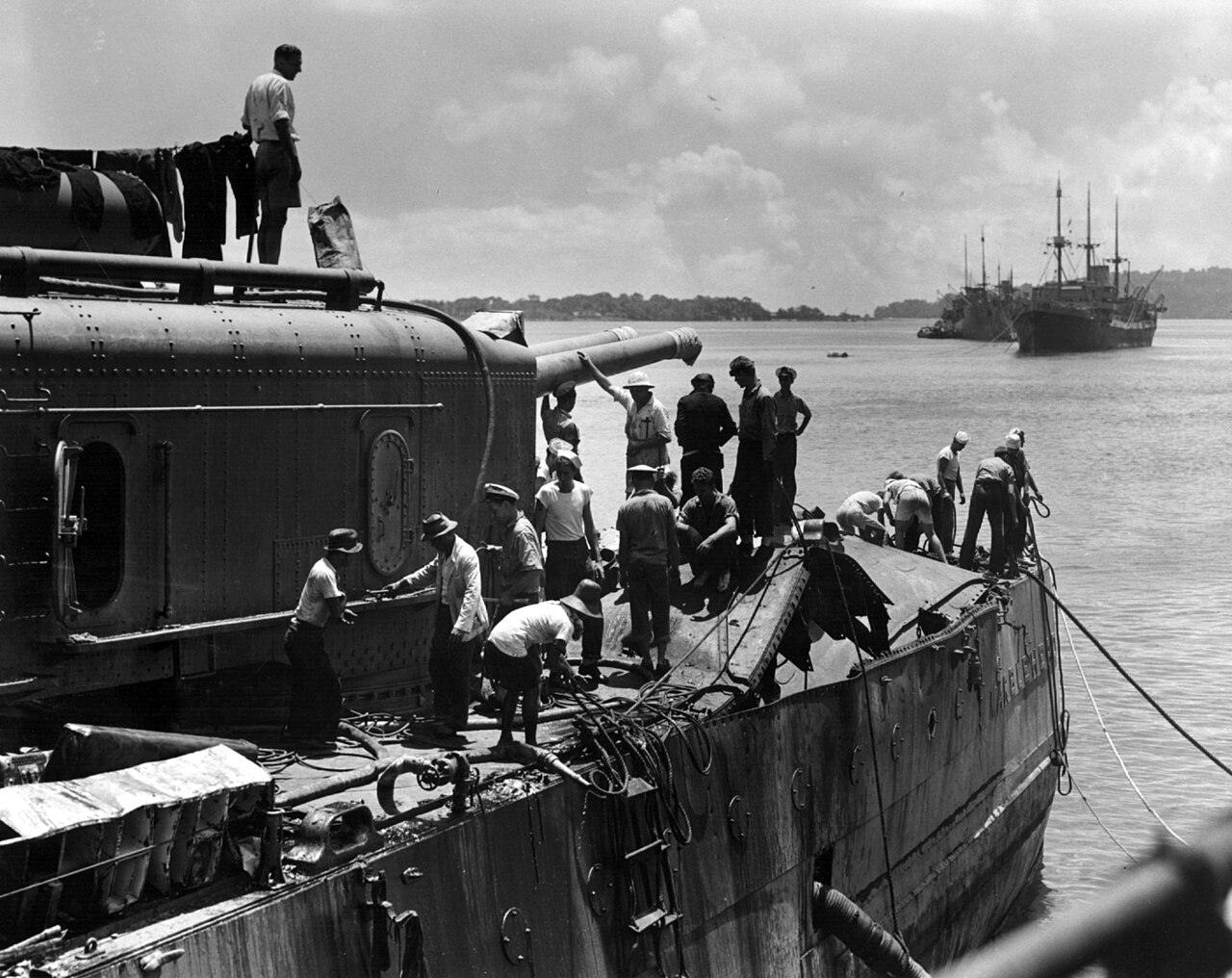
On the 4th they steamed out of Bunda Roads for another Japanese convoy, sighted at the southern entrance of the Makassar Straits. At 0949, thirty-six enemy bombers were closing from the east. She maneuvered through three attacks. After the third a plane spiraled in and her gunners splashed it. The next minute a fourth wave of seven bombers let go. Two bombs were direct hits and a third was a near miss close aboard the port bow, and the underwater damage was severe. Fires swept the ship. She listed to starboard and began to settle by the bow. The rudder jammed. Still steaming at full speed, she circled to port. The gunners kept firing. Damage control fought the fires and helped the wounded. By 1100 the fires were under control. Before noon the planes left. Fifteen men were dead or mortally wounded, and eighty-four were seriously injured. The engineers released the rudder to the angle the account prints as "9- left," and at 1255 she retired to Tjilatjap, steering by working the engines at varying speeds. She made port with a draft of 30 feet forward and 22 feet aft. She could not be docked there. The worst leaks were patched and she sailed on the 13th, the start of a voyage of more than 9,000 miles to find a yard that could finish the repairs. Captain Arthur Granville Robinson had her from about 1941. He was in command that morning. NavSource gives no day on which he was relieved.
She was still steering with her engines when she reached Trincomalee, Ceylon, on 21 February. The damage could not be repaired there, or anywhere in India, for several weeks. She left for South Africa on 2 March, touched at Durban and Port Elizabeth, and arrived at Simonstown on 24 March. After extensive repairs she sailed for New York on 15 April by way of Recife, reached New York on 4 May, and went straight into drydock at the navy yard.
On 15 October 1942 the rebuilt cruiser put to sea. With the South Atlantic Force she operated from Recife and Bahia until February 1944. Earl William Morris, a temporary captain, had her from the middle of 1942 until January 1944. She returned to New York on 20 February and spent the next five months on the North Atlantic convoy lanes, then sailed for the Mediterranean. Captain George Patton Kraker had her from about 1944. She reached Palermo on 29 July and joined the force staging for operation Anvil, the invasion of southern France. On 15, 16, and 17 August she bombarded enemy installations near Saint Raphael, where the assault troops were landing. On the 18th she withdrew to Corsica. Her part in the landing was finished.
She came home, took Naval Academy midshipmen on a summer training cruise, and entered the Philadelphia Naval Shipyard. Temporary captain Paul Rowe Coloney had her from 19 January 1945. The command list gives no day of relief. She was decommissioned there on 1 November 1945. Her name was struck from the Navy Register on 28 November 1945, and the hulk was scrapped on 27 February 1946. She received two battle stars for World War II service. She was not sunk.
A note on sources. The narrative follows the Naval History and Heritage Command Dictionary of American Naval Fighting Ships entry for Marblehead III (CL-12) for dates, places, the 4 February 1942 bombing, the repair voyage, the southern France bombardment, and the disposal of the ship. A digitized copy of an older, shorter DANFS text on the HyperWar site is not followed where the two differ. The NHHC page prints the length as "lengthy 555'6"". HyperWar prints "1. 555'6"", the old DANFS abbreviation for length. The figure used here is 555 feet 6 inches. HyperWar prints "supervise election," "August 19278," "Cornito," ".n March," "and enemy convoy," "Fires swept the ships," a first Tjilatjap and then "Tjilatajap," and "9º left." The NHHC page prints elections, August 1928, Corinto, in March, an enemy convoy, the ship, Tjilatjap both times, and "9- left." HyperWar counts "34 seriously injured." The NHHC page counts 84, and 84 is the figure used. HyperWar prints "the cruiser" for the August 1944 bombardment. The NHHC page prints "the crusier" and "Saint Raphael." The NHHC sentence "On 15 October 1942;" carries a semicolon after the date. NavSource's photograph of the ex-Marblehead in Dry Dock No. 4 at the Philadelphia Navy Yard, with the ex-Cincinnati, ex-Raleigh, and ex-Omaha, is dated 10 January 1946. DANFS dates the scrapping of the hulk to 27 February 1946, and that is the date used. Uboat.net places the 4 February air attack in the Bali Sea at about 07°28' S, 115°37' E, around 0955, and names Houston and the Dutch ships that rendezvoused north of Gili Raja. DANFS places the same bombing at the southern entrance of the Makassar Straits, at 0949, and does not say Bali Sea. Uboat.net's printed spellings include "rendes-vous," "north of of," "Makassar Stait," and "Atlas Stait." Its ship history adds a 9 January 1942 sortie from Darwin with Boise and the transport Bloemfontein, and has Marblehead retire from the Balikpapan approach at 15 knots with engine trouble. DANFS instead has her cover the withdrawal after the night attack of 24 January. Uboat.net also moves her to the Mediterranean in January 1944 and names Arkansas at the southern France landing. DANFS has her in New York on 20 February 1944, on North Atlantic convoy lanes for five months, and at Palermo on 29 July, and does not name Arkansas. Those uboat.net movements are not used. Command dates in the narrative follow NavSource where that list has a line: Robinson from about 1941, Kraker from about 1944, neither with a relief date. Uboat.net dates Robinson from 12 April 1940 to mid-1942 and Kraker, as temporary captain, from January 1944 to 19 January 1945. Morris and Coloney are on the uboat.net table and not on NavSource.