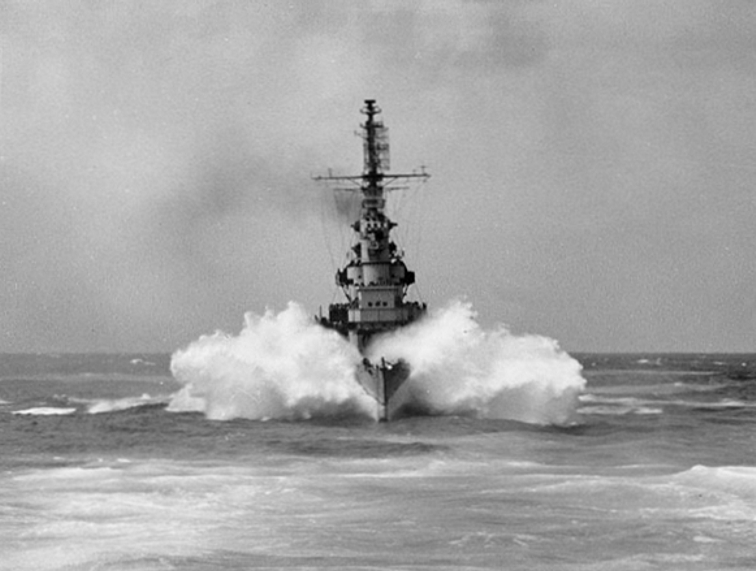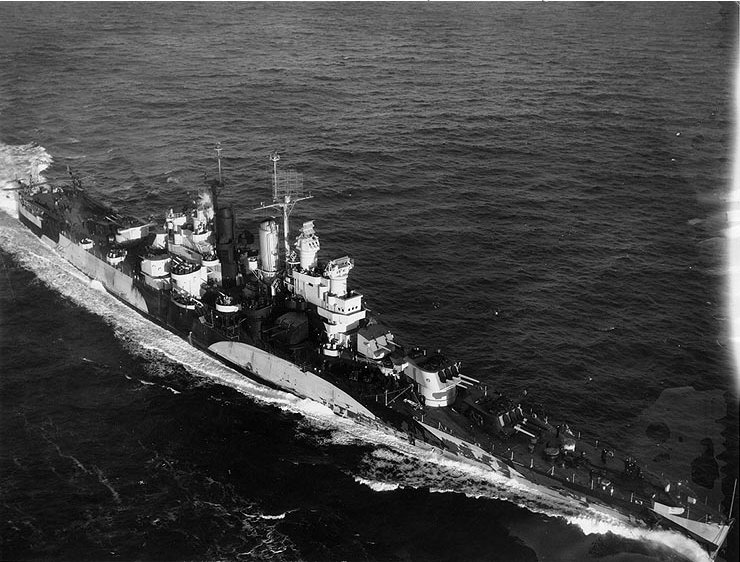
Miami, CL-89, was a Cleveland-class light cruiser, the second Navy ship of the name, for the port city on Biscayne Bay. Cramp Shipbuilding Company of Philadelphia laid her down on 2 August 1941. She went down the ways on 8 December 1942, sponsored by Mrs. Mary J. Reeder, wife of Clifford H. Reeder, the mayor of Miami. The Navy commissioned her at the Philadelphia Navy Yard on 28 December 1943, with Captain John G. Crawford in command. NavSource dates his command from that day. The DANFS line for the hull gives 10,000 tons, a length of 610 feet 1 inch, a beam of 66 feet 4 inches, a draft of 20 feet, 33 knots, a complement of 992, twelve 6-inch guns, twelve 5-inch guns, twenty-eight 40-millimeter guns, ten 20-millimeter guns, and two Vought OS2U-2 Kingfishers.
She fitted out at Philadelphia into the new year, ran a trial on the Delaware on 1 January 1944, and exercised in Delaware Bay and Chesapeake Bay. On 14 February she sailed for Trinidad with the heavy cruiser Quincy and two destroyers. On the second day of that passage, in heavy seas at about 0415, Seaman Second Class Leonard S. Dera of Buffalo, New York, fell overboard. The ships searched for more than an hour. He was not recovered. She drilled between Trinidad and the Gulf of Paria until 1 March, was back at Norfolk on 7 March, and spent the rest of the month in dry dock at Philadelphia for post-shakedown repairs. Early in April she fired with Houston (CL-81) in Casco Bay.
Ordered to the Pacific, she left Boston on 16 April 1944 in a task group with Vincennes (CL-64) and Houston. She transited the Panama Canal on 22 April, reached San Diego on 30 April, and moored at Pearl Harbor on 6 May. On 24 May she sailed for Majuro with the battleships North Carolina and Washington. In June she joined the Fast Carrier Task Force for strikes on the Marianas. On 11 June Essex, Langley, and Cowpens launched a fighter sweep against Saipan, and the carriers struck again on the 13th. From the 15th to the 17th the attacks shifted to Iwo Jima. On 19 June the Japanese struck back. Miami was not heavily engaged. She fired on at least one enemy plane, with unknown results, and she fired 5-inch guns at a reported submarine that turned out to be a derelict sampan. She screened Essex for strikes on Guam and Rota, and on 27 June, with Houston and five destroyers, she bombarded Rota, shelled buildings and a cargo ship moored at Apra harbor, and silenced a shore battery at Orote Point.
She replenished at Eniwetok early in July and was back with the carriers for strikes on Guam, Tinian, and Rota through the 30th. On 4 August the group struck Iwo Jima again. On 26 August she was sent to pick up a disabled Kingfisher from the battleship Indiana and was called off before she did it. On 7 September she was with the carriers off Peleliu and Angaur. From the 12th to the 15th the strikes shifted to the central Philippines. On 14 September she rescued Lieutenant (junior grade) Dan B. Driscoll, a Fighting Squadron 31 Hellcat pilot from Cabot, bureau number 58921. She replenished at Saipan on the 28th, exercised with Task Force 34, and anchored at Ulithi.
She left Ulithi on 6 October 1944 with Task Group 38.2. The carriers struck Okinawa on the 10th and Formosa on the 12th. That evening Japanese aircraft came back at the group. Miami went to general quarters at the warning, opened fire at 1902, brought down her first enemy plane, and helped splash at least one more. At 0140 on 13 October another raid came in, and she splashed a plane just off her port beam. On the 20th the Seventh Fleet landed General Douglas A. MacArthur and his troops at Leyte. From the 21st to the 24th the carriers in her task force struck the central Philippines. The Imperial Navy came down on Leyte Gulf from three directions. Miami operated with Rear Admiral Gerald F. Bogan's carrier task group and screened Intrepid, Hancock, and Bunker Hill. Planes from those carriers attacked the Japanese center force in the Sibuyan Sea on 24 October and sank the battleship Musashi.
Admiral William F. Halsey, Jr., then learned that the center force, thought to be withdrawing, had turned back toward the beachhead. Miami was sent with Bogan's group to intercept it. The Japanese force was turned by the destroyers, destroyer escorts, and escort-carrier planes already there. On 26 October, near the entrance of San Bernardino Strait, Miami and the cruisers and destroyers with her caught the Japanese destroyer Nowaki. Salvos from her 6-inch battery, with the other ships' fire, sent Nowaki to the bottom. She was back off Luzon for carrier strikes from 5 to 6 November and again from 18 to 25 November. On the 25th, while the carriers' planes were still away, she splashed a Japanese dive bomber that passed over her.
She supported further strikes on Luzon from 14 to 16 December 1944. A typhoon hit the force on the 18th. Heavy waves damaged one of her OS2U-3 Kingfishers of Cruiser Scouting Squadron 14 and threw the other, bureau number 01278, into the sea. The ship buckled at frames 21 to 33. On the 20th, as the storm eased, she helped Task Force 38 search for survivors and jettisoned the remaining Kingfisher, bureau number 09441. She anchored at Ulithi on the 24th. NavSource relieves Crawford on 28 January 1945 and gives the ship to Captain Thomas Howell Binford. DANFS's own table ends Crawford on 31 January and starts Binford on 1 February. The command used here is NavSource's.
Back at sea on 1 January 1945, she screened carrier attacks off Formosa and, from the 6th to the 8th, off Luzon. On 10 January Task Force 38 entered the South China Sea. The carriers struck French Indochina on the 12th and Formosa and the China coast on the 15th. On the 16th, during a strike on Formosa, she shot down a Mitsubishi A6M5 fighter, a Zeke. She came back through Balintang Channel on the 20th. The carriers attacked Okinawa on the 21st. After a stop at Ulithi she sailed on 10 February with Task Group 58.1. From the 15th to the 17th the group made night strikes on the Tokyo area, attacked Chichi Jima on the 18th, and from 20 to 22 February made further runs on Okinawa, which the same entry describes as support for troop landings then taking place on the island. On 2 March she bombarded Oki Daito Jima with main and secondary batteries and was back at Ulithi on the 5th.
From 18 to 31 March 1945 the carriers struck southern Kyushu and the Okinawa group, and Miami was under repeated air attack. On 1 April, with Task Group 58.1 — Hornet, Bennington, and Belleau Wood — she moved east of Okinawa and the group supported the troops ashore through the 11th. On 12 April her Kingfishers, flown by Lieutenant (junior grade) Henry C. Hyde and Lieutenant Denman W. Knight, searched for downed aviators. They brought in Ensign Terry Mills, a Bennington Hellcat pilot with slight burns on his hands; Ensign John A. Halle, a Corsair pilot from Intrepid, on the east side of Amami Oshima; and Lieutenant James E. Kussman, a Yorktown Hellcat pilot, on the west side. Hyde and Knight each received the Distinguished Flying Cross. On 14 April she half-masted her colors for President Franklin D. Roosevelt, who had died on the 12th. That day a large Japanese raid hit the group and her gunners claimed several planes. The Navy Department Library biography of Binford, which the ship's DANFS entry does not repeat, says that on the same day she was sent to the destroyer Sigsbee, stopped dead by a suicide plane, put medical aid aboard, and towed her clear while still under air attack. A further heavy raid on the 16th brought no particular action with Miami. Strikes then shifted to Amami Oshima, Tokuno Shima, and Kikai. She left Ulithi for Pearl Harbor on 10 May, embarked passengers, and reached San Pedro on 24 May for overhaul. She was still on the west coast when the war ended.
She sailed for Pearl Harbor on 20 August 1945 and reached it on the 24th. On 2 September, still at sea on the way to Guam, the crew heard the broadcast of Japan's surrender. She moored in Apra Harbor on 6 September, went on to Okinawa, and from 22 September supported the Tenth Army in the occupation of the Ryukyus. Typhoons pushed her off Kikaijima and later back to Buckner Bay. She left for Yokosuka on 29 October, stopped only briefly, and reached Truk on 11 November, where she surveyed bomb damage to the base. Ordered home on 25 November, she arrived at Long Beach on 10 December. NavSource has Binford relieved on 9 December 1945 by Captain Robert Bolton Jr., and Bolton relieved on 15 November 1946 by Commander William Baumert Braun. Commander Algernon Sidney Joyner Jr. had her from 27 February 1947. She trained naval reservists on the California coast until she was decommissioned on 30 June 1947 and entered the Pacific Reserve Fleet. Her name was struck on 1 September 1961. The hulk was sold for scrapping to Nicholai Joffe Corporation of Beverly Hills on 26 July 1962. She received six battle stars for World War II service. She was not sunk.
A note on sources. The narrative follows the Naval History and Heritage Command's Dictionary of American Naval Fighting Ships entry for Miami II (CL-89) for dates, places, the loss of Dera, the bombardments, the planes shot down, the Nowaki action, the typhoon damage, the April 1945 rescues, the decommissioning, the striking, the sale, and the six battle stars. The same page's hull line lists two OS2U-2 Kingfishers; later sentences and the Trinidad caption describe OS2U-3s, of Cruiser Scouting Squadron 8 at Trinidad and of Cruiser Scouting Squadron 14 in the December 1944 typhoon. Both are given as the page prints them. Two captions on that page use the same photograph number, 80-G-229733, once for her underway on 16 April 1944 and once for her at anchor off San Pedro on 18 July 1945. The 20 to 22 February 1945 runs are narrated as DANFS describes them, support of troop landings on Okinawa. The April landings, which the same entry dates from 1 April, are the Okinawa row. Hall of Valor's synopsis of Binford's second Legion of Merit, for 1 February to 5 May 1945, lists air strikes against Iwo Jima in that period and does not repeat the February landings sentence. She is not given an Iwo Jima row: DANFS does not put her on an Iwo Jima shore bombardment. The Sigsbee tow on 14 April 1945 is not in the ship's DANFS entry. It is in the Navy Department Library biography of Binford and in the Bronze Star citation quoted there, and Hall of Valor's Legion of Merit synopsis says that on that day, under air attack, the ship towed a crippled destroyer. The commanding officers and the dates in the story are NavSource's list for CL-89. DANFS's table differs by a day or two: Crawford through 31 January 1945 rather than 28 January, Binford from 1 February to 8 December rather than 28 January to 9 December, Bolton from 9 December 1945 to 14 November 1946 rather than 9 December to 15 November, and Braun through 26 February 1947 rather than 27 February. Joyner's dates, 27 February to 30 June 1947, agree. Uboat.net ends Crawford on 1 February 1945 and starts Binford that day, and it lists Bolton in Pittsburgh (CA-72) through 16 December 1945, which overlaps the Miami command NavSource starts on 9 December. A digitized copy of an older DANFS text on the HyperWar site disagrees with the NHHC page, and the NHHC page is followed. HyperWar has her arrive at San Francisco, not San Pedro, on 24 May 1945; has her ordered home on 23 November rather than 25 November; has the sale on 20 July 1962 to Nicholia Joffe rather than 26 July to Nicholai Joffe; and says her scout planes rescued pilots on four occasions during the September 1944 strikes, where the NHHC entry names Driscoll on 14 September. HyperWar also sends her north with the carriers to the force off Luzon, the action in which four Japanese carriers were sunk, before Bogan's group turned south. The NHHC entry does not describe that northern run. She is not given a Cape Engaño row. NavSource's building block adds an order date of 29 October 1940, which is not in DANFS and is not used above. NavSource dates the sale 20 July 1962 and spells the buyer Nicolai Joffe. Its launch caption names the sponsor Mrs. Nellie S. Reeder, wife of Charles H. Reeder. DANFS names Mrs. Mary J. Reeder, wife of Clifford H. Reeder. HyperWar says Mrs. C. H. Reeder. DANFS is followed. NavSource's armament line gives four aircraft, a draft of 25 feet, 32.5 knots, and a crew of 1,255. The DANFS hull line is the one used here.