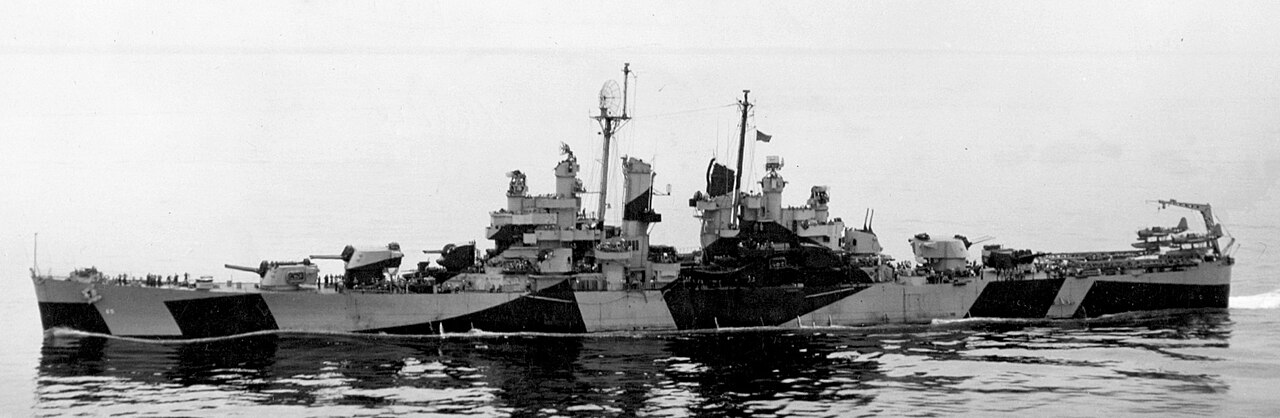
Pasadena (CL-65) was a Cleveland-class light cruiser, the second Navy ship of the name, for the city in California. The first Pasadena had kept a name she already carried. Bethlehem Steel Company laid CL-65 down at Quincy, Massachusetts, on 6 February 1943. She was launched on 28 December 1943 at the company's Fore River shipyard, sponsored by Mrs. C. G. Wopschall, and commissioned on 8 June 1944. NavSource lists Captain Richard Brittain Tuggle from that day until 2 June 1945. DANFS names him at commissioning as Capt. Richard B. Tuggle. The hull line gives 14,400 tons full load, a length of 610 feet 1 inch, a beam of 66 feet 3 inches, a draft of 24 feet 10 inches, 31.6 knots, a complement of 1,319, twelve 6-inch guns, twelve 5-inch guns, twenty-eight 40-millimeter guns, and ten 20-millimeter guns.
She was commissioned just before the thrust into the Marianas. Shakedown and training took the summer of 1944. On 25 September she got underway for the Pacific. She crossed the International Date Line on 3 November and at mid-month joined Task Force 38, the fast carrier force, at Ulithi. Through the rest of 1944 she took part in that force's operations against Luzon and Formosa in support of the Philippine campaign. In mid-January 1945, as the assault on Luzon went forward, the force entered the South China Sea and hit Japanese installations and shipping along the Indochina coast and on Formosa.
In February the ships, now Task Force 58, moved against the Japanese home islands and then swung southeast to cover the landings on Iwo Jima. Pasadena added her guns to the bombardment group and performed patrol duties. Replenished at Ulithi, the force sortied again in mid-March, with her in the inner screen, to soften the way for Operation Iceberg. The carriers struck the southern Japanese home islands and the northern Ryukyus as well as Okinawa. She was at sea for 80 days. As flagship of Cruiser Division 17 she took part in night bombardments of Minami Daito on 28 March and 10 May and in continuous strikes on Okinawa and Kyushu from 1 April to 30 May.
NavSource relieves Tuggle on 2 June 1945 and lists Captain James Henry Doyle from that day until 27 May 1946. After a brief respite at Ulithi and Leyte in June, the force left Leyte Gulf early in July for the last strikes on the home islands. From mid-July to mid-August it pounded the Tokyo plain, northern Honshu, and Hokkaido. On 15 August Japan accepted surrender terms. On 23 August Pasadena became flagship of Task Group 35.1. She anchored in Sagami Wan on the 27th and shifted to Tokyo Bay on 1 September. The next day she witnessed the official surrender. She stayed in the Tokyo Bay area, supporting the occupation, until mid-January 1946, and on 19 January got underway for San Pedro and an overdue overhaul.
Training and local operations followed. In September 1946 she headed west again. From November 1946 to February 1947 she took part in division exercises in Micronesia, then, after fleet maneuvers in Hawaiian waters, returned to California. NavSource lists Captain Marion Emerson Murphy from 27 May 1946 to 13 January 1947, and Commander Julius Max Berrey, USNR, from 13 January 1947 to 26 March 1948. For the next year after the Hawaiian maneuvers she conducted local operations. In the summer of 1948 she made an NROTC training cruise. A photograph released on 9 August 1948 shows her entering Pearl Harbor on that cruise. On 1 October she got underway for the Far East, arrived at Tsingtao at the end of the month, and operated off the China coast until May 1949. On 1 June she returned to California. Local exercises filled the summer. On 12 September she left Long Beach for Bremerton and inactivation.
She was decommissioned on 12 January 1950. DANFS, writing from the reserve fleet, says she remains at Bremerton as a unit of the Pacific Reserve Fleet into 1970. She earned five battle stars during World War II. She was not sunk.
A note on sources. The narrative follows the Naval History and Heritage Command Dictionary of American Naval Fighting Ships entry for Pasadena II (CL-65). Commanding officers and their dates are the NavSource list for CL-65. That list ends with Julius Max Berrey on 26 March 1948. DANFS keeps the ship in commission, on the 1948 NROTC cruise, off China into May 1949, and through decommissioning on 12 January 1950, and names no captain for that span. Uboat.net dates Tuggle's temporary captaincy of Pasadena from 6 August 1944 to 6 February 1945. DANFS commissions her under him on 8 June 1944, and NavSource runs him from that day to 2 June 1945. The command line keeps NavSource. A Wikipedia biography of James Henry Doyle says he assumed command in May 1945 and was detached in May 1946. His Bronze Star citation, quoted on that page, covers command from 2 June to 1 September 1945, which is the citation period, not the relief. NavSource dates are 2 June 1945 to 27 May 1946. The same page's opening dates are 22 August 1897 and 1 February 1981. A later sentence says he was born on 29 August 1897, and a category and a short description use 1982 for the death. The Hall of Valor Legion of Merit for a Rear Admiral Marion E. Murphy, as commander of Task Force 92 in 1953, does not give the name Emerson and is not treated as this officer. HyperWar prints the length as 610 feet 11 inches. The current entry prints 610 feet 1 inch. HyperWar adds a bracketed sentence that she was stricken on 1 December 1970 and sold on 5 July 1972. That sentence is not in the current entry, and the strike and sale are not stated here as DANFS fact. The current text's horizon is the Pacific Reserve Fleet into 1970.