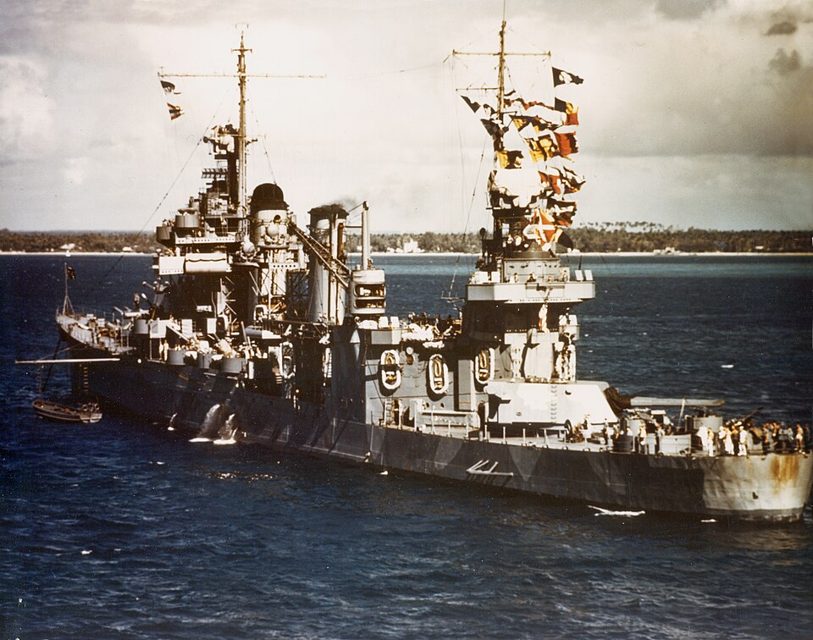
Building
Quincy was the second ship of the name and honored the Massachusetts city where she was built. Bethlehem's Fore River Shipyard laid her down on 15 November 1933. She was launched on 19 June 1935, sponsored by Mrs. Catherine Adams Morgan, wife of Henry S. Morgan, and commissioned at Boston on 9 June 1936, Captain William Faulkner Amsden in command. With Vincennes, she was a slightly improved version of the New Orleans class, the last American cruisers built to the limits of the 1922 Washington Treaty: 10,000 tons and 8-inch guns. She was authorized as a light cruiser because of her thin armor and reclassified as a heavy cruiser because of her guns.
Spain and the interwar years
Six weeks after commissioning, on 20 July 1936, she was ordered to Spain to protect Americans at the start of the Spanish Civil War. She passed Gibraltar on 26 July and reached Málaga the next day. Working alongside an international rescue fleet that included the German Deutschland, Admiral Graf Spee and Admiral Scheer, she carried 490 refugees to Marseille and Villefranche before Raleigh relieved her on 27 September. After acceptance trials in March 1937 she joined Cruiser Division 7 in the Pacific, reaching Pearl Harbor on 10 May 1937, and took part in Fleet Problem XIX in 1938. She returned to the Atlantic in January 1939 for Fleet Problem XX, then made goodwill cruises to South America from April to June 1939 and again in 1940, carried naval reservists on training cruises, and went on Neutrality Patrol when war broke out in Europe.
The Atlantic
In 1941 she operated with Wasp in Task Force 2 and later with Yorktown, enforcing American neutrality in the mid-Atlantic. On 28 July 1941 she sailed for Iceland with Task Force 16 and patrolled the Denmark Strait from 21 to 24 September. She escorted a convoy back to Newfoundland, then went by way of Trinidad to Cape Town to meet a convoy and bring it back, reaching Trinidad on 29 December. In 1942 she returned to Iceland on convoy duty and patrolled the Denmark Strait again from 8 to 11 March. After an overhaul at New York she went through the Panama Canal to San Diego on 19 June 1942 as flagship of Rear Admiral Norman Scott.
Guadalcanal and Savo Island
Before the Marines landed on Guadalcanal on 7 August 1942, Quincy shelled Lunga Point, destroying installations and an oil depot, and then gave close fire support to the landing. In the early hours of 9 August she was patrolling with Vincennes and Astoria between Florida and Savo Islands. They saw flares dropped over the southern group and had only just sounded general quarters when Admiral Gunichi Mikawa's cruisers switched on their searchlights. Captain Samuel N. Moore ordered her to open fire, but the guns were not ready. Within minutes Aoba, Furutaka and Tenryū had her in a crossfire and she was burning. Moore turned to charge the eastern Japanese column, and two torpedoes from Tenryū hit her. She still got off a few salvos, and one struck Chōkai's chart room 20 feet from Mikawa, killing or wounding 36 men.
At 02:10 shells swept her bridge, killing or wounding almost everyone there, including Moore. At 02:16 a torpedo from Aoba silenced her last guns. Her assistant gunnery officer reached the bridge and found it "a shambles of dead bodies with only three or four people still standing." The signalman at the wheel told him the dying captain had ordered him to beach the ship on Savo, four miles away. Then, he wrote, "the Captain straightened up and fell back, apparently dead, without having uttered any sound other than a moan." Quincy sank bow first at 02:38. She was the first ship to go down in the waters later called Ironbottom Sound. Three hundred seventy of her men were killed and 167 wounded.
The wreck
Robert Ballard's expedition found and explored her in July and August 1992. She sits upright about 2,000 feet down. Her bow is gone forward of No. 1 turret, both forward turrets are trained to starboard, and one gun of No. 2 turret has burst. Her bridge is battered but intact and both funnels are missing.
Sources
Wikipedia, "USS Quincy (CA-39)" (citing DANFS; the assistant gunnery officer's report; Ballard, Lost Ships of Guadalcanal).
NHHC/DANFS, "Quincy II."