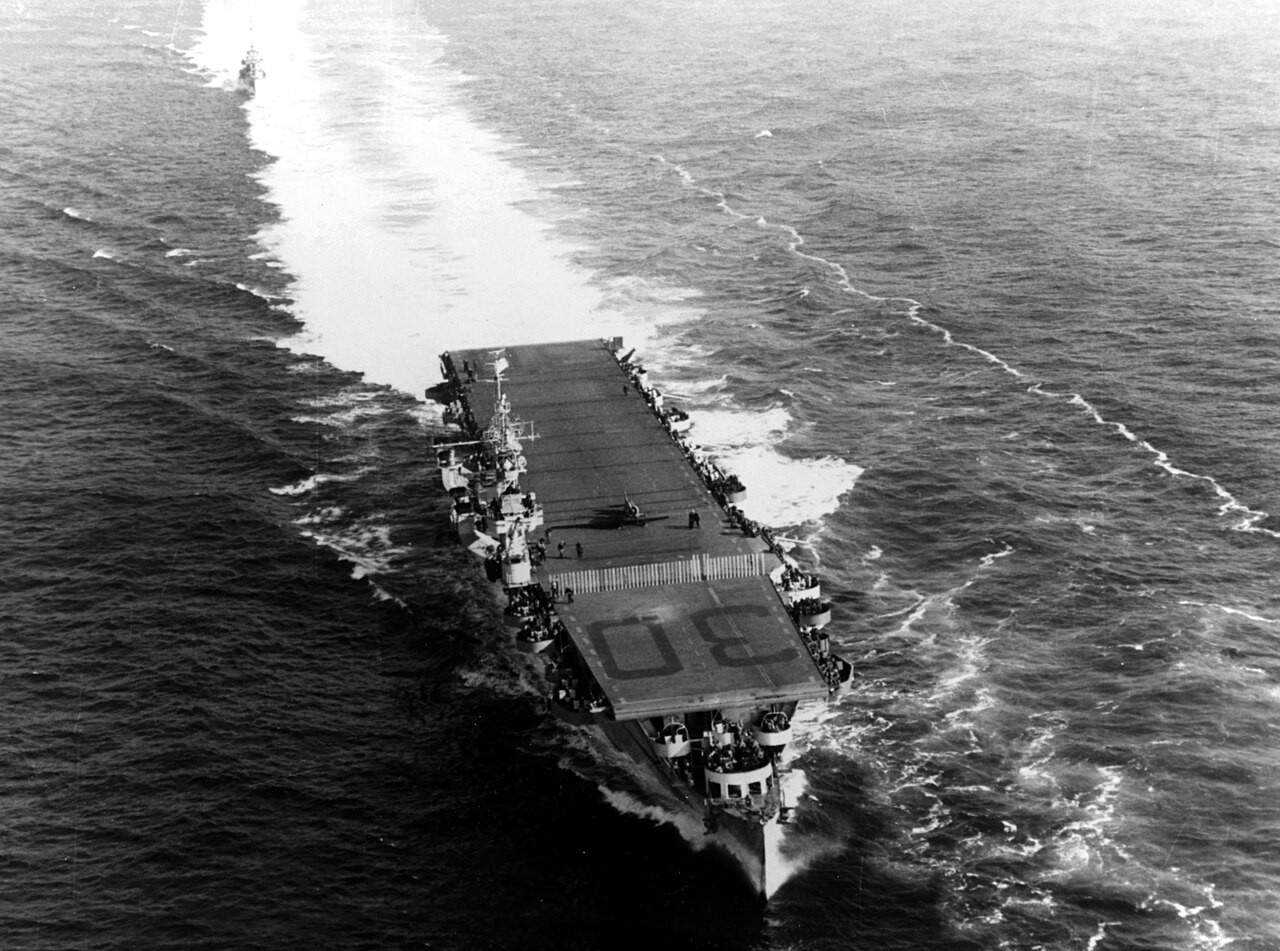
A cruiser hull becomes a carrier
San Jacinto began as the Cleveland-class light cruiser Newark (CL-100) at the New York Shipbuilding Corporation in Camden, New Jersey. She was renamed Reprisal (CV-30) and then, on 30 January 1943, San Jacinto, after the 1836 battle that won Texas its independence. She was converted on the ways into an Independence-class light carrier (CVL-30), one of nine fast cruiser hulls rushed into carrier service in 1943. She was launched on 26 September 1943, sponsored by Mary Gibbs Jones, wife of Commerce Secretary Jesse H. Jones of Texas, and commissioned on 15 November 1943, Captain Harold M. Martin in command.
Joining the fast carriers
After shakedown in the Caribbean she sailed by the Panama Canal, San Diego and Pearl Harbor to Majuro. There she joined Marc Mitscher's fast carrier force and took aboard Air Group 51. Her first offensive missions were the strikes on Wake Island on 23 May 1944.
The Marianas
On 5 June 1944 Task Force 58 sortied for the Marianas. On 19 June the Japanese launched more than 400 planes against the fleet, and more than 300 were shot down in the "Marianas Turkey Shoot," while San Jacinto's gunners helped bring down the few that got close. That evening Mitscher sent his planes after the retreating Japanese fleet. In the confused night recovery that followed, a Japanese carrier plane is said to have tried to land on San Jacinto and been waved off because its hook was not down. One of her fighter pilots was shot down over Guam and survived 17 days in a raft and 16 nights hiding ashore. She struck the Palaus on 15 July and Chichi Jima, Haha Jima and Iwo Jima on 5 August.
Her most famous crewman was a young torpedo-bomber pilot of VT-51, Lieutenant (junior grade) George H. W. Bush. On 2 September 1944 he was shot down attacking Chichi Jima and was rescued at sea by the submarine Finback. Forty-four years later he was elected President of the United States.
Leyte Gulf and the Philippines
She gave close air support for the Leyte landings on 20 October 1944. On 24 October, in the Battle of Leyte Gulf, she sent planes against the Japanese Center Force in the Sibuyan Sea, then raced north with Halsey to strike the Northern Force off Cape Engaño, where the Japanese carriers were destroyed. On 30 October her guns shot down two suicide planes. She struck Manila Bay, exchanged Air Group 51 for Air Group 45 at Guam, and was slightly damaged by the December 1944 typhoon. In January 1945 she joined the fast carriers' sweep into the South China Sea against Formosa and the China coast.
Japan and Okinawa
On 16–17 February 1945 she took part in the first carrier strikes on Tokyo, then supported the Iwo Jima landings. Off Kyushu she saw Franklin burn, and on 19 March a kamikaze narrowly missed her. During Okinawa she was almost constantly at general quarters. On 5 April her gunners shot the wing off a diving suicide plane, which splashed only 50 feet off her port bow. On 7 April her bombers torpedoed the destroyers Hamakaze and Asashimo in the action that sank the battleship Yamato. She rode out the typhoon of 5 June and from 9 July struck Hokkaido and Honshu until the cease-fire. Her last missions were mercy flights dropping food and medicine to Allied prisoners. She was in Tokyo Bay for the surrender on 2 September 1945 and tied up at Alameda on 14 September.
Fate
She was decommissioned on 1 March 1947 and laid up at San Diego. The Spanish Navy considered taking her but chose her sister Cabot instead. She was reclassified as an aircraft transport (AVT-5) on 15 May 1959, struck on 1 June 1970 and sold for scrap in December 1971. She earned the Presidential Unit Citation and five battle stars.
Date flag: Wikipedia's DANFS-derived text gives her keel laying as Newark on 26 October 1942 but her renaming to Reprisal on 2 June 1942, which is impossible in that order. Check NavSource or DANFS.
Sources
Wikipedia, "USS San Jacinto (CVL-30)" (based on DANFS).
Wikipedia, "George H. W. Bush" (shootdown at Chichi Jima, 2 Sept 1944; rescue by Finback).
NHHC/DANFS, "San Jacinto II."