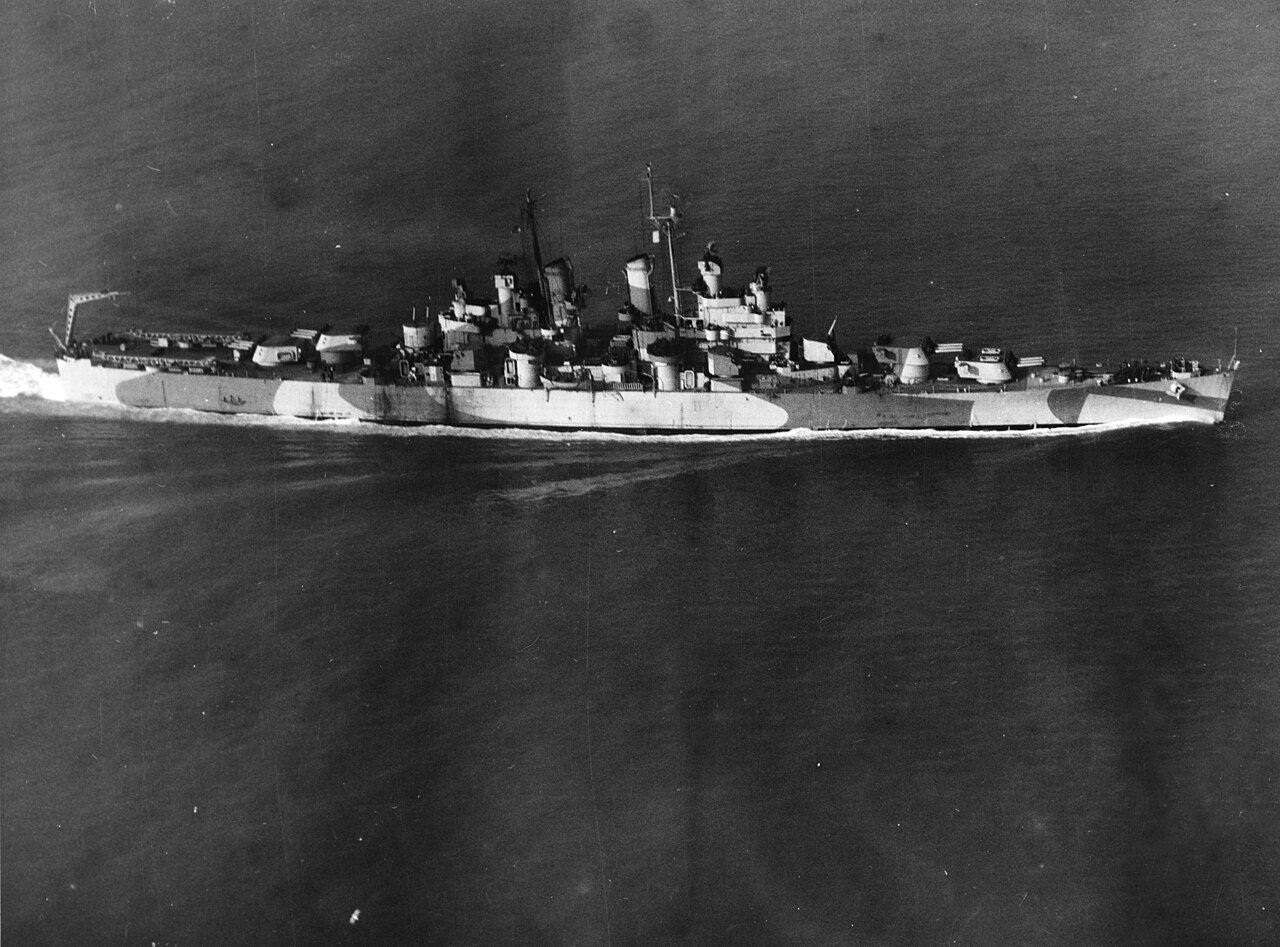
Topeka (CL-67) was a Cleveland-class light cruiser, the second Navy ship named for the capital of Kansas and the seat of Shawnee County. Bethlehem Steel Company laid her down at Quincy, Massachusetts, on 21 April 1943. She was launched on 19 August 1944, sponsored by Mrs. Frank J. Warren, and commissioned at the Boston Navy Yard on 23 December 1944. NavSource lists Captain Thomas Lippitt Wattles from that day until 7 November 1945. DANFS names Capt. Thomas L. Wattles at commissioning. The hull line gives 10,000 tons, a length of 608 feet 4 inches, a beam of 66 feet 3 inches, a draft of 25 feet, 31.6 knots on trial, a complement of 1,410, twelve 6-inch guns, twelve 5-inch guns, twenty-eight 40-millimeter guns, and ten 20-millimeter guns.
After a West Indies shakedown and repairs she left Boston on 10 April 1945. The next day she joined Oklahoma City (CL-91). They went by Culebra and Guantanamo, transited the Panama Canal on 19 April, and reported to the Pacific Fleet on the 20th. Topeka reached Pearl Harbor on 2 May. After almost three weeks of gunnery in Hawaii she sailed west as flagship of Cruiser Division 18, entered Ulithi on 1 June, and three days later put to sea with Bon Homme Richard (CV-31), Oklahoma City, Moale (DD-693), and Ringgold (DD-500) to meet Task Force 38.
On that first cruise she screened the fast carriers. On 8 June 1945 their planes hit Kanoya on Kyushu. On the 9th they struck Okino Daito, a little over 200 miles west of Okinawa. On the 10th, while Task Group 38.1 aircraft bombed the airfield on Minami Daito, the screen, Topeka among them, took the other installations under fire. She then went to San Pedro Bay, Leyte, and spent the latter half of June there. On 1 July she returned to sea with Task Force 38 for the last six-week sweep of the home islands. After fueling on the 8th, the carriers bombed Tokyo on the 10th, then ran a two-day anti-shipping sweep around Hakodate and Muroran. They fueled on the 16th and bombed Tokyo again on the 17th and 18th. On the night of the 18th she joined Atlanta (CL-104), Duluth (CL-87), Oklahoma City, and Destroyer Squadron 62 in an anti-shipping sweep of the entrance to Sagami Nada and fired at installations on Nojima Zaki. After replenishment from 19 to 23 July the carriers struck Inland Sea shipping on the 24th and the 28th. A typhoon at the end of July postponed air operations until the second week of August. Raids on northern Honshu on 9 and 10 August wiped out the transportation for 2,000 shock troops assembled for a one-way mission against the B-29 bases on Tinian. Tokyo was hit on the 12th and 13th. Planes were taking off to repeat the attacks when the capitulation message arrived on 15 August.
She patrolled Japanese waters until mid-September, then lay in Tokyo Bay until 1 October, when she started home. She stopped at Okinawa on 4 October to embark 529 veterans, went on the next day, and reached Portland, Oregon, on 19 October. Ten days later she went to San Pedro for overhaul. NavSource relieves Wattles on 7 November 1945 and lists Captain Walter Gabriel Schindler from that day until 24 July 1946. The ship sailed for the Far East on 3 January 1946, reached Yokosuka on the 24th, and supported the occupation in Japan, China, and the Central Pacific until the following fall, calling at Sasebo, Tsingtao, Shanghai, Manila, and Guam. She returned to San Pedro on 20 November. NavSource lists Captain Donald Hendrie Johnson from 24 July 1946 to 1 August 1947.
After overhaul and west-coast operations she headed for the Orient on 22 September 1947, reached Yokosuka on 10 October, and became a unit of Task Force 71. From Shanghai and Tsingtao she patrolled the north China coast during the Nationalist-communist civil war. NavSource lists Captain Ralph Earle Jr. from 1 August 1947 to 1 June 1948. She ended the China duty early in March 1948, entered Nagasaki on the 8th, visited Sasebo and Kure, sailed for the United States on 25 April, and reached Long Beach on 7 May. Later that month she went to Pearl Harbor for a four-month overhaul, then back to the west coast. Late in October she resumed local operations out of Long Beach and San Diego until February 1949. On 25 February she arrived at San Francisco to prepare for inactivation. NavSource lists Captain Paul Brogden Koonce from 1 June 1948 to 19 June 1949. DANFS decommissions her at San Francisco on 18 June 1949 and berths her with the local group of the Pacific Reserve Fleet. She earned two battle stars for World War II service.
Early in 1957 she was towed from San Francisco to the New York Naval Shipyard at Brooklyn, which she entered on 15 April for conversion to a guided-missile cruiser. On 23 May she was redesignated CLG-8. The work took almost three years. She kept half her gun battery, losing the two after 6-inch triple turrets and the three after 5-inch twin mounts, and received a twin Terrier launcher. She was recommissioned on 26 March 1960, with Long Beach as her west-coast home port, and made western Pacific deployments. After the 2 August 1964 attacks on Maddox (DD-731) and then on Maddox and Turner Joy (DD-951), she cruised the Gulf of Tonkin. From 29 November 1965 she deployed as flagship of the Commander, Cruiser-Destroyer Group, Seventh Fleet, for gunfire support and search and rescue in the South China Sea and the Gulf of Tonkin, and returned to Long Beach on 28 May 1966. A Mediterranean cruise began on 1 August 1967. On 22 August she relieved Galveston (CLG-3) as flagship of Task Group 60.2 and took part in the NATO exercise Eager Beaver. Her home port changed to Mayport. A second Mediterranean cruise ran from 29 June to 19 December 1968. She left Mayport on 30 January 1969, off-loaded ordnance at Yorktown, reached Boston on 5 February, and went out of commission on 5 June 1969. Towed to Philadelphia, she was stricken on 1 December 1973 and sold on 20 March 1975 to Southern Scrap Material Co., Ltd. She received three battle stars for Vietnam service. She was not sunk.
A note on sources. The narrative follows the Naval History and Heritage Command Dictionary of American Naval Fighting Ships entry for Topeka II (CL-67), updated by Robert J. Cressman on 6 July 2022. Commanding officers through the first decommissioning are the NavSource list for CL-67. Captains of the guided-missile recommissioning are not carried. DANFS names Capt. Frank L. Pinney, Jr., at the 26 March 1960 recommissioning. HyperWar prints that name as Capt. Frank L. Pinny, Jr. Neither name is used above. HyperWar says the conversion removed three after 6-inch double mounts. The current entry says three after 5-inch twin mounts. The current wording is used. HyperWar says her name was struck from the Navy list on 1 December 1973. The current entry says stricken from the Naval Vessel Register on that day. Both give the sale to Southern Scrap Material Co., Ltd., on 20 March 1975. NavSource prints the third wartime and occupation captain as Walter Gabriel J. Schindler. The name used here is Walter Gabriel Schindler, from his Wikipedia biography. That page says he assumed command in early November 1945 and returned to the United States in July. NavSource dates are 7 November 1945 to 24 July 1946. Koonce's list runs to 19 June 1949. DANFS decommissions the ship on 18 June 1949. The command line keeps 19 June. The current entry prints Hokadate for the July 1945 sweep. The ordinary spelling Hakodate is used above. No battle slug in the existing list matches the June 1945 strikes on Okino Daito and Minami Daito or the July and August sweeps of Japan. The two World War II battle stars are not tied to a presence row.