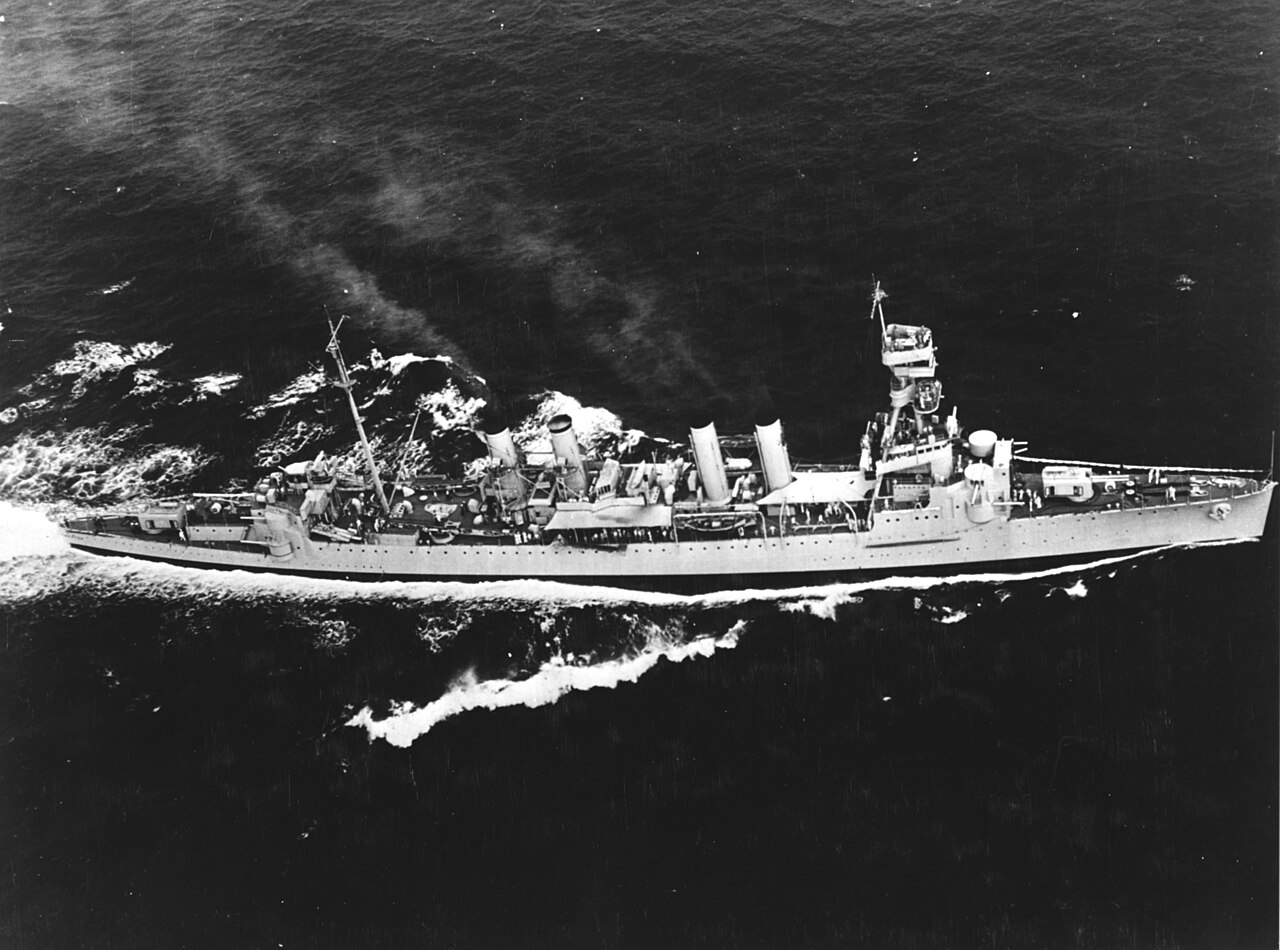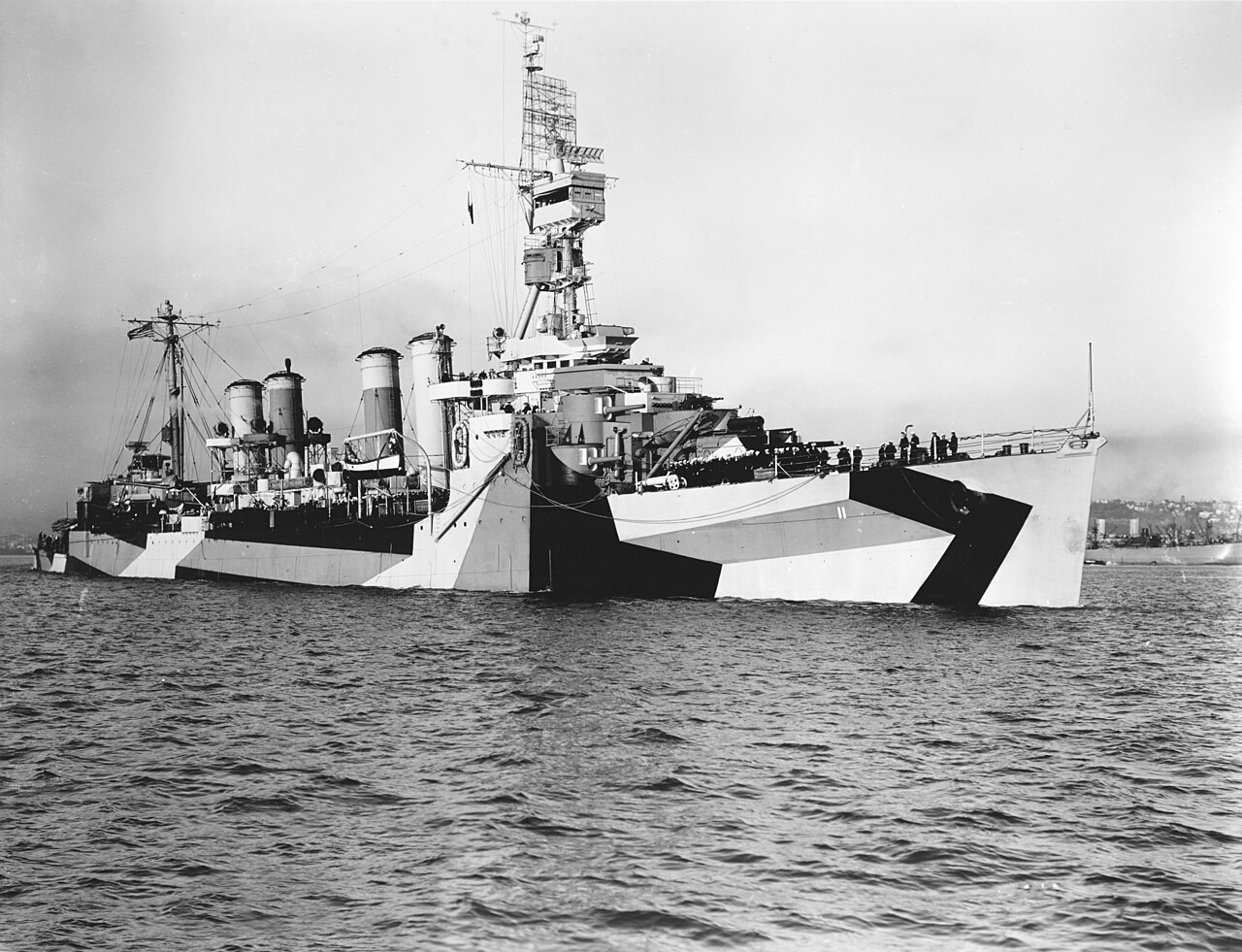
Trenton, CL-11, was an Omaha-class light cruiser, the second Navy ship of the name, for the capital of New Jersey. William Cramp and Sons of Philadelphia laid her keel on 18 August 1920. She went down the ways on 16 April 1923, sponsored by Katherine E. Haulenbeek, née Donnelly, daughter of Trenton Mayor Frederick W. Donnelly. The Navy accepted her on 15 April 1924 and commissioned her on 19 April 1924 with Captain Edward C. Kalbfus in command. The DANFS line for the hull gives 7,500 tons, a length of 555 feet 6 inches, a beam of 55 feet, a draft of 14 feet 3 inches, a speed of 33.91 knots, twelve 6-inch guns, four 3-inch guns, two 3-pounder saluting guns, ten 21-inch torpedo tubes, and a designed complement of 458.
She cleared New York on 24 May 1924 on a shakedown of about 25,000 miles, by way of Trinidad, Cape Town, and Durban, then up the African coast to Zanzibar and Aden and into the Red Sea. On 20 July a sandstorm met her there. She dropped speed in the poor visibility, sand covered the hull, and the storm lasted nearly two hours. She called at Alexandria from 20 to 26 July. Vice Consul Robert W. Imbrie had been beaten by a mob in Tehran on 18 July and died of his wounds. The State Department and the Navy turned Trenton back. She arrived at Bandar Bushehr on the morning of 26 August, took Imbrie's remains on board, returned the gun salute, and sailed the same day. She reached the Washington Navy Yard on 29 September and joined Light Cruiser Division 3 of the Scouting Fleet.
On 24 October 1924, about 40 miles off the Virginia capes, powder bags in the forward turret exploded. The blast killed or injured every man of the gun crew, blew the rear door open, and threw five men overboard. Seaman William A. Walker drowned. Ensign Henry C. Drexler and Boatswain's Mate First Class George R. Cholister tried to dump the powder charges into the immersion tank before they detonated. The charges burst and killed Drexler. Fire and fumes overcame Cholister, and he died the next day. Both received the Medal of Honor. Commander Paul F. Foster, the engineer officer, climbed the hoist into the burning mount with a hose and put the fire out. He received the Navy Cross. The ship ran for Hampton Roads and sent the wounded to Portsmouth Naval Hospital. Seventeen men are named as killed.
She stayed with the Scouting Fleet, Caribbean winters and New England summers, and in the summer of 1925 she went with the Battle Fleet to Australia and New Zealand. She was back at Philadelphia on 9 November 1925. In May 1927 she embarked Brigadier General Henry L. Stimson and his wife at Corinto and carried them to Hampton Roads after his mission in the Nicaraguan civil war. In January 1928 she and her division landed marines in Nicaragua to help supervise the elections that followed. She and Memphis then went out to the Asiatic Station. In March 1929 she put a landing force ashore at Chefoo while Chinese factions fought, with Rear Admiral John R. Y. Blakely's flag aboard. The division left the Asiatic Fleet in May 1929.
In the spring of 1933 she moved to the Pacific as flagship of the Battle Force cruisers. In January 1938 Rear Admiral Julius C. Townsend took her, with Louisville, Memphis, and Milwaukee, to Australia for the sesquicentennial of the first colonization. They reached Sydney on 25 January. On 13 February the sightseeing ferry Rodney capsized when passengers crowded the rail to wave Louisville off, and 19 people died. American sailors pulled a number of them from the harbor. Trenton came home by Singapore, Manila, and Guam. In May 1939 she returned to the Atlantic and joined Squadron 40-T, the small force watching American interests during the Spanish Civil War, and she served as its flagship. On 23 June 1940 Portuguese police arrested 30 of her sailors, three of them injured, after a brawl at Praia de Santo Amaro de Oeiras. Omaha relieved her as flagship the day after Independence Day. The Grand Duchess of Luxembourg stayed in Lisbon. Other members of the grand-ducal family boarded Trenton and were landed at Annapolis on a crossing dated 15 to 25 July 1940.
She reentered the Pacific in November 1940 as a ship of Cruiser Division 3. Captain Arthur D. Struble had her from 2 January 1941. She was not at Pearl Harbor on 7 December 1941. She lay moored at Balboa, in the Panama Canal Zone, with the Southeast Pacific Force. Early in 1942 she helped escort the Bobcat convoy that was to put a fueling station on Bora Bora. She and Milwaukee joined that convoy at the Panama Canal on 3 February. On 23 February Rear Admiral John F. Shafroth Jr. and Lieutenant Colonel Georges L. J. Orselli signed, on board Trenton, the agreement for American use of the island, and the United States recognized Free French sovereignty. Captain Joseph W. Gregory relieved Struble on 25 May 1942. From the middle of 1942 to the middle of 1944 she patrolled the west coast of South America between the Canal and the Strait of Magellan. Captain Stanley C. Norton relieved Gregory on 26 June 1943.
On 28 August 1943, patrolling between 22°5' S, 172°46' W and 20°16' S, 174°56' W, she held an unknown radar contact for nearly fifteen minutes and could not identify it. The next day the German auxiliary cruiser Michel, which had come around into the eastern Pacific, sighted her. The raider's lookouts took the four-stack cruiser for a Pensacola-class heavy cruiser. Trenton had just secured from general quarters and was steering a base course of 132 degrees. She did not challenge, and Michel got away. On 11 September Michel sank the Norwegian tanker India, of 9,977 tons, with all 41 hands, not far from Easter Island. The account says that if Trenton had queried the raider she might have saved that ship and her crew. The submarine Tarpon sank Michel off Chichijima on 17 October. Trenton called at Valparaiso on 11 January 1944. Captain William B. Coleman relieved Norton on 24 June 1944.
On 18 July 1944 she headed north for the Aleutians. She stopped at San Francisco on 11 August and arrived at Adak on 2 September. After a month of patrolling she shifted to Massacre Bay on Attu and joined the North Pacific Force under Rear Admiral John L. McCrea, in company with Concord and Richmond and destroyers. In October the force tried twice for the northern Kurils, from 14 to 19 October and again from 24 to 29 October, and heavy seas and fog turned both attempts back. From 1 to 25 November they got through. Overnight on 21 and 22 November their guns shelled the airfield, the seaplane station, and other installations on Matsuwa. Wind and sea held the retirement to nine knots and kept the Japanese naval bombers of the 553rd Kokutai on the ground. The ships returned to Attu.
McCrea took them out of Massacre Bay from 3 to 13 January 1945, and in snow squalls and a calm sea they bombarded the Suribachi Wan area of Paramushiro. On 18 February, just after sunset, they bombarded the Kurabi Zaki area of Paramushiro until midnight. An earlier attempt, against Kuabu Zaki from 8 to 14 February, had been turned back by seas too heavy for a fast retirement. The same account then has them bombard Matsuwa again, has a sortie five days later driven back by the sea, and has them exercise off Adak from 1 to 17 April. Early in May, under Rear Admiral John H. Brown Jr. in Task Group 92.2, they shelled Suribachi Wan on the 19th and swept the Sea of Okhotsk. On 10 June they shelled Matsuwa once more, made an antishipping sweep on the evening of the 11th, and bombarded again on the 12th. From 23 to 25 June Trenton led what the account calls her last offensive operation of the war, a sweep of the central Kurils. The group split. Bearss, John Hood, Jarvis, and Porter sank the auxiliary submarine chasers Cha 73, Cha 206, and Cha 209 and the guardboat No. 2 Kusunoki Maru, and damaged Cha 198, south of Onekotan at 49°40' N, 155°30' E, on 26 June. Trenton, Anderson, and Hughes patrolled to the east of the islands and engaged no one.
She reached San Francisco on 1 August 1945. The end of the war found her at the Mare Island Navy Yard awaiting an inactivation overhaul. Captain Joseph T. Talbert relieved Coleman on 20 August and had her through the decommissioning. Early in November she went south, passed the canal on the 18th, and reached Philadelphia a week later. She was decommissioned there on 20 December 1945. Her name was struck on 21 January 1946, and on 29 December 1946 she was sold for $67,228 to the Patapsco Scrap Company of Bethlehem, Pennsylvania. She received one battle star for World War II service. She was not sunk.
A note on sources. The narrative follows the Naval History and Heritage Command's Dictionary of American Naval Fighting Ships entry for Trenton II (CL-11), the long account signed by Mark L. Evans and dated 8 May 2020, for dates, places, the turret explosion, the Michel contact, the Kuril operations, and the sale. A digitized copy of an older, much shorter DANFS text on the HyperWar site is not followed where the two differ. HyperWar names the sponsor Miss Katherine E. Donnelly; the NHHC page and NavSource name Katherine E. Haulenbeek, née Donnelly. HyperWar has her arrive at Bushire on 25 August 1924; the NHHC page prints Bandar Būshehr and the morning of the 26th. HyperWar does not mention the turret explosion. NavSource dates that explosion to 20 October 1924 and says 14 men were killed. The NHHC page dates it 24 October 1924 and names seventeen dead, including Walker, who drowned, and Cholister, who died the next day. The NHHC page dates both the Red Sea sandstorm and the call at Alexandria to 20 July 1924. HyperWar's shakedown is a short passage to the Mediterranean and does not describe the Cape run. HyperWar sends Light Cruiser Division 2 home from Australian waters late in August 1925; the NHHC page keeps Trenton with the fleet through New Zealand and back to Philadelphia on 9 November. HyperWar places her second Australian cruise in the winter of 1937 and 1938; the NHHC page has the detachment sail on 3 January 1938 and reach Sydney on 25 January. HyperWar omits the Rodney capsizing, Squadron 40-T, the Luxembourg passage, the Bora Bora agreement, and the Michel contact. NavSource's characteristics line gives 7,050 tons, a beam of 55 feet 4 inches, a maximum draft of 20 feet, two 3-inch guns, and 35 knots. The DANFS line is the one used above. The NHHC page prints a sortie from Massacre Bay on 14 August 1944, and another try on the 26th, both cancelled for weather, and it attaches those attempts to the Leyte invasion. That August date falls before the 2 September arrival at Adak given in the same account, and it is not used here as a movement. HyperWar has no August sortie. It dates two October sweeps, a diversion for the Leyte landings, to 16–19 and 22–29 October, with Richmond and nine destroyers. The NHHC page dates the October attempts 14–19 and 24–29 October, and those are the dates used above. HyperWar does not mention the 21–22 November 1944 bombardment of Matsuwa. The NHHC page prints "again hit Matsuwa on 15 March 1944" in a passage that otherwise runs from the February 1945 Paramushiro bombardment into April exercises and "Early in May 1945." HyperWar says only that a month after 18 February she bombarded Matsuwa, and gives no day. The printed year 1944 is not used as the date of that bombardment. HyperWar puts a further Matsuwa bombardment on the evening of 11 June 1945. The NHHC page puts the antishipping sweep on the evening of the 11th and another bombardment on the 12th. HyperWar says the other half of the late-June sweep sank five ships and calls the force Task Force 94. The NHHC page, which had redesignated the force Task Force 92 and then Task Group 92.2, names four ships sunk and Cha 198 damaged, on 26 June, and says Trenton did not engage. Uboat.net adds a movement the NHHC page does not: on 13–17 December 1941 Trenton and Richmond, with the British cruiser Diomede, escorted the Norwegian transport Ferncliff toward Seymour Island in the Galapagos, and the event line calls Struble a captain. That passage is not in the narrative. Commanding officers in the narrative follow the NHHC list, which matches uboat.net: Struble from 2 January 1941, Gregory from 25 May 1942, Norton from 26 June 1943, Coleman from 24 June 1944, Talbert from 20 August 1945. NavSource agrees on Struble's dates, ends Gregory only as 1943, omits Norton, gives Coleman no relief date, and spells Talbert's given name Joesph. NavSource ranks Struble a captain for the whole tour. Uboat.net's command table ranks him a commander and dates his captaincy from 1 July 1941. An NHHC biographical sketch of William Bryan Coleman, adapted from a 1 July 1950 biography, says he had Trenton until July 1945 and quotes a Legion of Merit citation running from 22 September 1944 to 24 July 1945. The NHHC ship history and uboat.net both end his command on 20 August 1945, when Talbert took her, and that date is used here. A NavSource caption elsewhere on the page says ships of the class were sold to the Patapsco Scrap Co. of Baltimore. The fate line on that page, HyperWar, and the NHHC history all name Bethlehem, Pennsylvania, and the price $67,228, and that is what is used here.