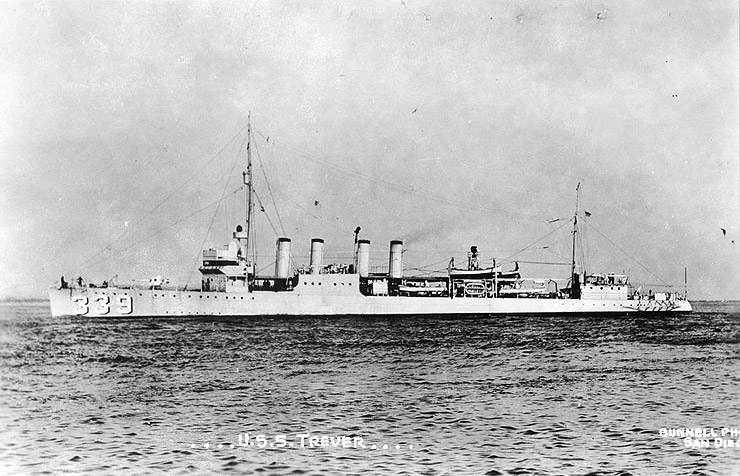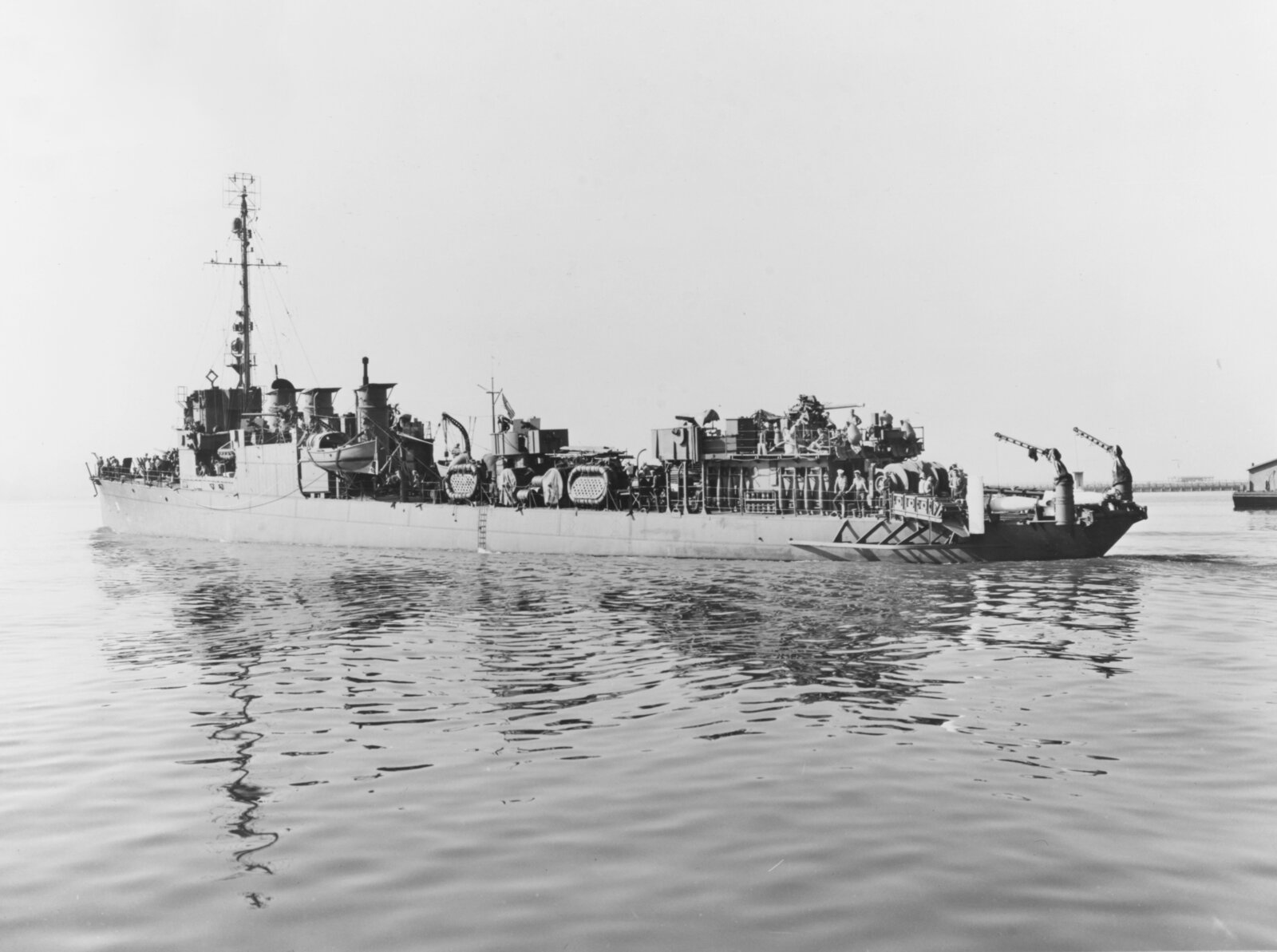
Trever, DMS-16, was named for George Arthur Trever. He was born at Waupun, Wisconsin, on 11 June 1885, appointed to the Naval Academy in May 1905, and graduated on 4 June 1909. He died on 14 October 1918 at the Naval Hospital in Brooklyn, of injuries from an explosion aboard the submarine O-5 during trials on 5 October. The destroyer was laid down on 12 August 1919 at the Mare Island Navy Yard, launched on 15 September 1920, and sponsored by Mrs. Bess McMillan Trever, his widow. She was commissioned on 3 August 1922 as Destroyer No. 339, a ship of the Clemson class. Lieutenant Commander Harold Eugene Snow was her first commanding officer and had her until 17 January 1923.
After shakedown she was placed out of commission at San Diego on 17 January 1923, with Destroyer Division 44. She lay in the inactive ships of red lead row until 2 June 1930. She then operated from San Diego with the Battle Force, in Destroyer Division 15 and later Division 10, until she was reclassified a high-speed minesweeper and redesignated DMS-16 on 19 November 1940. She worked out of Pearl Harbor through 1941 in Mine Division 4, Mine Squadron 2, of the Base Force.
On 7 December 1941 she lay nested with Zane, Wasmuth, and Perry, the whole of Mine Division 4, off the Pearl City Yacht Club. The ships opened fire almost at once. Her .50-caliber Brownings concentrated on one attacker strafing the yacht club and sent that plane into a hillside, where it exploded. A second raider lost its wings and crashed near Beckoning Point. In the sortie many ships left commanding officers ashore. Trever embarked the captain and executive officer of Henley. Later those two officers returned to Henley by a raft towed on a manila line. Henley took station ahead, reeled out the line with the raft on the end, and the two officers climbed down into it. A high-line transfer alongside was out of the question under the submarine threat. They had a wet ride in the chop and were taken back aboard their own ship. The officer who had gone to sea in Wasmuth boarded Trever in mid-afternoon while she swept the channel. She spent the next months sweeping, escorting, and on antisubmarine patrol.
On 15 April 1942 she and Hopkins, as Task Group 15.2, escorted a six-ship convoy from Honolulu to San Pedro, arriving on 25 April. She then had an overhaul at Mare Island in which the 4-inch mounts came off and 3-inch antiaircraft guns and 20-millimeter Oerlikons went on. With Task Group 15.6 she escorted a westbound convoy and reached Pearl Harbor on 2 July. On 12 July she sailed with Zane, Hopkins, Navajo, and Aldebaran for Tutuila and Tongatabu, and joined Task Force 62, preparing the Solomon landing.
She arrived off Guadalcanal on 7 August. Commander William H. Hartt, Jr., had the Minesweeper Group, Task Group 62.5. Trever was one of the five ships. The combat narrative and Morison's task organization name Lieutenant Commander Dwight M. Agnew as her commanding officer. Lieutenant Commander Dwight Merle Agnew had the ship from 17 December 1941. She screened the transports until she was detached with Hovey and Hopkins to bombard targets ashore. While the American ships steamed in column some 3,000 yards off, Japanese batteries on Gavutu opened at 0807. A minute later the shells straddled the column. Trever's 3-inch guns, with her 20-millimeter guns, answered. At 0830 a direct hit silenced the gun. The minesweepers ceased fire at 0835 and withdrew. While she swept with Mine Squadron 2, her antiaircraft fire helped drive off bombers over the transports. On 8 August, Betty bombers came over. She opened fire at 1203. In a four-minute fight she helped to splash four of them. That night a Japanese cruiser force came down the Slot and fought the Battle of Savo Island. Vincennes, Quincy, Astoria, and Canberra were sunk. The Japanese commander did not continue down the strait to the anchored transports, some of them still loaded with supplies for the Marines. On 9 August Trever helped screen the transports retiring to Noumea.
On 14 September she joined a reinforcement unit and left Espiritu Santo with supplies for the Marines, arriving off Guadalcanal on the 17th and at Noumea on the 22nd. On 10 October, with Mine Squadron 2, she escorted McCawley and Zeilin from Espiritu Santo. On 13 October she and Hovey were ordered to search for survivors of the Battle of Cape Esperance, fought the night before. She took aboard 34 enemy survivors, including three officers. One raft of eight refused to surrender and fought, and she destroyed the raft and the men on it. She transferred the prisoners to McCawley and returned to Espiritu Santo.
With Zane she reached Tulagi on 25 October 1942 with torpedoes, ammunition, and aviation fuel for Motor Torpedo Boat Squadron 3. They waited for orders to bombard Japanese positions along the Guadalcanal coast. The orders did not come. At 1000 a message said three Japanese destroyers were coming down the strait, apparently to bombard Henderson Field. Agnew, commanding the task unit, had two choices. One was the Maliala River, where Jamestown and the damaged McFarland were camouflaged. Zane and Trever were not. Going in might draw the Japanese onto all four ships. He did not wish to be caught like rats in a trap, and he chose a dash for Sealark Channel. At 1014 three silhouettes came over the horizon, hull-down and throwing a bone in their teeth. The engineers got 29 knots out of the old machinery. The Japanese, making 35 knots, gained and opened with 5.5-inch guns beyond the reach of the American 3-inch. The first shells went overhead. The next salvo fell some 300 yards astern. The two minecraft dodged and kept firing. The Japanese hit Zane amidships and killed three men. Agnew turned for the shoals of Niella Channel. The Japanese broke off the action, perhaps remembering the bombardment they had been sent to make. Three days later the two ships ran to Tulagi again, each with 175 drums of gasoline lashed on deck, and Trever continued such runs through January 1943. Agnew was relieved on 7 February 1943. She reached Sydney on 27 January for overhaul and was back at Espiritu Santo on 28 February.
Lieutenant Commander Joseph Caldwell Wylie, Jr., had her from 7 February to 24 April 1943. Lieutenant Commander William Henry Shea, Jr., had her from 24 April 1943 to 26 January 1944. She called at Wellington on 31 May. On 20 June she escorted LST-343 from Lunga Roads to the Russell Islands. After nightfall a twin-float Japanese biplane dropped bombs on the two ships, and Trever's 20-millimeter guns answered. On 29 June, Rear Admiral George H. Fort hoisted his flag in her as commander of Task Group 31.3. That night, with Schley, McKean, and seven infantry landing craft, she left Wernham Cove in the Russells. At daybreak the fast transports launched their boats, and the troops went ashore at Oliana Bay and took the defenders by surprise. With the objective secured, Fort went ashore at Renard Sound. On 5 July, for the landing at Rice Anchorage in Kula Gulf, she embarked 216 men of the 3d Battalion, 148th Infantry. On 5 August she joined Honolulu, which had lost her bow to a torpedo at Kolombangara, and escorted the cruiser from Espiritu Santo toward Pearl Harbor. On 19 August she sailed with an eastbound convoy for San Francisco. After a month at Mare Island she left for Pearl Harbor on 8 October. On Armistice Day she screened American Legion to Empress Augusta Bay, and later that month she took part in the Cape Torokina landings.
Lieutenant Commander Morgan Adams, Jr., had her from 26 January to 24 July 1944, and Lieutenant Alfred Samuel Brengle from 24 July 1944 to 14 June 1945. Through that year she escorted ships and towed targets in the South and Central Pacific. In October 1944, under Brengle, she screened the torpedoed cruisers Houston and Canberra to Ulithi. On 18 December 1944, escorting a convoy toward the Western Carolines, she met a typhoon. By 1440 the wind was at typhoon force. Visibility went to zero. Seas and winds reported at 90 knots carried away both motor whaleboats and bent their davits. At 1630 a man working topside was washed overboard. She searched and, two hours later, picked him up alive. She put into Guam the next day, transferred him to the naval hospital, reached Eniwetok on 22 December, and with the Army transport Santa Isabel reached Pearl Harbor on the last day of 1944. Overhaul at the Naval Repair Base, San Diego, began on 9 January 1945. She headed for Oahu on 25 March. Lieutenant Henry Lemle Phillips had her from 14 June 1945 to 23 November 1945, so he was in command on 2 September. She had been reclassified AG-110 on 4 June 1945, ten days before his tour. For the remainder of the war she operated from Pearl Harbor, where she had been when the war began. On 22 September she left Pearl Harbor for the last time, reached San Diego, went through the Canal Zone, and arrived at Norfolk on 21 October. She was decommissioned on 23 November 1945, struck on 5 December 1945, and sold for scrap on 12 November 1946. She received five battle stars.
A note on sources. The career is the Dictionary of American Naval Fighting Ships entry for Trever. Commanding officers are NavSource's page for DD-339. The 7 August assignment, and Agnew's name in it, are the combat narrative, chapter 5, and Morison, volume IV, pages 270 to 274. The 25 October Japanese ships are named in the Dictionary entry for Zane, the fuller account of the same hour. The Dictionary commissions her under Lieutenant H. E. Snow. NavSource names Lieutenant Commander Harold Eugene Snow, from 3 August 1922 to 17 January 1923. For 7 December the Dictionary says her own commanding officer, Lieutenant Commander D. A. Agnew, had gone to sea in Wasmuth and boarded her in mid-afternoon. NavSource has Lieutenant Commander James Stuart Smith, Jr., in command through 17 December 1941 and Lieutenant Commander Dwight Merle Agnew from that day. Morison and the combat narrative, for 7 August 1942, print Dwight M. Agnew. The body uses the NavSource date for his command and leaves the afternoon boarding without a name. The Dictionary calls the 14 September reinforcement unit TP 65. That designation is omitted here. The Maliala River and Niella Channel are the names in the Trever entry. The Zane entry gives Agnew's refusal of the river as his words, "trapped like rats." The Trever entry says he did not wish to be caught like rats in a trap.