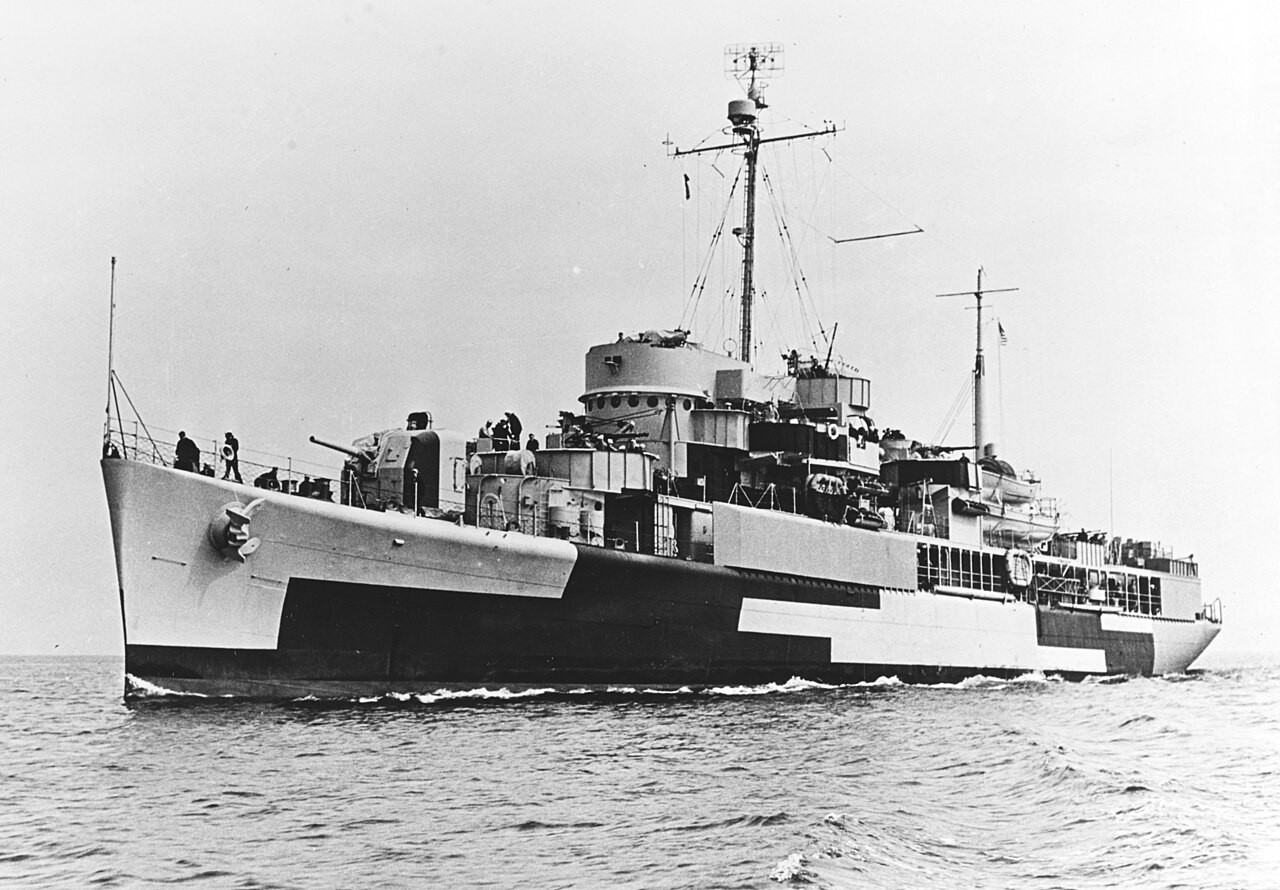
Wachapreague was a motor torpedo boat tender, named for an inlet on Virginia's Eastern Shore. Lake Washington Shipyards at Houghton, Washington, laid her down on 1 February 1943 as AVP-56, a Barnegat-class small seaplane tender. The next day the Navy reclassified her as a motor torpedo boat tender, AGP-8. She was one of four ships of that class finished for the role. In service they were treated as the Oyster Bay class. Mrs. E. L. Barr sponsored the launch on 10 July 1943. She was commissioned on 17 May 1944. Lieutenant Commander Harold A. Stewart, USNR, had her. No relief date is given for him. As completed she displaced 2,592 tons, measured 310 feet 9 inches by 41 feet 1 inch, and drew 13 feet 6 inches. Twin diesels on two shafts gave her 18.2 knots. She carried two 5-inch guns, eight 40 mm guns, eight 20 mm guns, and two depth-charge tracks. Her complement was 246. Her work was to fuel, repair, rearm, and direct the PT boats she tended.
After shakedown out of San Diego she sailed on 18 July 1944 for the Southwest Pacific. She called at Espiritu Santo and at Brisbane on 17 August, and reached Milne Bay, New Guinea, on 20 August. She anchored at Motor Torpedo Boat Base 21, then the largest PT base in the Pacific, and reported to Commander, Motor Torpedo Boats, Seventh Fleet. She tended the ten boats of Motor Torpedo Boat Squadron 12. That squadron had already taken a heavy toll of Japanese barge traffic and shore positions in the New Guinea campaign. As those operations wound down she also took on five boats from Squadron 7, for the Philippines.
On 13 October 1944 she sailed for Leyte, about 1,200 miles, with the tenders Oyster Bay (AGP-6) and Willoughby (AGP-9), the seaplane tender Half Moon (AVP-26), and two Army craft, escorting 45 PT boats. Slowing to about nine knots, Wachapreague refueled two boats at a time, one alongside and one astern, and replenished all 15 of her own boats underway. After a two-day stop at Kossol Roads in the Palaus, the boats entered Leyte Gulf on 21 October, the day after the landings. The tender anchored in northern San Pedro Bay. On 24 October she shifted to the cramped anchorage at Liloan Bay, off Panaon Island, and tied into the Philippine guerrilla radio net.
That night boats she had tended were in the van of the Battle of Surigao Strait. The first contact report Rear Admiral Jesse Oldendorf received went out through her, from PT-130 by way of PT-127, and on to Louisville. PT-137 fired at a destroyer. The torpedo ran on and hit Abukuma, and the cruiser fell out. Lieutenant (junior grade) Isadore Michael Kovar could not see her when he fired. Wachapreague did not fire it, and she did not sink the cruiser. Army bombers sank Abukuma the next day off Negros. In the same melee Nachi collided with Mogami and was reduced to 18 knots. Shiranui came out of the strait. Aircraft finished her later. Of the Japanese southern force, only Shigure came back out.
The tender was working while the boats fought. Her crew repaired the badly damaged PT-194, and antiaircraft fire drove off a Japanese plane. On 25 October, as she finished fueling PT-134 in Hinunangan Bay, a bomb landed about 18 feet from that boat's stern. It killed one man and wounded four aboard the PT boat. Wachapreague was not hit. She cleared the bay under smoke just before a raid by 14 aircraft. She claimed two Mitsubishi G4M Betties, one crashing into the sea and a second, trailing smoke, going down behind an island. She was back at San Pedro Bay late on 26 October. Her boats then worked against Japanese shipping in Ormoc Bay and the Mindanao Sea. She sailed for Mios Woendi on 13 November with Willoughby.
She returned to San Pedro Bay two weeks later. For a time she tended 22 boats from Squadrons 13, 16, and 28, plus six from Squadron 36 and two from Squadron 17. On 4 January 1945 she headed for Lingayen Gulf with Squadrons 28 and 36. At noon a kamikaze hit a merchantman 100 yards ahead. At dusk seven Japanese planes attacked. One crashed about 100 yards ahead of her, and another diving on her was knocked into the sea by her guns. That evening PT-382 came alongside and transferred two men blown overboard from the freighter Kyle V. Johnson. She entered Lingayen Gulf on 13 January and anchored near Damortis, then shifted on 16 January to Port Sual. From there the boats of Squadrons 28 and 36 patrolled north to Vigan and Aparri, shelled shore positions, and destroyed about 20 barges. The tender handled their electrical, engine, and communications work. She left for Leyte on 12 March to replenish.
On 23 April she sailed with Squadron 36 for the invasion of Tarakan, off Dutch North Borneo, and entered Tarakan Bay on 1 May while the guns were still firing, to set up an advance base. For the next four months her boats ran daily strikes up the Borneo coast, destroying shipping at Tawao, Cowie Harbor, and Noneokan, rocketing shore installations, taking about 30 prisoners, and making swells to help landing ships retract from the beach. She was still there when the war ended on 15 August 1945. She kept tending boats at Tarakan until she headed home.
She arrived at San Francisco on 5 December 1945, took upkeep at Mare Island, and sailed for the east coast on 20 March 1946. She reported at Boston on 6 April for inactivation. She was decommissioned on 10 May 1946, transferred to the Coast Guard on 27 May, and struck from the Navy list on 5 June. She was not sunk. Her four battle stars were for Western New Guinea, 29 August to 13 October 1944; Leyte, including Surigao Strait, 19 October to 18 November and 24 to 29 November 1944; Lingayen Gulf, 4 to 18 January 1945; and Tarakan, 1 to 29 May 1945.
After conversion for ocean-station work she was commissioned on 25 November 1946 as the Coast Guard cutter McCulloch, WAVP-386, named for Hugh McCulloch, Secretary of the Treasury under Lincoln, Johnson, and Arthur. From Boston, and after July 1966 from Wilmington, North Carolina, she spent about three weeks a month at sea on Atlantic weather stations: meteorological reporting, an aircraft checkpoint, search and rescue, oceanography, and law enforcement. She was reclassified a high-endurance cutter, WHEC-386, on 1 May 1966, and stayed on that duty into the early 1970s. In January 1959, on Ocean Station Bravo off Labrador, winter seas cracked her decks and swept a crewman overboard. She reached Argentia, Newfoundland, without further loss. In October and November 1965 she patrolled the Florida Strait during the Cuban exodus and rescued 280 refugees. The crew received a Unit Commendation on 22 April 1966. On 17 June 1970 she helped fight a fire aboard the merchant ship Tsui Yung in Wilmington.
She was decommissioned on 21 June 1972 and transferred the same day to South Vietnam, as Ngô Quyền, HQ-17, named for the ruler who expelled Chinese forces in 938. With a 5-inch gun she was among the largest ships in the South Vietnamese Navy. She spent the last years of the war on coastal patrol, interdiction, and gunfire support. When South Vietnam collapsed in late April 1975 she fled to Subic Bay packed with refugees. A Coast Guard inspection on 22 and 23 May 1975 found her rat-infested and in poor condition. She was formally transferred to the Philippines on 5 April 1976 and commissioned on 7 February 1977 as Gregorio del Pilar, PF-8, later BRP Gregorio del Pilar. She was decommissioned in June 1985, reclassified PF-12 and recommissioned in 1987, then decommissioned again in April 1990 because of her material condition. She was discarded in July 1990 and is believed to have been scrapped.