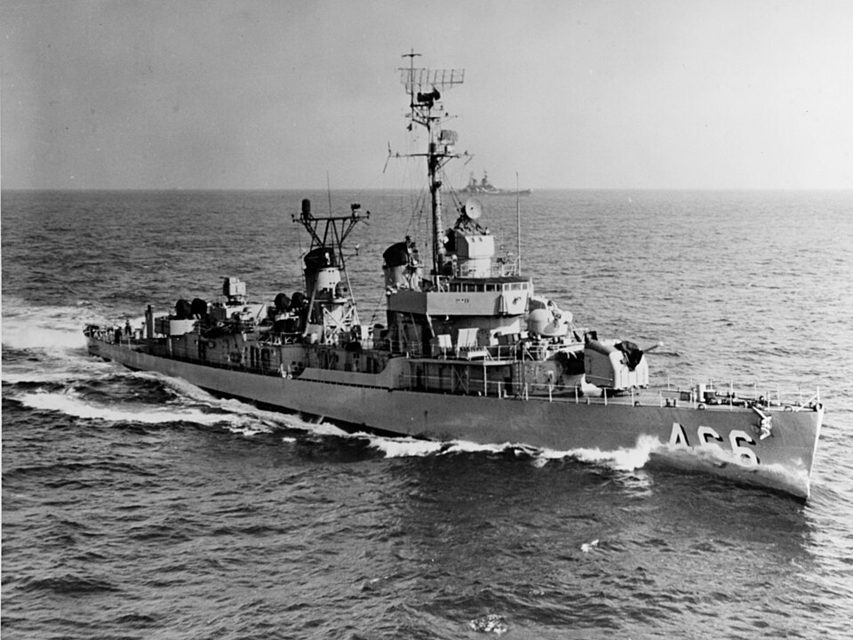
USS Waller (DD-466) was a Fletcher-class destroyer. She was launched on 15 August 1942 and commissioned on 1 October 1942, with Lawrence H. Frost as captain from that day. During the fall of 1942 she ran her shakedown from Casco Bay, Maine, and from time to time stood local escort for submarines training out of New London, Connecticut. Late in the season she left the New York Navy Yard at Brooklyn, headed for the Pacific, and passed through the Panama Canal on the way to Pearl Harbor.
She arrived at Efate on 21 January 1943. Six days after reaching port she took station in the destroyer screen of Task Force 18. Rear Admiral Robert C. Giffen led the force, with his flag in the heavy cruiser Wichita (CA-45). Ahead lay a meeting off Guadalcanal with transports that were carrying supplies and reinforcements to the troops trying to push the Japanese off the island. Intelligence had described a major Japanese effort to resupply their garrison. That reading of the enemy's intent was mistaken. Japanese forces were gathering for an evacuation of their troops.
On 29 January, some fifty miles north of Rennell Island, Betty bombers of the Mitsubishi G4M-1 type approached low out of the east, each armed with a torpedo and each staying clear of the last dusk glow so as to avoid a silhouette. Waller steamed abeam of the flagship on the starboard side, with Louisville (CA-28) and Chicago (CA-29) nearby. The leading bomber swept her with machine guns as it bored in. Heavy American fire met the first pair of aircraft, and one of them rolled into the sea and exploded. Flares spread red, green, and white light over the formation as the attackers tried to pick the ships out of the dark. At 7:31 another flight of Betties went after the heavy cruisers in the right-hand van. One plane went into the water off Waller's stern. At 7:45 a torpedo struck Chicago along the forward starboard side and left three of her four shafts stopped. A further torpedo let the sea into a fireroom and into the engine room ahead of it, and Chicago lost all headway.
The attack then eased. Louisville took Chicago in tow, and early on 30 January the damaged cruiser was bound for Espiritu Santo, making only four knots. Louisville in time handed the tow to the tug Navajo (AT-64). At 2:45 in the afternoon twelve Betties were reported well south of New Georgia, steering for Rennell Island. Fighters on combat patrol from the carrier Enterprise (CV-6) destroyed three of them. Nine pressed on toward Chicago, and seven of those fell to the task force's guns and to Wildcats from Enterprise. Waller claimed one Betty destroyed and two damaged. Two more torpedoes hit Chicago. Her crew abandoned her, and at 4:44 she sank by the stern. Navajo, the fast transport Sands, the destroyer Edwards, and Waller took up 1,049 survivors among them. La Vallette, hurt in the fighting, was towed clear by Navajo. On the way back toward Espiritu Santo, Waller gained a submarine contact, and that contact never grew into an attack. The Battle of Rennell Island cost the United States one cruiser sunk and one destroyer damaged. It also drew Japanese attention off the shipping near Lunga Point, so the reinforcements afloat there could enter the final phase of the fight for Guadalcanal.
Early in March 1943 Captain Arleigh Burke, known as 31-knot Burke, hoisted a broad pennant aboard Waller and made her his flagship. On 5 March she led a raid against the Japanese airfields at Vila, on the southern shore of New Georgia. The destroyers Conway and Cony came with her, together with the light cruisers Cleveland, Denver, and Montpelier. The destroyers were to cover the larger ships and to silence any shore battery that tried to interfere with the cruiser fire. A little past midnight on 5 March the column entered Kula Gulf. Radar on Waller found two ships off the east end of Blackett Strait. They were Murasame and Minegumo, standing out at speed and giving no sign they had seen the Americans. Near 1:00 Waller opened the fight by firing five torpedoes at a range of about three and a half miles. A minute later her main battery joined in. Caught by surprise, the Japanese destroyers answered with scattered fire that fell wide. Six minutes after the action started, Murasame split apart in a huge explosion, the shared result of torpedoes and shellfire from Waller and the ships beside her. Minegumo was smashed into a wreck as well, and she floated only a little longer. At 1:14 the American ships turned west and soon began the bombardment of Vila they had already scheduled. For sixteen minutes the six ships hammered the airstrip, then ceased fire and left fires burning in the dark. Waller was ordered to finish Minegumo. The blazing hulk sank before she could close and carry out the order.
Admiral Chester W. Nimitz praised the Vila raid and the Battle of Blackett Strait, and his wording stayed modest. He called the exploit a creditable performance. He pointed to the way Task Force 68 had picked up two enemy ships on radar with land close behind the targets, had formed a gunnery solution at once, had sunk those ships in a steady and orderly way, and had still reached the planned shelling nearly on time. He likened the night to a drill already practiced by seasoned ships, and he stressed how newly the ships on the line had come to combat. Waller's Solomons duty ran on past the close of 1943 and occupied part of 1944. Japanese garrisons sat trapped on Vella Lavella, on Arundel, and on Kolombangara, and enemy destroyers tried to reach them with troops and supplies on the shuttle Americans called the Tokyo Express. Those ships met American cruisers and destroyers in a series of hard actions fought at night. Waller survived the war. On 17 June 1970 she was sunk as a target.