Building
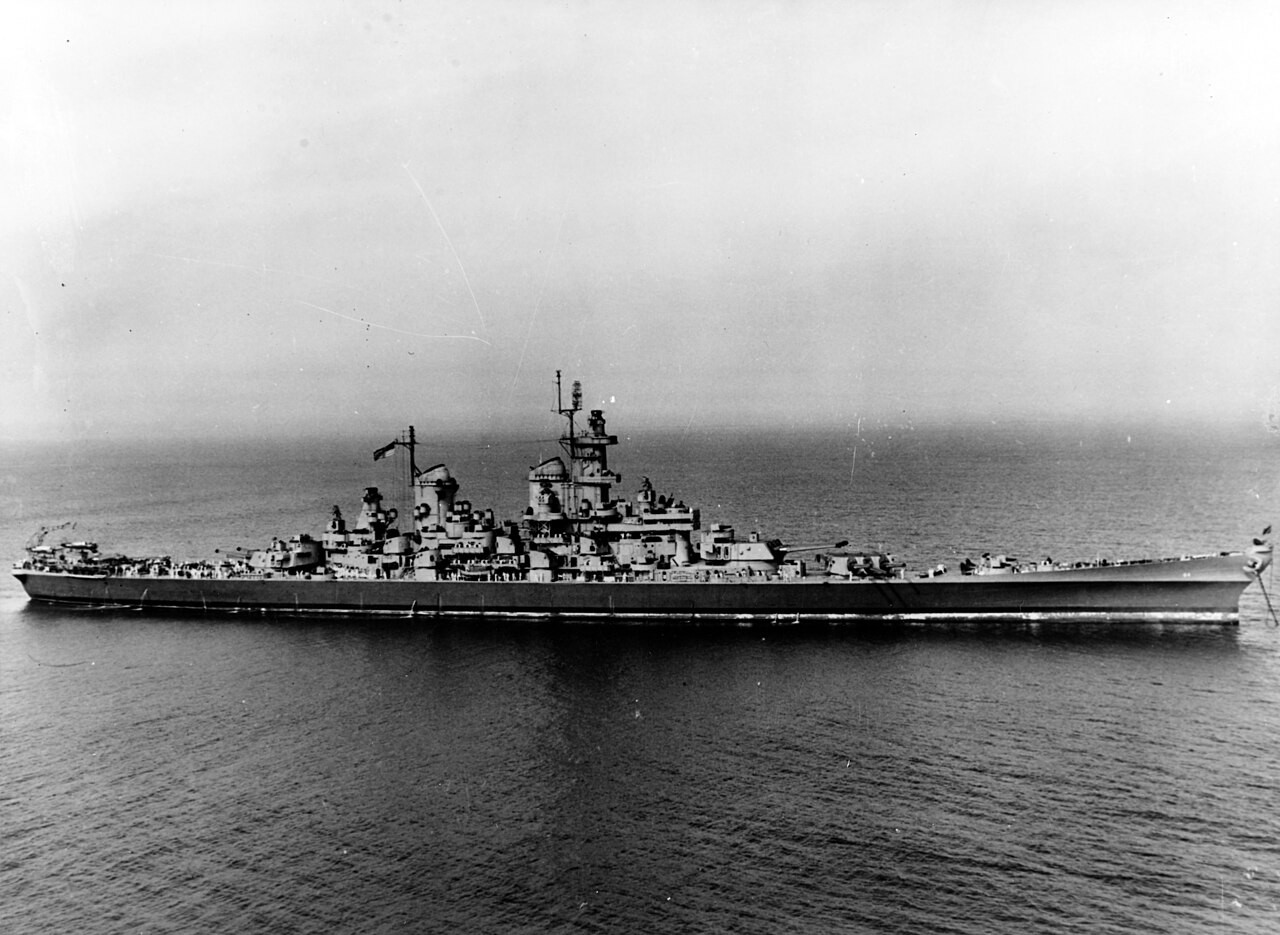
Wisconsin was the second Navy ship named for the state and the third of the four Iowa-class fast battleships. She was authorized in 1938, ordered on 12 June 1940, and laid down at the Philadelphia Navy Yard on 25 January 1941. She was launched on 7 December 1943, the second anniversary of Pearl Harbor, sponsored by Mrs. Walter S. Goodland, wife of the governor of Wisconsin. She was commissioned on 16 April 1944, Captain Earl E. Stone in command. Her keel was laid after Missouri's, but she was commissioned first. She carried nine 16-inch guns and was designed for 33 knots, with 117 officers and 1,804 men in her designed crew. That number rose sharply during the war.
The Philippines
After trials in Chesapeake Bay and a shakedown in the British West Indies, which began on 7 July 1944, she went to the Pacific and was assigned to Task Group 38 at Ulithi. She screened Halsey's carriers through three days of strikes that covered the Mindoro landings, and then rode out Typhoon Cobra on 18 December 1944, east of Luzon. From 3 January 1945 she covered the carrier raids on Formosa, Okinawa, the Sakishimas and the Pescadores for the Lingayen landings, and then the carriers' sweep through the South China Sea.
Iwo Jima, Okinawa and Japan
When Spruance took over the fleet at Ulithi, she joined Vice Admiral Willis Lee's Task Force 59. She covered Task Force 58 during its strikes on Tokyo and Chichi Jima from 16 to 25 February, which were meant to keep Japan from reinforcing Iwo Jima. Captain Roper relieved Stone, and on 14 March she sailed for the strikes on Kyūshū and the Okinawa campaign. She replenished at Ulithi in mid-May and returned to Okinawa on 24 May. On 15 July she and her sisters fired 860 main-battery shells into the Japan Steel Works blast furnaces and the coal-liquefaction and coking plants at Muroran and Wanishi on Hokkaidō. Joined by HMS King George V, Alabama and North Carolina, they then shelled the industrial Hitachi area northeast of Tokyo with 1,207 16-inch and 267 14-inch shells. She entered Tokyo Bay on 5 September 1945, three days after the surrender was signed in Missouri. She left Okinawa on 23 September, carried veterans home by way of Pearl Harbor, and was inactivated at Norfolk in January 1948.
Korea
She was recommissioned on 3 March 1951, Captain Thomas Burrowes in command. In late 1951 she sailed from Yokosuka with Vice Admiral Harold M. Martin and Rear Admiral Francis Denebrink aboard. She screened Task Force 77's carriers and fired on the "bombline" for the 1st Marine Division and the ROK Corps around Kasong-Kosong, including night illumination fire that helped ROK troops beat off a North Korean assault. From 15 March 1952 she shelled railways at Songjin. She was decommissioned at Bayonne on 8 March 1958, which left the Navy without an active battleship for the first time since 1895.
The Gulf War and museum
She was reactivated in 1986 and modernized with 32 Tomahawk and 16 Harpoon missiles, four Phalanx guns, and eight RQ-2 Pioneer drones to spot for her guns. She was recommissioned in 1988. In Desert Storm she was Tomahawk strike commander for the Persian Gulf, directed the opening launch sequence, and fired 24 of her own Tomahawks in the first two days. On 7 February 1991 she shelled an Iraqi communications compound, the first time a Pioneer drone had spotted for a battleship in combat. On the night of 23 February she and Missouri bombarded Faylaka Island in a feint toward an amphibious landing. When her drone flew low over the defenders, Iraqi troops signaled their surrender to it. She was decommissioned in September 1991 after 14 years of active service, during which she earned six battle stars (World War II and Korea) and a Navy Unit Commendation for the Gulf War. She was struck on 17 March 2006 and donated as a museum ship. Nauticus operates her in Norfolk, Virginia.
Sources
Wikipedia, "USS Wisconsin (BB-64)" (citing DANFS; Garzke & Dulin; Gulf War records).
NHHC/DANFS, "Wisconsin II."