Ships
- USS Hammann (DD-412) Captain from 11 August 1939
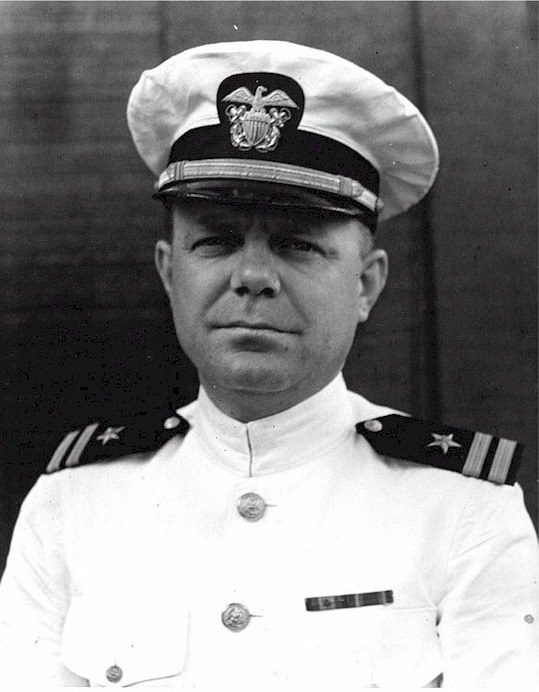
Arnold Ellsworth True, recorded as A. E. True, was born in Owenton, Kentucky, on 23 January 1901. He graduated from the United States Naval Academy in 1920 and spent the following years in cruisers, destroyers, and airships. In 1929 he began formal study of aerology and meteorology, and in 1931 he received a master of science degree from the Massachusetts Institute of Technology. He then served in a succession of Navy weather billets. In 1936, as a lieutenant, he was aerological officer at the Fleet Air Base, Pearl Harbor. He attended the Naval War College in 1938 and 1939.
On 11 August 1939 True, then a lieutenant commander, became the first commanding officer of the new Sims-class destroyer Hammann (DD-412). The ship had been built by the Federal Shipbuilding and Drydock Company at Kearny, New Jersey, and launched on 4 February 1939. She was commissioned that August at the New York Navy Yard in Brooklyn. Hammann shook down off the East Coast and, over the next two years, trained and kept ready on both coasts. As the Atlantic war widened, her duty reached into the North Atlantic as far as Iceland.
Hammann was at sea off Iceland when the United States entered the war in December 1941. She put into Norfolk to fuel and resupply, sailed early in January 1942, crossed the Panama Canal, and arrived at San Francisco on 22 January. Late in February she joined Task Force 17, built around the carrier Yorktown, and headed for the South Pacific.
By the Battle of the Coral Sea, True was a commander. On 8 May 1942, after Japanese aircraft left Lexington burning and fatally damaged, he brought Hammann alongside the carrier while explosions continued and the chance of another air attack remained. The destroyer took off a large number of the carrier's men. For that rescue he was awarded the Navy Cross.
At Midway the next month, Hammann again screened Yorktown. On 4 June she helped beat off the Japanese air attacks. After the carrier was abandoned, the destroyer picked survivors from the sea. On 6 June True was ordered to secure Hammann to the listing Yorktown so the destroyer could supply water for fighting fires and flooding empty tanks, and electric power for the salvage pumps. He kept her there for a long time, with enemy submarines already reported in the area and with almost no room to maneuver if an attack came at the carrier. The Japanese submarine I-168 fired a spread of torpedoes, and one of them hit Hammann. The blow broke the destroyer's back. She sank in about four minutes. A heavy underwater explosion followed and killed many of the men already in the water. About eighty of her crew were lost. The blast threw True against a desk in the pilothouse and broke a rib. He got clear with his executive officer and gunnery officer as the forecastle went under. Benham and Balch picked up the survivors. For holding Hammann alongside Yorktown, True received the Navy Distinguished Service Medal. Admiral William F. Halsey later presented him with that medal and the Navy Cross.
After the loss of Hammann, True commanded Destroyer Division 4 from late 1942 into 1943. He then returned to Navy weather and aerology duty. He left active service in December 1946 and was advanced to rear admiral on the retired list. He died in Palo Alto, California, on 11 December 1979.