Ships
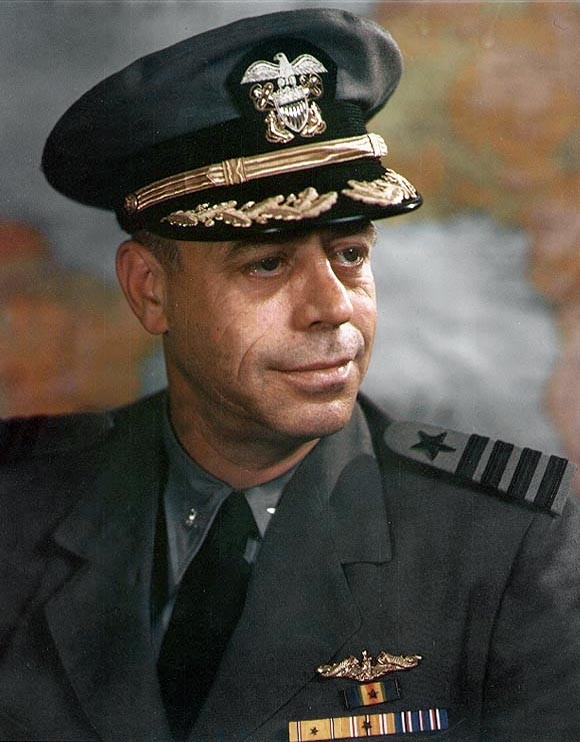
- USS Iowa (BB-61) Captain, 16 August 1944 – 28 November 1944
Allan R. McCann was born Allan Rockwell McCann in North Adams, Massachusetts, on 20 September 1896. He attended Drury High School in that city, entered the United States Naval Academy from Massachusetts in 1913, and graduated in 1917 as the country went to war. His first sea duty was in the battleship Kansas, where he served until 1919. He then qualified in submarines and was assigned to the submarine K-6.
In the early 1920s he commanded the small boats N-4 and L-3, then R-21 at Coco Solo in the Canal Zone, staying with R-21 until she was decommissioned in 1924. He spent the next two years at the submarine base in New London, first as a diesel engineering instructor and then as chief engineer and repair officer, with a period as technical adviser to a Peruvian naval commission at the Electric Boat yard in Groton. From 1926 to 1929 he commanded S-46, again out of Coco Solo. Ordered to the Bureau of Construction and Repair, he worked on escape gear for trapped crews and carried a submarine rescue diving bell through to a finished design. The Navy named the chamber for him.
He commanded the submarine Bonita from 1931 to 1934, then served with the Board of Inspection and Survey on the Pacific coast. In April 1936 he joined the cruiser Indianapolis as first lieutenant and damage-control officer, and after that tour he went to the staff of Commander, Cruisers, Scouting Force. In 1939, while assigned to the Bureau of Navigation, he joined the effort to save the submarine Squalus, which had flooded and sunk off Portsmouth, New Hampshire. The rescue chamber made trip after trip to the hull and brought 33 men to the surface. He also took part in the later salvage of the boat. President Franklin D. Roosevelt sent him a commendation for that work.
Detached from the Navy Department in April 1941, he became commander of Submarine Squadron 7 in the Atlantic Fleet the next month and was in that command when the United States entered the Second World War. In January 1943 he went out to the Southwest Pacific as senior representative of the submarine commander there, with additional duty in temporary command of Task Force 51. In April 1943 he took Submarine Squadron 6, and in September he came home. Until July 1944 he served in the Fleet Maintenance Division in the Office of the Chief of Naval Operations. The Legion of Merit recognized his submarine duty in the Southwest Pacific.
On 16 August 1944 he took command of the battleship Iowa (BB-61). He was her captain until 28 November 1944. Iowa had already made her reputation under John L. McCrea, who had commanded her when she carried President Roosevelt across the Atlantic in 1943. Under McCann she worked in the Western Pacific with the fast carrier forces. In the autumn of 1944 those forces operated in the Third Fleet of William Frederick Halsey, Jr., and Iowa screened the carriers and bombarded Japanese-held positions through the raids that accompanied the fighting in the Philippines. He received the Bronze Star for the way he handled the ship in that fighting.
In December 1944 he reported to the headquarters of the Commander in Chief, United States Fleet, as assistant chief of staff for antisubmarine warfare and as chief of staff of the Tenth Fleet. The Tenth Fleet was the Navy's Atlantic command against the U-boats, and he worked under the immediate direction of Fleet Admiral Ernest J. King. In 1945 he commanded Task Force 68, the ships that escorted President Harry S. Truman to the Potsdam Conference and brought him home. Late that year, after further duty in Washington, he became Commander, Submarine Force, Pacific Fleet.
He retired on 1 May 1950 as a vice admiral. The rescue chamber that bore his name stayed in Navy use long after Squalus, the device crews trained with when a submarine went down. McCann died on 22 February 1978.