Ships
- USS Craven (DD-382) Captain from 19 December 1941
The Navy registers and the Academy yearbook spell the middle name with two ls: Allen Phillip Calvert. The man behind both spellings was a United States Navy officer, Naval Academy class of 1924, who took a Gridley-class destroyer into the first year of the Pacific war, then spent the winter of 1942–43 as commander of Motor Torpedo Boat Flotilla One at Tulagi while Guadalcanal was fought out under his boats’ nightly patrol. The Army gave him its Distinguished Service Medal for that command. He lived to retire as a rear admiral and died of heart disease at Oakland in 1965. What follows is what the registers, the yearbook, the official PT history, the published award citation, the destroyer’s ship history, and a handful of contemporary notices will support. Where they disagree, the disagreement is stated rather than smoothed.
Origins
He was born on 15 September 1901. The Navy Register of 1945 puts the date beside his name as a line officer; the California death index and the Social Security death index, as cited in later genealogical work, give the same day and Michigan as the state of birth. Battle Creek, Calhoun County, Michigan, is the birthplace named in the Navy Department’s modern biographical file and repeated in the 1965 Time death notice. The 1910 federal census, as cited from the National Archives microfilm, places a boy named Allen Calvert in the Battle Creek household of Frank W. and Louise Calvert. Contemporary newspaper notices recovered through the same genealogical apparatus name the parents Frank Waite Calvert and Louise Marion Allen, and a sister, Frances. A Long Beach paper in August 1923 recorded a first-class midshipman A. P. Calvert arriving to visit those parents and that sister at the LaSalle. The father’s 1935 Battle Creek obituary said he left a widow, one son, Lieutenant Allen Calvert, and two grandchildren, “the son and daughter of Lieutenant Calvert.” So by the mid-1930s there was already a household with children. The wife’s name does not appear in the sources used here. The mother’s 1967 Battle Creek notice, written after her son’s death, still called him Rear Admiral Allen R. Calvert — a middle initial the Navy never used for him — and placed his death at Oakland on 14 November 1965.
The Navy biographical file, quoted at length in a later compilation that cites the Naval History and Heritage Command’s modern-bios page for Allen Phillip Calvert, says he graduated from Battle Creek High School in 1919 and spent a year at the Carnegie Institute of Technology in Pittsburgh before entering the Naval Academy from Michigan on 18 September 1920. That entry date matches the midshipman date later tabulated for him in secondary officer compilations. The file’s prose is treated here as an official career summary, not as living memory; its dates of ship duty that can be checked against the Navy Register are checked below.
Formation
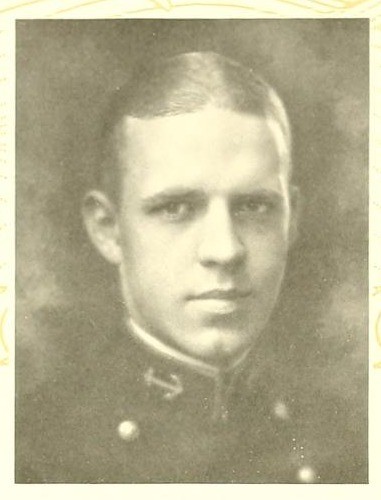
The Lucky Bag for the class of 1924 prints his full name as Allen Phillip Calvert and lists Long Beach, California, beneath it. The sketch calls him “Al.” It does not invent a Midwestern childhood for the page. It gives a midshipman’s portrait of a man the class thought hard to read: courtly enough for chaperones, cold-blooded enough to propose, after a dinner, that the party go on to the Black Cat and “chow”; popular with older people; the only one who still had cigarettes in hand the week before requisition; “sheik to the very limit of his eight dollars per month”; “the hero of Forest Glen.” The activities line is firmer than the jokes. He served on the Christmas Card Committee in his second- and first-class years, on the staff of The Log through most of the course, on the Lucky Bag staff, and on the Gymkhana Committee in his first-class year. The yearbook’s own staff list confirms A. P. Calvert among the associate editors. The Navy biographical file’s statement that he worked on The Log and The Lucky Bag is therefore not an orphan claim. He was graduated and commissioned ensign in June 1924. The biographical file gives 4 June; some secondary tabulations give 5 June. The register columns used here do not settle the day, only the class.
The same Navy file lays out the peacetime sea and school years that the registers only sample. After graduation he served first as radio officer of Pennsylvania, flagship of a battleship division of the Battle Fleet, until January 1926, then as assistant engineer and later engineer officer of Thompson with Destroyer Squadrons, Battle Fleet, into May 1930. He took the mechanical-engineering postgraduate course at Annapolis and finished a Master of Science at Columbia University in June 1932. From June 1932 to June 1936 he went back to sea as engineer of Dent (DD-116), as assistant squadron engineer of Destroyer Squadron 2 in Decatur, and as broadside battery officer again in Pennsylvania. The 1933 Register of Commissioned and Warrant Officers, in the lieutenant (junior grade) list, places Allen Phillip Calvert at “Dent,” which is consistent with the engineer tour. In June 1936 he reported to the Naval Engineering Experiment Station at Annapolis as superintendent of the metals and welding laboratories and stayed until the summer of 1939. The special-course codes that trail his name in later registers include 22, the mechanical-engineering postgraduate mark.
By the 1 July 1940 Navy Register he was a lieutenant commander, date of rank 13 February 1939, with present duty or station “Detroit.” The Navy biographical file fills that line: from June 1939 until October 1941 he served in Detroit first as first lieutenant and damage-control officer and later as navigator. The 1942 register still carried him as lieutenant commander with the same date of rank. The file says that in October 1941 he assumed command of Craven (DD-382). That October date is one of the hard conflicts of this life and is treated in the gaps section. What is not in conflict is the navy. He was United States Navy throughout. He is not to be confused with James Francis Calvert, the later submarine officer and Academy superintendent of the same surname; nor with a Royal Naval Volunteer Reserve memoirist named Philip Calvert; nor with the several other Calverts who crowd the wartime registers under different given names.
War years as lived
Craven was a Gridley-class destroyer, commissioned in 1937, based at Pearl Harbor from April 1940. DANFS, as reprinted by the Destroyer History Foundation from the Naval Historical Center text, states that when the Japanese attacked Pearl Harbor she was at sea with Enterprise, returning from Wake Island. That is the morning that matters for her captain, whoever he was that day. The Navy biographical file, by contrast, says he had already taken her in October and was serving in that command when the Japanese attacked — and then, in the same paragraph as quoted, prints the attack date as “December 1,” which is an obvious slip for the seventh. The essay will not choose between October and 19 December as if the choice were free. It will say what the ship did in the months when both traditions place him on her bridge, and it will refuse to pad her later career after the date on which every compilation has him gone.
DANFS gives Craven the early carrier raids: the Marshalls and Gilberts on 1 February 1942, Wake Island on 24 February. After an overhaul on the west coast she returned on 8 April to convoy and west-coast work. On 12 November 1942 she sailed from Pearl Harbor to join the Guadalcanal struggle, escorting transports to the island. That November departure is the last clear DANFS movement that can be tied, even loosely, to a Calvert command if the December 1942 relief date used by the CO lists is right. NavSource and uboat.net both end his Craven command on 19 December 1942. The Navy biographical file does not print a relief date for the destroyer; it simply moves him, in the next sentence, into Motor Torpedo Boats. The destroyer’s later fights — Vella Gulf in August 1943, the fast-carrier screens of 1944 — belong to other captains and are not narrated here.
What he did next is better documented than how he left the destroyer. On 15 December 1942 Motor Torpedo Boat Flotilla One was activated with headquarters at Sesapi, on Tulagi. Captain Robert J. Bulkley’s official history At Close Quarters states the fact flatly: the flotilla, under Commander Allen P. Calvert, was stood up that day to bring the Solomons PT squadrons under a single command. Operational control of the boats remained with the local naval base commanders — for the Tulagi boats, Commander Naval Base Guadalcanal — a split that Bulkley later called unfortunate. The United States Naval Administration in World War II manuscript on Pacific Fleet motor torpedo boat squadrons, which lists Calvert among its interview and correspondence sources as formerly ComMTBFlot ONE, tells the same activation: additional squadrons were coming, the senior officer on the beach after Montgomery’s evacuation had been only a lieutenant, and Commander Allen P. Calvert was directed to take the new organization. Direct operational control remained with CNB Guadalcanal. The Tulagi PT base took his name. Bulkley’s caption for the ACME photograph is blunt: “‘Calvertville,’ the Tulagi PT base, named for Comdr. Allen P. Calvert, Commander Motor Torpedo Boat Flotilla 1.”
He arrived into a fight that was nearly finished and into a maintenance crisis that was not. Bulkley’s narrative of the weeks before and after his activation is the closest the record comes to the weather of the command. From early December into early February the Tokyo Express still ran. The boats met destroyers on the nights of 7–8 December, sank the submarine I-3 on the 9th, fought again on the 11th–12th, and through January into the first nights of February kept going out against superior forces in Iron Bottom Bay. On the night of 1–2 February eleven PTs went out against a large Japanese destroyer force covering the Guadalcanal evacuation; three boats were lost; six men were killed and others missing or burned; the boats claimed two destroyers sunk and two damaged, of which only Makigumo, finished after striking a mine while maneuvering to avoid PT torpedoes, is confirmed. On the night of 7–8 February the Japanese completed the evacuation. Guadalcanal was American. Bulkley’s chapter then turns to the lull. The first squadrons had barely enough men to run the boats, let alone keep a base. Crews sickened with malaria and dengue. Spares cannibalized at Espiritu Santo never reached Tulagi intact. Calvert’s flotilla command was activated into that exhaustion, not into a clean slate.
The award that fixed him in the public record covers the short, hard stretch from the day the flotilla stood up to the day after the island was secured. War Department General Orders No. 33 (1943) awarded Commander Allen Philip Calvert — one l in the Army printing — the Army Distinguished Service Medal for exceptionally meritorious service from 15 December 1942 to 9 February 1943 at Guadalcanal. The citation, as published by Hall of Valor from that order and as reprinted in the Navy biographical file, says he commanded the motor torpedo boat flotilla that maintained a nightly patrol of enemy coastal waters during offensive land operations; that on four separate occasions the flotilla intercepted enemy forces and succeeded in destroying two enemy destroyers and damaging one enemy cruiser and eight destroyers; that the boats supported the transport of Army ground forces to Verahue and helped maintain them without loss or damage at sea; and that his fearlessness and professional ability inspired his officers and men. Bulkley’s own reconstruction of those same nights is more careful about confirmed sinkings than the citation’s score sheet. The medal stands as awarded. The tonnage claims inside it stand as the War Department’s language, not as a modern battle study.
After Guadalcanal the flotilla’s boats continued routine patrols and endured the air war that still reached Tulagi. Bulkley records a single plane on the night of 5 March 1943 that put a bomb into the PT operations office at Sesapi, killing one officer and three enlisted men and wounding others; PT-118, moored alongside, was riddled with shrapnel. The administrative history remembers Calvert for something quieter and longer-lasting than a night action: he ordered PT captains to ride the Black Cat patrol planes, to learn the reefs and landmarks of their own patrol areas, to understand the aircraft that worked with them at night, and to build an esprit between the two services. Out of that practice, the manuscript says, a PT–Black Cat doctrine grew. The same history places him in the chain of sources for how the Solomons PT organization actually functioned. How long he kept the flotilla is another soft edge. The Navy biographical file says he commanded Motor Torpedo Boats, Solomons Area, South Pacific, from December 1942 until November 1943, and that he returned to the United States in December 1943. Bulkley does not print a relief date. Secondary PT retrospectives that call the base Calvertville into November 1943 are following that outline, not inventing a new one.
The biographical file’s next sentence is shore duty: from December 1943 until June 1945 he served in the Division of Construction and Maintenance of Patrol and District Craft in the Bureau of Ships. A wartime photograph published by a PT veterans’ page shows Rear Admiral Edward L. Cochrane, Chief of the Bureau of Ships, presenting Captain Allen P. Calvert with the Distinguished Service Medal for PT service — the Army medal in a Navy ceremony — which fits a BuShips tour even if the print is undated. Promotion to captain ranked from 1 June 1943 in the Navy file; the 1944 register already lists him as captain.
From mid-1945 he went back to sea in a larger ship. The Navy biographical file says that from June 1945 until May 1946 he commanded Oakland (CL-95). CO compilations on NavSource and uboat.net narrow the dates to 27 August 1945 through 19 May 1946. DANFS for Oakland does not name him; it does record that by late August and September 1945 she was in Tokyo Bay for the occupation and the surrender ceremonies, then made Magic Carpet voyages home. Either set of dates puts him in her for the surrender month and the first repatriation runs. The essay will not invent his feelings on that anchorage. It will only note that the officer who had run plywood boats out of Sesapi in the winter of Guadalcanal finished the war on the bridge of an antiaircraft cruiser in the enemy’s home waters.
Cost
The costs that can be counted without guessing are institutional and human, and most of them are not his alone. The PT flotilla he took over in mid-December had already lost boats and men in the Express fights of early December and would lose three more boats and a dozen dead or missing on the night of 1–2 February. The citation that praised him for operations “without loss or damage at sea” in the Army’s chosen window sits beside Bulkley’s list of burned hulls and men in the water. That tension is in the sources; it is not resolved here by choosing a side. The Sesapi bomb of 5 March killed four in the operations office of the base that bore his name. Malaria and dengue, Bulkley says, took crews who had no replacements. Spares rotted on the beach at Espiritu Santo while boats broke down at Tulagi. Calvert’s job, as the administrative manuscript describes it, was to impose a flotilla command on that shortage while operational control stayed somewhere else.
What the war cost him privately is almost entirely missing. No letter, no diary, and no quoted remark from his own mouth about Craven or Calvertville has been found in the sources used for this essay. The Lucky Bag jokes about cigarettes and chaperones are the last personal voice that is securely his. The father’s 1935 notice proves a son and a daughter existed by then; the 1965 Battle Creek notes that reported his death name only his mother among survivors. Whether the marriage endured, whether the children outlived him, whether anyone waited in Oakland or Battle Creek while he was at Sesapi — the newspapers cited here do not say. Time’s one-sentence obituary remembered him as the World War II commander of the PT-boat flotilla in which John F. Kennedy skippered PT-109, and as later deputy chief of MacArthur’s planning staff. Kennedy’s boat and squadron belong to the Solomons PT world Calvert commanded; the coincidence is historical, not intimate. The sources do not show the two men meeting.
After
After Oakland the Navy biographical file, written while he was still a captain on active duty, carries him through temporary duty in the Bureau of Naval Personnel, instruction at the Naval War College from September 1946 to June 1947, and orders to report in August 1947 as Deputy Chief, Joint Strategic Plans and Operations Group, on the staff of General of the Army Douglas MacArthur in Tokyo. Time’s 1965 notice repeats the MacArthur staff tour in condensed form. The file also lists the American Defense Service Medal with Fleet Clasp for Detroit, the American Area Campaign Medal, the Asiatic-Pacific Area Campaign Medal with seven battle stars, and the World War II Victory Medal, and notes membership in Delta Upsilon and the American Society of Naval Engineers. Those are the file’s claims, printed as a contemporary officer biography.
The postwar registers keep him in the Navy. The 1952 register still lists CALVERT ALLEN PHILLIP as a captain. By the 1956 and 1957 registers he appears as RADM; the 1957 retired list and the 1958 register mark him RET, file number 058675. Secondary compilations date the retired rear-admiral rank from 1 July 1954. The registers confirm the retired flag rank by the mid-1950s; they do not, in the pages read here, narrate the shore billets between Tokyo and retirement.
He died of heart disease on 14 November 1965 at the Naval Hospital in Oakland, Alameda County, California, aged sixty-four. Time printed the death in its 26 November 1965 milestones column under the full name Allen Phillip Calvert. Battle Creek notices the same month called him a native son and said his mother still lived. Veterans’ gravesite records, as cited from the official compilation, give interment at Arlington National Cemetery on 18 November 1965. The boy from Battle Creek, the midshipman listed from Long Beach, the destroyer captain, the commander whose name stuck to a mosquito base in the Solomons, and the rear admiral who died in Oakland are one officer. The sea and the war gave him a formal life that can be followed in orders and citations. The private life between those lines remains mostly closed.