Ships
- USS Melvin (DD-680) Captain from 10 October 1944
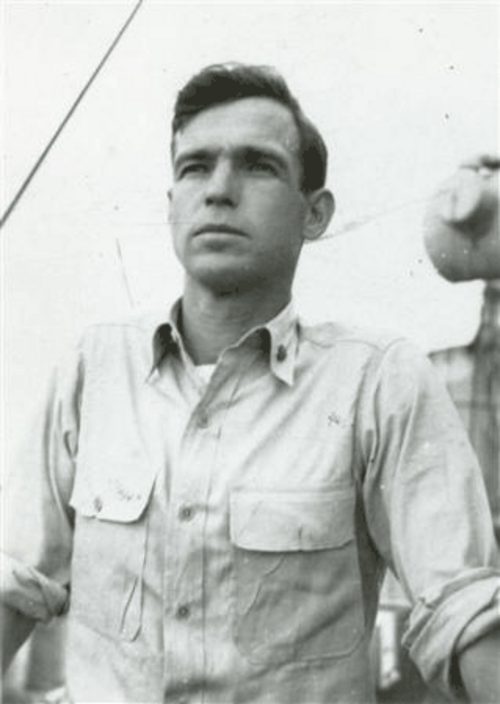
The name is his. The rank is the rank he held that summer: the Navy Register of 1 July 1944 already lists Barry Kennedy Atkins as a commander. The day, 10 October, is the day given by the USS Holder association biography and by the NavSource compilation of commanding officers. It was not re-read from a deck log. A Hartford Courant profile of 7 December 2003, working from a Melvin sailor’s memory, puts him aboard on 2 October instead. The place is the part the records correct. The Holder biography says he assumed command “in the Philippines on 10 October.” The action report of Destroyer Squadron 54, and the Dictionary of American Naval Fighting Ships entry for Melvin, both have the squadron leaving Manus on 11 October to escort the Leyte landing craft. If he took the ship on the 10th, he took her at Manus, in the Admiralties, and he had about a day before she sailed. He did not command Healy, Bailey, or Leary. The ship is the one that identifies him, and the fight that made his name came fifteen nights after he read his orders.
He lived to be ninety-four. He retired a rear admiral on the tombstone promotion the Navy gave a decorated captain, and he was the first to say the rank would do him no good except on the stone. He died in a hospital in Richmond, Virginia, on 15 November 2005.
Origins
He was born on 2 August 1911. That date is on the Navy Register of 1 July 1944, beside his name, and the Hall of Valor page repeats it. The place, where he told it in 2003 and where the later obituaries put it, is Annapolis. His father was a naval officer attending the postgraduate course there. The Register of 1 January 1933 and the Register of 1 July 1938 both list a Captain Arthur Kennedy Atkins, an engineering officer, in the same alphabetical block. The 2003 interview names that man as the father, a Montanan whose profession kept the family moving. The mother’s name in that interview is Frances Griswold Terry, daughter of Nathaniel Matson Terry, a chemistry professor at the Academy, and of Frances Augusta Griswold. The Griswolds, he said, were Old Lyme people, shipbuilders among them. No birth certificate or marriage record was read for this essay. The parentage stands on his own account, corroborated by the father’s name and rank in the registers and by the geography his classmates already knew.
The 1932 Lucky Bag does not name the parents. It does not have to. The sketch is headed “Barry Kennedy Atkins,” nickname “Barry,” appointment “At Large,” which is how a Navy son often came to Annapolis when he was not sponsored by a congressional district. “After sixteen years of restless roaming over the seven seas, Barry once more dropped anchor in his home port.” He had been born in 1911 and he entered the Academy on 14 June 1928, the entry date printed with his name in the 1944 Register. Sixteen years is the whole of his life up to that gate. The sketch sends the roaming to the places he later described to the Courant: “the lazy warmth of Samoa,” “the chill of London’s fogs,” “the roar of New York’s subways,” and then Crabtown, which is Annapolis. In Samoa, he told the reporter, his father had charge of the naval station, and he and his brother rushed fish up from the coral for their mother to paint. In London he went to school in a top hat and a morning coat. The yearbook’s phrase for the schooling is “the ancient Halls of Westminster.” Summers, he said, were mostly in Connecticut, and Old Lyme was the place he thought of as home. The yearbook’s joke is that none of it could “rob the Navy of a rightful son.”
The brother in the interview is “Gris.” The 1933 Register index lists an Ensign Griswold T. Atkins on the line after Barry, and the 1938 Register lists that officer as a lieutenant. The middle name fits the mother’s family. The identification is the natural one, and it is not a birth record. What the yearbook is willing to say about the boy himself is plainer. Water polo had given him a letter and, the sports pages say, All-American mention. He was fourth in league scoring on a team that lost the collegiate title to Pennsylvania, the first such loss since 1928, after beating C.C.N.Y. 46–25, Rutgers 70–33, Columbia 48–9, and Yale 56–13, and losing to the New York Athletic Club and to Penn. He swam well enough for an “N,” played class soccer and class lacrosse, and wore two stripes. In the battalion he was sub-commander of the Eighth Company. The sketch says unlimited energy and a fighting heart put him on the water-polo team, that his “strange maneuvers” bothered opposing backs, and that he was a good man to have in the pool “when a couple of tons of beef are trying to drown you.” The last personal note is social, and it is the only one. Classmates had watched him go from “the reddest of ‘Red Mikes’” — a midshipman who wanted nothing to do with women — to “a devotee of the femmes,” and still “he dreams on of blue skies and is very happy.” There is no class standing in the sketch, and no quotation that can be treated as his own words. The happiness is what they chose to leave on the page.
Formation
He was commissioned ensign on 2 June 1932. The Register of 1 January 1933 gives him that date of rank, signal number 5761, and present duty on the battleship Tennessee. The oral-history catalog at the National Museum of the Pacific War, summarizing interviews he gave on 20 and 21 February 1997, says the same first ship, and adds that he was aboard her at Long Beach during the earthquake of 1933. The catalog then sends him to New Mexico from 1933 to 1936, to the new destroyer Mahan from 1936 to 1938, to the oiler Cuyama from 1938 to 1939, and to the Naval Academy from 1939 to 1941. The Holder association biography, written while he was alive, gives the same sequence and is a little more specific about the jobs: battleships first, then the commissioning crew of Mahan in 1936 — commissioning duty, not command — then a year in what the biography calls the “beef boat navy” on Cuyama, then two years in the Executive Department at the Academy. He told the Courant that he had asked for destroyers. “There was something exciting about destroyers,” he said.
The registers that were actually read catch him at the hinges of that story, not in the middle of every cruise. On 1 July 1938 he is a lieutenant (junior grade), date of rank 2 June 1935, signal number 4632, present duty Cuyama. The body line of the register dropped his name in the optical text and printed a ditto; the index is what ties 4632 to Barry K. Atkins, and the duty on that signal number is the oiler. On 1 July 1941 he is a lieutenant, date of rank 1 August 1939, signal number 4239. The column for the start of his current cruise reads June 1941, and the column for the end of his last sea tour reads May 1939. May 1939 is the month the later accounts have him leaving Cuyama for the Academy. June 1941 is the month the register has him going back to sea. The association biography says he reported on 31 July 1941 to USS Parrott (DD-218), then in overhaul at Cavite. A register dated 1 July cannot record a reporting date of 31 July. The June date and the July date can be orders and arrival, or one of them can be wrong. Both are left standing.
The museum catalog says that on Cuyama he worked at techniques for refueling at sea. That is his later account as the library summarized it. It was not checked against a manual or a report, and it is not repeated here as an invention he owned. What is solid for the peacetime years is the class, the dates of rank through lieutenant, Tennessee at the start of 1933, Cuyama in the summer of 1938, shore time after May 1939, and a new sea cruise ordered for the early summer of 1941. New Mexico and Mahan are in his own later telling and in the association biography. They were not re-read from a register page.
He was married three times. He said so in 2003, and he did not give the first wife’s name. She was a musician, “absorbed in her damn cello,” and her friends were too far to the left for him. He called that marriage a mistake. The second and third, he said, were to wonderful women, and both were dead by the September afternoon when he told it. The Holder biography, in the text that still has him living, calls his wife “the former Muriel Strong” and places the household in Fredericksburg, Virginia. The Los Angeles Times obituary of 21 November 2005 lists the children who survived him and does not list a wife: Sue-Sheila Strong Keener, Lynn Strong Agee, Norman and Ian Atkins, four grandchildren, three great-grandchildren. He had told the Courant he had two sons and two stepdaughters, and that Sue Keener, the stepdaughter from the last marriage, was the one who drove him to reunions and to doctors and kept rice off his plate because he choked on it. The Strong surnames on the daughters’ names in the obituary fit that account. No marriage date, no decree, and no name for the first wife or for the mother of the sons was found. The family he left is the one the obituary counted.
Parrott
Parrott was a flush-deck, four-stack destroyer, commissioned in 1920 and on the Asiatic station since the middle of the 1920s. He joined her, on the association biography’s date, as a lieutenant at the end of July 1941, third officer, gunnery officer, and commissary officer on the side. The overhaul at Cavite ended in October. The ship went back to training and to the sound patrol off the entrance to Manila Bay. Late in November, Admiral Thomas C. Hart scattered the Asiatic Fleet, and Destroyer Division 58, Parrott with it, went to Tarakan in Borneo. When the war began, on 8 December by the time kept on that side of the date line, he was on an old destroyer as far from the Navy he had grown up in as the Navy could send him.
The biography’s account of the next month is the one that can be followed, and it is a ship-association narrative, not the deck log. After dark on 23 January 1942, Parrott and three other four-stackers went for a Japanese landing at Balikpapan. The biography’s count of the enemy is sixteen transports, two light cruisers, twelve modern destroyers, and patrol craft. Beginning about 0230 on the 24th the American destroyers ran up and down the anchorage, fired torpedoes, and then used their four-inch guns. The enemy, the biography says, did not shoot back, apparently taking the attack for submarines. By 0400 the four old ships were leaving at twenty-eight knots. The biography credits Parrott with one transport sunk and a share in another, and the division with four transports and a patrol craft. Those numbers were not re-checked against the action report. The oral-history catalog confirms only that he was aboard for the battle, which it dates 23 January and calls Makassar Strait. The night of the 23rd into the morning of the 24th is the same action. What belongs to him, on the evidence in hand, is that he was the gunnery officer of one of the four ships, not that a particular hull was his kill.
At the end of January, the biography says, Parrott’s captain fleeted up to command Destroyer Division 59, the executive officer took the ship, and Atkins became executive officer and navigator. On the night of 19–20 February the ship was in the Allied attempt against the Bali landing. Her rudder jammed. She touched ground and pulled off. The biography does not say who had the conn, and it does not claim a victory. Most of the Japanese ships had already gone. The Allied force took losses. On 1 March Parrott was at Tjilatjap, on the south coast of Java, with what was left of the ABDA command. The Japanese were already ashore on the northwest of the island. The ships were told to get out and make for Australia on their own. Parrott reached Fremantle. The biography’s count of the cost around her, not aboard her, is five destroyers of the squadron lost in those three months, and other ships with them. She sailed for home in May. In Hawaii, the same biography says, he was promoted to lieutenant commander, and in August he was sent to the Motor Torpedo Boat Squadrons Training Center at Melville, Rhode Island. No register between July 1941 and July 1944 was read for the day of that promotion. The July 1941 Register still has him a lieutenant. The next register in hand, July 1944, has him a commander.
He told the Courant, decades later, that he had lived through hard fights and come out of them second in command of Parrott. He did not, in the interview as printed, talk about the men on the transports at Balikpapan. The hard sentence he was willing to say about killing people came from the barge war, not from this one.
The boats
The official history of the motor torpedo boats, Robert J. Bulkley Jr.’s At Close Quarters, is the spine of the next year. The appendix lists Motor Torpedo Boat Squadron 8 as commissioned on 10 October 1942 and gives Lieutenant Commander Barry K. Atkins as squadron commander from that day until November 1943. The boats were 77-foot Elcos. The Holder biography says he commissioned the squadron at the New York Navy Yard after Melville, that the boats went out on merchant ships to Australia, and that they were then brought up to New Guinea. The museum catalog compresses the same movement differently: New Caledonia in November, operational in New Guinea in December. Bulkley, writing from the records, puts the arrival of Squadron 8 in Milne Bay at the end of February 1943, with Bulkeley’s Squadron 7 and the advance echelon of a base coming in at the same time. The catalog’s November and December are not thrown away. They may be the voyage. They are not the date the boats were fighting. The fighting, in the history, starts in March.
By the night of 3 March he had relieved Lieutenant Baughman in command of the advance base at Tufi, on the north side of the Papuan peninsula, and the Battle of the Bismarck Sea had already been fought in the air. Dispatches said what was left of a Japanese reinforcement of Lae would be within reach of the boats. He had seven boats at Tufi. Commander Mumma came up from Milne Bay with three more. Ten boats went out in three sections to a line across Huon Gulf. Atkins was in PT 143 with Lieutenant (junior grade) John S. Baylis. Two boats of his section hit logs and turned back. At 2310 the 143 and PT 150 found a ship on fire, dead in the water: Oigawa Maru, 6,493 tons, a large fire forward and a smaller one aft, looking abandoned. At 800 yards the 143 put a torpedo into the stern and the ship began to heel. Five minutes later the 150 fired at 700 yards. Other boats fired and missed and, for a while, thought the explosion was theirs. Atkins then sent all three groups farther west. They found heavy seas, rain, and no more ships. The history says that only two ships had still been afloat when the boats arrived, the damaged cargo ship they sank and a destroyer that aircraft finished in the morning.
The next sentences in Bulkley are the ones that sit on the man, because they are not a triumph. On 4 March the planes came back and strafed everything still floating in the gulf. Thousands of Japanese soldiers from the sunken transports were in collapsible boats. For several days the PT boats met those boats and sank them. “It was an unpleasant task,” the history says, “but there was no alternative.” The alternative is implied and not spelled out: if the boats reached shore, the men in them would be the garrison the campaign was trying not to feed. He was the officer who had just been given the advance base. The history does not quote him. Years later, talking about barge patrols rather than about this morning, he told the Courant what the work felt like from the cockpit of a boat. They ran as close inshore as they could, so the barges could not get inside them, close enough to see the surf or the fronds. When a barge came up they closed and shot it up, and the barge shot back. “It was never fun.”
The base at Tufi was the wrong place to do that job from. On 8 April he took Major General Horace H. Fuller of the 41st Infantry Division up the coast in Ensign Dean’s PT 114 and looked at Morobe Harbor, forty miles beyond Cape Ward Hunt. It was empty of the enemy, closer to the gulf by enough to cut more than two hundred miles off a patrol, and the river had deep water under trees that would hide a boat from the air. Mumma looked at it on the 14th. On the 20th Atkins took PT 142, PT 66, and PT 149 up and started the base. From then on Tufi was a fuel stop between Milne Bay and Morobe. The boats lay under the trees. A photograph in the history shows them there.
He was on the boats, not only at the base. On the night of 13–14 May he and Mumma went after a surfaced submarine five miles off Lae, he in PT 152. They fired four torpedoes at 6,000 yards. The submarine stopped and the torpedoes passed ahead. At 4,000 yards another torpedo missed astern. The submarine went under. On the night of 29–30 June, in rain and almost no visibility, PT 142 with Atkins aboard led the first wave of landing craft out of Mort Bay for the landing at Nassau Bay and overshot by about three miles. The craft scattered, frightened of each other. The 142 rounded them up. The troops went ashore at 0130, unopposed, after a second wave had arrived and the surf had begun to broach the boats. On 2 July he was in PT 149 for another lift into the same bay, and the boats strafed two villages on the south side that the Japanese held. The history does not say who was in the villages.
On the night of 28–29 July he was in Lieutenant (junior grade) James W. Emmons’s PT 149, with PT 142, when the two boats ran into thirty or more heavily loaded barges bound from Cape Busching toward Finschhafen. The night was so dark that the boats were in the formation before they knew it. Lights blinked on the port beam and on both quarters. They sank six. Barges tried to ram. One came at the 149 firing 20-millimeter and was sunk at ten feet. One man on the 142 was wounded. Bulkley calls it an unusual action. The Silver Star citation, from Commander Seventh Fleet serial 02378 of 25 November 1943, is the Navy’s sum of the whole tour and not a log of that night. It credits him, as commander of Squadron 8 and as commanding officer of advanced bases from February to October 1943, with numerous hazardous patrols as officer in tactical command, with plans for the nightly missions that “materially reduced” the resupply of enemy positions, and with two occasions on which boats under his immediate command sank eleven hostile ships by gunfire. The citation does not say which two nights, and it does not say that the eleven were all barges. The July night’s six are inside that period. They are not the whole of the eleven, and this essay does not invent the other five.
He also wrote, in the margin of other men’s reports, the sentence that shows he was paying attention to what the enemy was learning. Forwarding an action report in which Ensign Cox’s boats had sunk three barges east of Lae under fire from the beach, he noted that the shore guns, there and at other points, looked like an effort to protect the barge line by fortifying the coast. That is the only comment of his that Bulkley quotes. It is a staff officer’s sentence. It is also the sentence of a man who had been shot at from those beaches.
By the end of October, Squadron 8 had gone to Kana Kopa for overhaul. Soon after, Lieutenant Robert L. Childs relieved him. The appendix dates the relief in November 1943. The Holder biography says he was back in the United States in December and in charge of the PT shakedown detail at Miami, and that he had been on more than seventy combat missions. Seventy is the biography’s number. It is not in the citation, and it was not counted from patrol reports for this essay. The citation’s word is “numerous.” The museum catalog says that in late 1943 he came home and asked for a destroyer. That request is the choice the rest of the war turns on. He had a decoration coming, a reputation in the PT boats, and a stateside job breaking in new ones. He asked to go back to sea in the kind of ship he had wanted as a lieutenant.
The Silver Star was real by the summer of 1944. The Register of 1 July 1944 prints “(E)” after his name, and the register’s own key says “(E)” means the Silver Star. The Hall of Valor text of the citation calls him “Commander [then Lieutenant Commander].” The bracket is that site’s habit. He was a lieutenant commander during the New Guinea months. Whether he was already a commander when the citation was signed on 25 November 1943 is not settled by a register. The association biography puts the promotion to commander in July 1944, which would make the Hall of Valor’s “Commander” the rank at a later date. The 1 July 1944 Register lists him as a commander, so the promotion had happened on or before that day. “In July” may be exact or it may be a rounding. The day was not found.
Fifteen nights
Melvin was a Fletcher, built at Kearny, launched on 17 October 1943, commissioned on 24 November 1943 under Commander Warner R. Edsall. The DANFS narrative, in the HistoryCentral transcription used here, gives her the first half of 1944 under that captain: Pearl Harbor, the Marshalls, Saipan, a submarine and a merchantman in the middle of June, Guam, the Palaus, Ulithi, then Manus to stage for Leyte. That half-year is not his. One copy of the narrative calls the submarine RO-66; the boat Edsall’s Melvin is credited with is RO-36 in the accounts that distinguish the two. Either way it was before Atkins. He inherited a worked-up destroyer with a combat record, a nickname the crew argued about for the rest of their lives — Black Devil for the dark paint, Blue Devil on the models, the veterans telling the Courant that Blue Devil was the mistake — and a squadron that was about to be sent down Surigao Strait in front of the battleships.
The NavSource list, credited to Wolfgang Hechler and Ron Reeves, gives Edsall the ship from commissioning through 10 October 1944 and Atkins from that day through 31 May 1946. The end date is the day Melvin decommissioned, and it collides with the next command. The Holder biography has him detached from Melvin in time to commission Holder on 18 May 1946. A compilation that runs a captain out to the ship’s own decommissioning date is a habit of those lists, not a log of the relief. What the list and the biography agree on is the start.
He told the Courant he had wanted a destroyer command and that he did not have long to learn this one. The sailors who talked to the same reporter remembered the learning as a manner. Ed Hawk, the ship’s doctor, said he knew when to bear down and when to let a thing pass. Curtiss Houghton, a seaman, said the crew called him a cowboy because he brought the ship in like a PT boat, fast, and then stopped her where he meant to stop her. Houghton’s larger claim was that the ship-handling was why he was alive to say it. Hawk told the reporter that Atkins never lost a man from any of his commands. That sentence is a shipmate’s summary, not a casualty roll. It was not audited. The squadron report for the one night that can be checked says no one in Squadron 54 was killed or wounded, and no ship was hit. That is one night.
On 11 October the squadron, less Wadleigh and Norman Scott, left Manus with patrol craft and a long column of landing ships. The action report says they arrived in the transport area off Leyte about 0400 on 20 October. The HistoryCentral copy of DANFS says “soon after midnight 20 December,” which cannot be right: the battle it describes next is the 25th, and the ships had sailed on 11 October. The action report’s 20 October is the date this essay uses. Melvin was in Task Group 79.11, screening the landing at Dulag, and then on anti-submarine stations across the southern end of Leyte Gulf. She was not in the battle plan of the heavy ships. The transports were the reason she was there.
The Japanese Southern Force came anyway. On the afternoon of the 24th, Captain Jesse G. Coward — the name is in Bob Hackett’s tabular record of Fuso; the HyperWar copy of the squadron report is signed only as Commander Destroyer Squadron 54 — asked the commander of the battle line for permission to attack with torpedoes if a surface contact showed to the south, and then to get out of the way. Rear Admiral Jesse Oldendorf approved. The plan Coward put on the voice radio at 2020 was two groups: a western pair, McDermut and Monssen, and an eastern column of three, Remey with the squadron commander, McGowan, and Melvin, in that order. Attack speed thirty knots. Individual targets. Intermediate torpedo speed. After the firing, retire clear of the battleships and then north along the coast. Mertz and McNair would stay on the eastern entrance and keep submarines out of the anchorage. The squadron commander’s assumption, written into the report, was that the enemy was coming for the transports and did not know how many old battleships were waiting at the head of the strait. He expected the column to turn toward the anchorage after it passed Kanihaan Island. He meant to shoot before that turn, and north of the PT boats that were already stationed down the strait.
Atkins had been in boats like those, on the New Guinea coast, until November of the year before. The report for this night counts about thirty of them between Bohol and the mouth of the strait. Their contact reports came up the strait all night: three destroyers and two larger ships at 2310, more contacts after midnight, star shells, a PT attacking a large ship with the result unknown. At 0155 Melvin was told to leave her screening station and fall in astern of McGowan. At 0206 the squadron went to general quarters and lit off all four boilers. At 0225 Coward told the battle line he was starting down. At 0228 he ordered McGowan and Melvin into column on him at 500 yards. At 0242 Melvin’s radar had the enemy at 33,400 yards, two large pips. The eastern column had been illuminated by a searchlight for ten or fifteen seconds at 0258, at about 11,000 yards, before a torpedo was fired. Up to that moment the report says there was no reason to think the Japanese had seen them.
The fire distribution he was given, as the report records the order at 0258, was specific. Remey would take the third ship. McGowan and Melvin would both take the second. The squadron commander had decided the main body was two very large ships, possibly battleships, led by a cruiser. Torpedoes were set to run at six feet, which meant an actual depth of about ten. One hit would not stop a battleship. The order to fire when ready went out at 0259, with the order to make smoke. Between 0300:30 and 0301:30 the eastern column fired. Melvin had one primer failure. Remey had two. The squadron later counted forty-seven Mark 15 torpedoes expended, which is fifty tubes minus those three failures, and twenty-seven of them from the eastern three ships. No gun of Squadron 54 fired. The Japanese searchlight came back on as Remey was firing, and the salvos started. The report says some of them were close enough to throw water on deck, generally right for range and a little off in deflection, and that Remey and Melvin were the ships that reported the close ones. McGowan, behind smoke, did not. The column zig-zagged, made smoke, and went north at whatever speed the boilers would give. At 0303 Coward told Oldendorf, in the sentence the report preserves, “We are being straddled now. We have fired our fish and are retiring to northward.”
Atkins’s own account of those minutes, given to reporters sixty years later, does not match the report in one particular, and the difference matters because it is the decision he wanted remembered. He told the Courant that the range looked too long, that night torpedo attacks on battleships in training had not felt like this, and that he left the column to get closer before the order to fire. The Los Angeles Times, quoting a 2004 Associated Press interview and a 2002 Richmond Times-Dispatch interview, says the same thing: he deviated from the plan, closed the range and improved the angle, and the Fuso was about 10,000 yards off when he fired. The action report does not record Melvin leaving the column. It records her in station astern of McGowan, assigned to the second large ship, firing in the same minute as the other two. A line the Courant attributes to the Naval War College’s tactical analysis cuts the other way: Melvin “was on her correct target, the second of the three larger ships, and was the only one of the above three destroyers which correctly interpreted the target designation order.” That study was not re-read for this essay. If the quotation is accurate, the Navy’s later analysts praised him for firing at the ship he had been told to fire at, not for leaving the formation. Both memories can be partly true — a small change of station that the squadron plot did not bother to record — or the old man can have remembered a decision the paper does not show. This essay does not pick one to flatter him.
What the report does show is the minute after the firing. The eastern ships saw from two to five detonations, not gunfire, at about 0309, which was when their torpedoes should have arrived. Two of the heaviest ships dropped astern. Melvin’s radar, at 0310, showed the enemy’s course changed and a wing destroyer gone. The western pair fired at about 0311 and saw their own detonations at about 0319. The enemy formation came apart. Squadron 54 had no one dead and no hole in a hull. The Japanese had lost the unmolested approach to the gulf. Oldendorf’s battleships did the rest. The endorsements, by Vice Admiral Theodore S. Wilkinson and by the Seventh Fleet, call the attack the first blow, well executed, and a reason the later destroyer attacks and the gun line had an easier target. They do not name Melvin, and they do not name Fuso.
The credit came afterward, and it has never sat still.
DANFS, in the transcription used here, says Melvin scored on Fuso, “which exploded and sank at about 0338.” Hackett’s tabular record, compiled from Japanese-language sources and current through 2003, says one or two of Melvin’s torpedoes hit Fuso on the starboard side amidships at 0309, that she sheered out, reversed course, and made about ten knots, and that around 0345 her magazines exploded and she broke in two. In that account the bow was still afloat to be shot at by Louisville and went down about 0540, and the stern about 0640, with almost none of roughly 1,400 men saved. Atkins told the Times-Dispatch that the argument he remembered was whether one torpedo or two had hit, and that his own theory was one hit in the fuel tanks amidships, because the ship broke in half. He told the Associated Press that Fuso had opened fire, that the shells were getting close, and that he had asked the doctor, “When the heck are those torpedoes going to get there?” The Courant heard a harder version of the same sentence, addressed to the combat information center: “When the hell are our torpedoes going to arrive?” Hawk, in the same profile, remembered a voice calling the fish away by the numbers and then, “Let’s get the hell out of here.” Harlan Johnson, a fire-controlman, remembered the star shells as bright enough to read a newspaper by, and the thought that they had been caught. William A. Robie, the gunnery officer, remembered Atkins chasing salvos, turning toward the last splash so as not to steam into the next one. Houghton said he was shaking, and that he still was when he told it.
Anthony Tully, in a note added in August 2009 to his survey of Japanese wrecks and referring to his book The Battle of Surigao Strait, rejects the magazine explosion and the ship torn into two separately floating pieces. His summary is a torpedo in the forward powder room and a second amidships, a starboard list, speed bleeding off, the bow settling, and then, twenty to forty minutes after the hits, the ship nosing under and heeling over, screws coming clear, a corkscrew descent. A pagoda striking the water, he writes, would mean she may have buckled on the way down. That is not the same event as being blown in half. He does not, in that paragraph, reopen the question of which destroyer fired the torpedoes. The War College line quoted by the Courant, and a note the newspaper got from Commander Jeremy Gillespie at the Naval Historical Center, kept the older claim: Melvin the only one of the three eastern destroyers on the right target, and the only American destroyer of the war that could be said to have sunk a battleship. Gillespie’s e-mail, as the paper printed it, said the claim “appears solid.” It was an opinion in 2003. It is not a finding that survived unchallenged.
The Navy Cross citation, as the Hall of Valor prints it, is more careful than the legend and less careful than the report. Commander Third Amphibious Force serial 00394 of 26 December 1944 recommends the cross for extraordinary heroism as — and here the printed text goes wrong — “Executive Officer” of Melvin, and it calls him “Commander [then Lieutenant].” He was the commanding officer, and he had been a commander since on or before 1 July 1944. The same text spells him Adkins once. Those are transcription errors. The operational sentences match the report: a flanking torpedo attack, star shells, fire, a full salvo timed into the first coordinated blow, a retirement without damage, two Japanese battleships and three destroyers sunk by the force before that force was seriously hit, and his ship’s part called material to the defeat. The citation does not say that his torpedoes alone sank Fuso. The Holder biography’s shorter quotation — extraordinary heroism “in action against major units of the enemy Japanese Fleet,” contributing materially to the defeat — is the part that agrees with the citation’s ending and does not call him the executive officer. The Register of 1 July 1945 prints “(B)” after his name. In that register’s key, “(B)” is the Navy Cross. By the same date “(E)” is still there for the Silver Star. The cross was not a newspaper invention.
He had been aboard fifteen days, if the 10th is the day, or a little over three weeks if the Courant’s 2 October is. Hawk wrote, in a ship history the Courant quotes, that many of the men thought they were going down the strait with little chance of coming back, and that one sailor smoked a last cigarette and shook hands around the circle before he went to his station. Atkins’s contribution, on the paper that was written in November 1944, was to be the captain of the third ship in a column that shot first and came home. The legend that grew up around the third ship was larger than that paper. He spent the rest of his life inside the legend, sometimes pushing it, sometimes stepping back from the people who wanted to use it.
The rest of the ship
The DANFS narrative after the battle is the skeleton of his remaining sea time, with the caution that the copy in hand is a transcription and that the one impossible date in it has already been thrown out. Within forty-eight hours Melvin was on her way to Hollandia and then on resupply convoys back to the Philippines into December. She went down to the Solomons to rehearse the Luzon landing, left Purvis Bay on 25 December with transports, and brought them into Lingayen Gulf on 11 January 1945. For four days she screened, illuminated, and fired in support of the beach. The narrative says she met suicide attackers in the water, in boats, and in aircraft. It does not give him a sentence of his own. The museum catalog says the interviews cover kamikazes off the Philippines and later off Okinawa and Iwo Jima, and a typhoon in December 1944. Typhoon Cobra struck the fast carrier force on 17–18 December. DANFS has Melvin in convoy work and then at Purvis Bay by the 25th. She may have been near bad weather. She is not, on this narrative, one of the ships that were in the typhoon with Halsey. The catalog’s word is not promoted into that disaster.
From Leyte and the Carolines she joined the screen of the fast carriers. On 10 February she went north with them. The planes raided Honshu, then covered the Iwo Jima landings. On 21 February she stood by the damaged Saratoga, fought fires and aircraft with her, and was credited by DANFS with three planes shot down, then escorted the carrier to Eniwetok. The Courant, from a sailor who came aboard after Surigao, remembers Saratoga’s dead as 123 and the sea burials that followed. That number was not re-checked against Saratoga’s report. The picture that is Atkins’s, rather than the carrier’s, is a destroyer captain using the ship the way he had used a PT boat: alongside, in the smoke, shooting at aircraft that were trying to finish a ship already hit.
By the middle of March he was back with the carriers at Ulithi. They sailed on the 14th for the Okinawa campaign. DANFS gives him sixty-one days at sea: screen, gunfire support after the 1 April landing, picket station, a short rest at Ulithi in the middle of May, then the Ryukyus again from the 24th and raids on Kyushu. The Bronze Star, as the Holder biography quotes the citation, is for 14 March to 14 May 1945, and the sentence it preserves is not about a battle line. On 29 April he took Melvin alongside a badly damaged destroyer, with ammunition burning and exploding, fought the fires, and after they were out stayed alongside to give the other ship electrical power and water until she could make her own. The biography does not name the destroyer. Neither does the fragment of the citation. The 1 July 1945 Register does not yet print the Bronze Star symbol, “(G-1),” after his name. The period of the citation runs through 14 May, so an award signed after 1 July would not be in that book. The medal is in the association biography, on his chest in the memory of Holder’s crew, and in the obituaries. The full citation and the name of the ship he lay alongside were not in hand.
There is a harder memory from the same spring or from the months after, and it is his. He told the Courant that he remembered Japanese boats that looked like fishing boats, with only civilians in them, and that Melvin and other destroyers had been ordered to sink them. The reporter does not give a date, a position, or an order number. A sailor remembered survivors in the water who would not look up at the American deck. Atkins said he had no regret, and he pointed at Japanese conduct at Bataan and elsewhere. The essay can record that he said it. It cannot turn a paragraph in a newspaper into an incident with a latitude. It also cannot leave the paragraph out. He was willing, at ninety-two, to describe an order he had carried out against people he believed were not combatants, and to stand by it. That is a different fact from the Navy Cross.
In the middle of June Melvin was at San Pedro Bay. On 1 July she went north again with the carriers for the last raids on Honshu and Hokkaido. DANFS keeps her with them until 10 August, then sends her to Task Force 92 for an anti-shipping sweep and a bombardment of Paramushiro, finished on the 12th. She was at Adak when the surrender came. The new orders were minesweeping off northern Honshu with the occupation force. On 12 October she sailed for home, reached San Francisco on 4 November, and on 31 May 1946 decommissioned at San Diego. If he commissioned Holder on 18 May, he was not on Melvin’s bridge for that last ceremony. The association biography says the Navy sent him to the Eighth Naval District as prospective commanding officer, and that he brought Holder into commission at Orange, Texas, on 18 May 1946. The crew he met there could see the Navy Cross, the Silver Star, and the Bronze Star. The biography says almost none of them knew he had already commanded a destroyer, and that the rumor about PT boats was only a rumor. He did not, on that telling, spend the war story on them.
The biography’s judgment of him as their captain is a shipmate’s, and it has an edge the decorations do not. He was a great teacher. A man who would not learn caught it. He was the best shiphandler most of them had seen. The only anecdote of his temper that a sailor was still carrying fifty years later is small, and it is from Melvin, not from Holder. After the war, in fog, while the ship was helping sweep mines off Japan, a bridge talker named Al Parley reported “a tin can dead ahead.” He meant a metal can, the kind the Navy packed potatoes in. Atkins heard a destroyer, ordered right full rudder, and laid the ship over hard enough to throw men into bulkheads. When he understood, he leaned into Parley and took him apart. Another officer got the sailor off the bridge. At a reunion in 2000 Parley finally asked about it. Atkins told him it had not been worth half a century. Parley then tried to make a public story out of the captain and the battleship. Atkins bristled. He told the Courant that Parley had caught him with his guard down and started asking personal questions, and that he bore it and did not like it. Parley said a session with an old seaman was probably not very interesting to the admiral. The exchange is the character under a light that is not a citation: precise about a helm order, rough on a careless phrase, unwilling to be managed, and, when asked directly, finished with an old grievance.
After
The association biography is the only continuous account of the peacetime career, and it reads like a biography he supplied or approved. It was last modified on the website in 2008, but the prose still has him living in Fredericksburg with Muriel Strong, so the facts in it stop before the Richmond years. After Holder, in August 1947, he went to the United Nations Military Staff Committee. In March 1950 he attended the Fleet Sonar School at Key West, then served as surface operations officer and staff navigator for Carrier Division 16 and for the Atlantic Fleet’s hunter-killer task force. In March 1951, by then a captain, he became chief of staff of the new Carrier Division 14. From December 1952 to July 1955 he was on the staff of the commander of U.S. Naval Forces, Eastern Atlantic and Mediterranean, in London, the city where he had gone to school in a top hat. He then took Winston (AKA-94) at Yokosuka. In August 1956 he fleeted up to Transport Division 32. In April 1957 he took Amphibious Squadron 3 and, with it, the amphibious group in the western Pacific. After a joint exercise with Korean marines he received a letter of commendation from the Korean chief of naval operations. The letter was not read. In January 1958 he came back to Annapolis, in command of the Naval Station and as chief of staff to the Superintendent. On his own request he was transferred to the retired list as a rear admiral on 1 November 1959, twenty-seven years after the ensign’s commission of 2 June 1932.
He explained the rank himself. The Navy let a decorated officer retire one grade up. He called it a tombstone admiral, “because the only good it’ll ever do you is to show up on your tombstone.” The museum catalog’s summary of the 1997 interview shortens the postwar life to the Holder cruise in the Mediterranean and retirement in 1959. The six-month Mediterranean cruise is in that summary. The biography’s August 1947 detachment is the end of the command, not a measurement of how long the cruise was. The two are not in conflict if the cruise was part of the commission, and they were not checked against a log.
The man the Courant found in September 2003 was in the Azalea building of an assisted-living complex outside Richmond. He was a small man, the reporter’s estimate five feet eight and about 120 pounds, with wraparound sunglasses, a walker, nitroglycerin on a cord around his neck, and a fourteen-year-old Maltese named Baby. The room had history books and a stack of Beethoven and Bach. A machine blew print up to the size of a headline because his eyes were going. He disliked the food. He still navigated a strange street by the sun, and he thought it was funny when someone said he had been better at it on the water. He was not interested in a ship named for him. Parley was trying to get one. Atkins said the Navy did not name ships for the living, and he had told an earlier attempt the same thing he told this one: he had never been wounded and he had never been killed. The sentence he wanted on the record, if a ship was the only way Melvin’s crew would be remembered, was grudging. “If the only way we’ll get any credit for what the Melvin did is to have a ship named after me, well then that’s OK by me,” he told the Associated Press in December 2004, as the Times later quoted it. The credit he meant was the battleship. He also said, to the Courant, that he was ready to go. “I’m not looking for longevity or anything of the sort. … I have nothing to really live for.” Sue Keener was the person who kept the practical life running.
He died on Tuesday, 15 November 2005, of natural causes, in a hospital in Richmond. The Los Angeles Times obituary, by Dennis McLellan, ran on 21 November and called him a retired admiral of ninety-four. A family spokesman was the source for the cause and the place. The obituary’s account of Surigao is the legend: the only American destroyer to sink an enemy battleship, nine torpedoes fired and one misfire, the argument about one hit or two, the ship breaking in half. It is accurate to what he believed. It is not the last word on the wreck, and it is not what the squadron report was willing to sign in 1944. Funeral services in Richmond on 17 November, and burial at Arlington on 30 January 2006, are in the biographical sketch circulated with his name on an Arlington cemetery website that could not be retrieved intact for this essay, and they are repeated on the Find a Grave memorial and on Wikipedia. The Times obituary does not give the burial date. The death does not depend on it.
What he left the children named in that obituary was a long life, a famous night, and a father who in old age did not want the publicity and did not take back the orders. The Navy left him the cross, the star, the bronze star the register of July 1945 had not yet caught up with, and a rear admiral’s title he had already reduced to a joke about a stone. No ship was named for him.