Ships
- IJN Takao Captain from 15 August 1941 · Relieved on 23 February 1943
- IJN Musashi Captain from 6 December 1943 · Relieved on 12 August 1944
The characters are not 文治. The Navy’s own sheets, the JACAR name entry, and the Japanese biographical article all print 朝倉豊次, and they read it あさくら ぶんじ. Bunji is that reading. 豊次 can be read other ways. No source used here reads this man Toyotsugu, and none prints 文治. He is not Aruga. Aruga is 有賀幸作, Naval Academy class 45, born in 1897, last captain of Yamato. Asakura is the class before that, born in 1894, and he outlived the war by twenty years. The ships do not overlap.
15 August 1941 is the date the later lists use for the start on Takao. The appointment sheet for 15 August 1941 was not opened. What was read, on the page, is the order that took him off her. On 23 February 1943 the internal appointment gazette still identifies him as Takao’s captain and sends him to the Navy Technical Department. Between those two dates, and after them, the record is much longer than that one date.
Origins
He was born on 6 July 1894. The Japanese article gives the place as Maezawa village, Shimoniikawa county, Toyama prefecture, the district that is now Maezawa in Kurobe city, and it points that sentence at a Kita Nippon Shimbun article of 25 March 2015. That newspaper was not opened. Nishida’s class table gives the same birthday and the prefecture only: Toyama. No birth register was seen. A father’s name was not found. The wife is present in the later family interview only as “mother.” She is not named.
The same article, citing a volume it calls 『朝倉豊次著作集』, says he spent five years at Uozu middle school and sat the examinations for the Naval Academy, the Army Academy (28th class), and two other schools, and passed them all. It adds that the Army Academy result can be checked in the Official Gazette. That gazette was not opened, and the collected writings were not found in the National Diet Library search tried for this essay and were not read. The middle-school years and the four examination passes are the book’s claim, as the article reports it.
What the class compilations agree on is the Naval Academy. He is in the 44th class, graduated 22 November 1916, forty-eighth of ninety-five. Nishida’s table and the Japanese article give the same place in the class. The graduation gazette itself was not opened. Forty-eighth of ninety-five is the middle of the list, not a brilliant exit. The article says that by the time his class was being selected for captain, the second time through, his place among the survivors had risen to thirteenth. That sentence is the article’s. The list it would have to come from was not opened.
Formation
The years from Etajima to the staff are a table, not a life. No letters, no fitness reports, and no photograph with a known photographer were found. Nishida’s class-44 sheet, which matches the service table on the Pacific War Online Encyclopedia almost line for line, is the only continuous account, and it is a private compilation. It is used here where a document later confirms the man, and it is labeled where it does not.
On that sheet he left the academy a midshipman on 22 November 1916 and joined the armored cruiser Yakumo, then the old cruiser Azuma on 17 August 1917. He was commissioned ensign on 1 December 1917. In 1918 he was in the battleship Hizen, a Russian prize, and that December he went to the basic course at gunnery school, then in May 1919 to the basic course at torpedo school. From December 1919 he was a lieutenant junior grade in the destroyer Kiri, then the cruiser Iwate, then the destroyer Nashi. On 1 December 1921 he was an acting division officer in the new battleship Nagato. He was promoted lieutenant on 1 December 1922 and stayed in her as a division officer. A year later he was chief gunnery officer of the destroyer Hakaze, and from December 1925 chief gunnery officer of the submarine tender Jingei. None of those early orders was read off a gazette. They are the shape of a gunnery officer’s apprenticeship, and they should be treated as that until the sheets are opened.
On 1 December 1926 the same table puts him at the Naval Academy as instructor and trainer. He was still borne on the academy in a Showa 3 file, the unclaimed-box list for the enthronement commemorative medal: under 海軍大学校 and the academy, the catalog transcription includes 兵学校 朝倉豊次 among men who had not collected the box. The file is a list of names, not a citation. It does put him at Etajima in the late 1920s, which is where the table already had him.
He was promoted lieutenant commander on 10 December 1928 and entered the Naval Staff College A course. The article says he finished the A course, 28th class, in November 1930. Nishida has him leaving the course on 1 December 1930 for the staff of Destroyer Squadron 2, which is the ordinary next day. From December 1931 he is on the staff of the Second Fleet. From 15 November 1932 he is on the Naval General Staff.
That last step is the first one a document, and not only a table, will carry. On 16 June 1933 the General Staff adjutant asked the Navy Ministry to arrange for the vice chief, Vice Admiral Takahashi Sankichi, and a General Staff officer, Lieutenant Commander Asakura — the sheet writes 朝倉豊次 — to see Army weapons on 21 June while they were inspecting the Mitsubishi aircraft works at Nagoya. The request is in the catalog transcription of JACAR C05022823100. He was a staff lieutenant commander in Takahashi’s orbit, junior enough to be named second, senior enough to be taken along to look at another service’s weapons. In the same year a spectators’ list for the naval review, filed under the 1933 ceremonial papers, puts 朝倉豊次 aboard the battleship Hiei among the officers attending. The rank next to his name is not cleanly given in the short transcription. A January 1933 funeral order for a dead lieutenant names him among the officers designated for the ceremony in Tokyo. These are attendance lists. They are not a portrait.
He was promoted commander on 15 November 1933. Nishida then has him, from 15 November 1934, on the staff of the Combined Fleet and of the First Fleet. The Japanese article is more specific: gunnery staff to Admiral Takahashi Sankichi, who by then was commander in chief of the Combined Fleet and of the First Fleet. The article and the table agree on the headquarters and the date. Only the article says the duty was gunnery. While he held that staff job the February 26 incident broke in Tokyo, on 26 February 1936. The article says he encountered it during the appointment. It does not say where the fleet was, what he did that week, or whether he was ashore. Nothing else found here does either.
On 16 October 1935, still a commander, he was appointed an umpire for that year’s special naval maneuvers. The internal Navy gazette of 18 October, in the catalog transcription of JACAR C12070354900, lists 海軍中佐 朝倉豊次 with Inagaki and others for the duty, and notes that Arima Masafumi and Takagi Sokichi were relieved of the same duty the same day. It is a routine fleet-exercise billet. It is also his name in a gazette, in his own rank, three years before the war.
From 1 December 1936 Nishida has him in the Navy Ministry’s Bureau of Education, sections 2 and 1. A ministry letter of 2 June 1937, answering a query about a visit to the Kenchūfu memorial hall (顕忠府) on 11 June, includes 海軍中佐 朝倉豐次 — the old form of 豊 — on the list of officers who wanted to go. That is JACAR C05110592200, read as catalog text. He was a commander in the education bureau, putting his name down for the visit. There is no remark attached.
On 15 November 1938 the table promotes him captain and parks him at Yokosuka Naval District, the usual holding billet, and on 15 December gives him his first command, the oil tanker Iro (石廊), rated a special-service ship. Combined Fleet’s Iro record gives the same two dates and says that on 1 September 1939 he was reassigned as an instructor at the Naval Academy. The September order was read. Internal appointment gazette, issue 375, 1 September 1939: 石廊特務艦長海軍大佐 朝倉豊次 is appointed supervisor and instructor at the Naval Academy (補海軍兵学校監事兼教官), and Captain Horie Yoshiichiro (堀江義一郎) is appointed to Iro. That is the catalog transcription of JACAR C13072076300. The start of the Iro command, 15 December 1938, is Combined Fleet and Nishida. The end of it is the sheet.
What the Iro movement record does not contain is Honolulu. Between the two captaincy lines the tabular record is blank. The call at Hawaii is a family account, published by Jiji Press on 22 November 2021. His youngest daughter, Ogihara Michi, then 85, of Uji in Kyoto, said that in April 1939, about two years and eight months before the Pearl Harbor attack, he took Iro into Honolulu. Jiji adds that foreign-ministry telegrams and other papers show the American cruiser Astoria in port at the same time, carrying home the remains of Saito Hiroshi, the ambassador who had died in Washington, an unusual gesture by President Roosevelt, and that Asakura went aboard Astoria with diplomats and expressed thanks. Those telegrams were not opened. The grandson, Asakura Takeo, told the same reporter that an album of the call survives in his hands. The album was not seen. The visit is real enough to have left photographs the family still keeps, and it is not in the ship’s published movement table. Until the telegrams or the album are read, April 1939 at Honolulu rests on that interview.
He stayed at the academy, on the September order, as supervisor and instructor. Nishida keeps him there until 25 July 1941, when he is attached to the Second Fleet staff, and then, on 15 August 1941, gives him Takao. The July attachment was not found in a gazette opened here. The August appointment is Combined Fleet, Nishida, and the Japanese article. The sheet for that day was not opened. The next sheet that was opened still calls him her captain.
The war years, as lived
There is a story, printed in the Japanese article and sourced to a 1997 magazine history of the Takao class, that has no gazette behind it in the searches made here. Soon after he joined, the article says, he took Takao out of the Yokosuka dock for trials and collided with the steamer Hokkai Maru. The fault, “it seems,” was Takao’s. He was given twenty days’ confinement. The damage was put at about 280,000 yen in the money of the time. He is said to have finished the confinement aboard, still her captain, and so to have been in command when the war began. A search of the JACAR catalog for his name with the collision, and for the ship with the steamer, returned nothing. The punishment gazette was not found. The magazine was not opened. The article itself hedges. It then wonders whether the punishment is why, in November 1943, classmates junior to him on the telegraph-code list — Kuroshima Kameto, Hayakawa Mikio, Ono Takeji — were made rear admirals and he was not. That “whether” is the article’s. The codes it quotes (his 395 against their 405, 406, and 409) were not checked against the 1943 Navy List. The collision and the twenty days are not established here. They are the only explanation on offer for a delayed flag, and they are not yet a fact.
If the lists are right about 15 August, he had her for eighteen months of the war’s first half, and the ship’s track is the only diary. No deck log in his hand, no signal signed with his name, and no recollection by a Takao survivor were found. What follows is the track Combined Fleet gives for the months the later order proves were his. It should not be read as a record of his decisions.
She was in Vice Admiral Kondo Nobutake’s Second Fleet, Cruiser Division 4, with Atago and Maya. At the start of the war the division covered the landings in Malaya and the Philippines. On 9 and 10 December 1941 Kondo’s ships sortied after the British Force Z and made no contact. Prince of Wales and Repulse were sunk by shore-based naval aircraft off Kuantan, not by his guns. Through January and February the same body covered the move south into the Dutch East Indies. On 1 March 1942, south of Cilacap, the force sank a small Dutch motorship and a British auxiliary minesweeper and took a Dutch steamer. A floatplane from Takao found the Dutch freighter Enggano and set her on fire. The hulk was finished later by other ships. On the night of 2 March Takao and Atago overtook the old American destroyer Pillsbury, misidentified as a light cruiser, and sank her with all hands. On 4 March, with the destroyer Nowaki, they sank the Australian sloop Yarra, a motor minesweeper, the tanker Francol, and the depot ship Anking. Those are the ship’s kills while he was captain. No citation in his name was found, and no order of his was read. He brought her back to Yokosuka on 18 March for a refit.
In May and June 1942 she was sent north, not to Midway. With Maya she joined the Aleutian covering force. On 3 June her floatplanes were bounced by Army P-40s off Umnak; Combined Fleet says two were shot down and two badly damaged. The same day she picked up three survivors of a Navy Catalina shot down by Junyo’s fighters, and held them as prisoners. On 5 June she is credited with a B-17. Through the middle of the month she covered the Attu landing, and she was back at Ominato on 24 June. The three prisoners are a line in a movement record. What was done with them is not in that line.
From August she was in the Solomons. She was at sea northeast of Guadalcanal on 24 August for the Battle of the Eastern Solomons, in Kondo’s force with the carriers, and she was not one of the ships that decided it. She was out again for the Santa Cruz operation in late October. On 15 November 1942, in the second night battle off Guadalcanal, Takao and Atago were in Kondo’s emergency bombardment force with the battleship Kirishima. Combined Fleet’s account, which is a reconstruction and not a log, says the two cruisers hit the American battleship South Dakota with seventeen 8-inch shells and some smaller ones, and that each fired eight torpedoes at Washington, all of which missed. Kirishima and the destroyer Ayanami were sunk. Atago was lightly damaged. Takao was not, in that account, the ship that died. He brought her into Truk on 18 November and sailed for Kure on 22 November for battle-damage repairs. In late January and early February 1943 she was at sea again north of the Solomons, distant cover for the evacuation of Guadalcanal. She was back at Truk on 9 February.
On 23 February 1943 the Navy took him off her. The order is on PDF page 12 of JACAR C13072089800, the February section of the 1943 internal appointment gazette, issue 1058. The catalog transcription of that file stops earlier in the month — it includes, among other things, Aruga’s own transfer — and does not reach this page. The page was read from the image. The printed page is 2000. The issue in the margin is 第千五十八号. In the block closed by 以上二月二十三日海軍省, the small type over his name is 高雄艦長海軍大佐, the name is 朝倉豊次, the parenthetical after the name reads 四四三, and the order is 補海軍艦政本部出仕: appointed to the Navy Technical Department, on the rolls, without a named desk in that line. The next column takes Captain Inoguchi Toshihira (猪口敏平), until then attached to Second Fleet headquarters, and appoints him captain of Takao. The parenthetical in this gazette is the telegraph code, not the academy class. He was class 44. The code on this page is 443. The sheet ends the command on 23 February 1943, and it ends it by making him a captain without a ship.
The article and Nishida fill the next nine months with desks. From 5 March 1943 he is chief of the second section of the Technical Department’s administration bureau. From 27 September he is also chief of a temporary motor-torpedo-boat section. On 1 December he is attached to Combined Fleet headquarters. None of those three orders was opened. The daughter’s memory, in the Jiji interview, sits in this interval and a little before it. She had lived at Etajima from about the age of three to five, which is his academy tour, and in Tokyo after that until she was evacuated in the second grade. She said he almost never talked about the work at home. In 1942 and into the spring of 1943, when the war had turned and he was coming home late, she woke and heard him tell her mother that if it went on much longer it would be difficult, and ask whether they understood the difference in strength. She was on his knee and glad of it. The phrase that stayed was “the difference in strength.” She said she learned only after the surrender, from her mother, that he had meant the difference with the United States. She thought the Honolulu call was why he could say it. Jiji prints this as her recollection, not as a diary. He left no letter, in any source opened here, that says it in his own hand. What he did with the thought, if he had it, was take the next ship.
The date he became captain of Musashi is the one point where a gazette correction and the secondary lists can be put side by side, and they do not quite say the same thing. Combined Fleet dates the appointment 6 December 1943 and calls him her former Takao captain. The Japanese article says December 1943, third captain. The Pacific War encyclopedia says 7 December. The correction that was actually read, in the catalog transcription of JACAR C13072121400, does not name the ship. It says that in issue 1276 the order-date for Rear Admiral Yamada Sadayoshi, Rear Admiral Komura Keizo, and Captain Asakura (朝倉豊次) is corrected from 7 December to 6 December. Komura was the captain he would have been relieving. Musashi’s movement record has Komura in command from 9 June 1943. The correction is why 7 December and 6 December both exist. The uncorrected date is the one the encyclopedia kept. The corrected date is the one Combined Fleet uses. The words “captain of Musashi” are not in the correction. They are in every later list, and in the Inoguchi article’s statement that in August 1944 Inoguchi relieved him as the previous captain. The December order itself, as distinct from the correction of its date, was not found as catalog text and was not read.
If that appointment holds, the ship he was given was the Combined Fleet flagship, and for much of his time in her she was used as a transport. Combined Fleet’s Musashi record, a compilation from diaries, action reports, and decrypted traffic, not a log opened here, has Admiral Koga Mineichi’s flag in her at Truk. On 10 February 1944 she left Truk for Yokosuka with the light cruiser Oyodo, the last Japanese battleship to leave the lagoon before the February carrier raid. At Yokosuka she loaded ammunition, trucks, bombs, torpedoes, and gasoline for Palau, and on 22 February she sailed with about three hundred men of an anti-aircraft unit and other drafts. She made Koror on 29 February. Koga’s flag was moved ashore on 28 March, ahead of an expected air raid. On the afternoon of 29 March, leaving Palau to the north with three heavy cruisers and destroyers, she was hit in the port bow by one of six torpedoes from the submarine Tunny. The hole was about nineteen feet across. The windlass room and the hydrophone compartment flooded. Combined Fleet’s figures are eighteen casualties, seven of them the hydrophone operators killed, and 2,630 tons of water. She cleared at 24 knots. Koga’s staff would not let her return to Palau. She sailed that night for Kure and arrived on 3 April. The seven bodies were taken out of the compartment that evening. On 31 March, while she was on the way home, Koga and his chief of staff, Vice Admiral Fukudome Shigeru, left Palau by flying boat. Both aircraft were lost in a storm off Cebu. Koga was killed. Fukudome was picked up by the Army. Asakura’s next commander in chief, two postings later, was that same Fukudome. Nothing in the record says the two men had met before, or that the March sinking meant anything personal when they shared a staff in 1945.
He was in Kure through April while the bow was repaired and the anti-aircraft battery was multiplied, the 6.1-inch wing turrets coming out, 25-millimeter guns going in, until the compilation counts 115 barrels. On 1 May 1944, still in her on every list that was checked, he was promoted rear admiral. Nishida, Combined Fleet, and the Japanese article all give that day. The promotion gazette was not opened. A later staff roster, discussed below, prints a rank-date of Showa 19, May 1, beside his name and the rank rear admiral. That is the same day, if the digits are a date. It is not the promotion order.
The rest of his time in Musashi is the Mobile Fleet’s summer. On 16 May he is recorded as piped aboard Yamato at Tawi-Tawi for a conference with Vice Admiral Ugaki, commander of Battleship Division 1. On 2 June the two ships fired a long-range offset practice. The next day’s conference, in the same compilation, criticized Musashi’s gunnery officer, Commander Yunoki, for large salvo patterns. The criticism is of the gunnery officer. No source quotes Asakura, or says the rebuke was passed to him in those words. On 10 June he sailed with Yamato for the Kon operation, the attempt to relieve Biak. A destroyer on Musashi’s bow reported Harder’s periscope and the boats dodged torpedoes. During the submarine scare the compilation says Musashi nearly rammed Yamato. At Batjan on 12 June, while fueling, she was grazed by the oiler Genyo Maru and lost two 25-millimeter mounts. Kon was called off the next day because the Marianas had been invaded. On 19 June, in the Battle of the Philippine Sea, Kurita’s van was ahead of Ozawa’s carriers. A friendly fighter formation from the 601st Air Group flew over and was taken for enemy. Takao, no longer his ship, fired recognition starshells. The fleet turned and opened fire. Four Zeros were damaged and one ditched. Combined Fleet says Musashi and Yamato were among the few ships whose lookouts identified the aircraft in time. On the evening of 20 June, covering the damaged carrier Zuiho, Musashi fired main-battery incendiary shells at a formation of Helldivers and claimed two, and her 25-millimeter gunners shot down one of their own Zeros. He brought her to Hashirajima on 24 June and to Kure on 29 June.
In July she was a transport again. With Yamato she embarked men and equipment of the Army’s 49th Division, called at Okinawa, and reached Lingga, south of Singapore, on 16 July. The troops were put into a merchant ship by barge over the next two days. Through the end of July and the first days of August the division exercised off Lingga: gunnery, anti-submarine drills, searchlights. On 2 August another conference again criticized Musashi’s salvo patterns, this time under a new gunnery officer. On 12 August Combined Fleet and the Inoguchi article replace him with Captain Inoguchi Toshihira, the same man who had relieved him in Takao eighteen months earlier. The article cites appointment gazette issue 1565, 12 August 1944, JACAR C13072100600, for Inoguchi’s appointment and names Rear Admiral Asakura as the captain relieved. That file was downloaded. A page of issue 1565 was on the screen. The Musashi lines were not securely read, and they are not quoted from the image. Nishida’s table complicates the hand-over. It dates his attachment to the First Southern Expeditionary Fleet on 2 August 1944, ten days before the movement record takes him out of Musashi, and dates him chief of staff and supply chief of that fleet on 16 August. Both can be true only if the staff order and the captain’s order overlapped, or if one of the dates is wrong. The 2 August and 16 August orders were not opened.
He was not in her when she died. Inoguchi took her to Leyte Gulf. She was sunk in the Sibuyan Sea on 24 October 1944. Inoguchi was killed. Jiji’s 2021 piece, quoting the family, puts the loss about two months after the change of captains. That interval is right if the change was in the middle of August.
The southern commands are ranks and titles, not a narrative. No staff diary, no order he drafted, and no description of how he ran a fleet that no longer had a fleet were found. Nishida’s remaining lines are: 8 January 1945, chief of staff of the 13th Air Fleet and, still, of the First Southern Expeditionary Fleet; 5 February 1945, chief of staff of the new 10th Area Fleet, keeping the other two staffs. The Japanese article on the 10th Area Fleet gives the same 5 February date and cites the appointment gazette of 9 February 1945, orders effective the 5th, JACAR C13072103400. The catalog transcription of that file was opened. It is a fragment of other officers’ orders. His name is not in it. The image was not read page by page. The citation stands as the article’s, not as a line transcribed here.
One roster does name him, and it names the man over him. JACAR C14061157200, filed under the Rempang Island papers of the Second Southern Expeditionary Fleet, is a list of fleet-headquarters officers, warrant officer and above, “as of 8 July.” The transcription does not give the year, and it does not name the fleet in the lines that were transcribed. The commander in chief is Vice Admiral Fukudome Shigeru, telegraph code 58. The chief of staff is Rear Admiral Asakura (朝倉豊次), telegraph code 286. The job title, as the transcription runs it together, is chief of staff, with additional duty as overall commander of a labor or works unit and as head of the maritime transport department. The column headed 現官, if the digits are a rank-date, reads Showa 19, May 1, rear admiral, for him, and Showa 17, November 1, vice admiral, for Fukudome. Fukudome’s promotion to vice admiral was 1 November 1942. The May 1944 flag rank for Asakura is the date every compilation already gave. The roster is the one document in which the two names sit on the same page. Fukudome took the 10th Area Fleet, whose headquarters at Singapore also wore the titles of the 13th Air Fleet and the First Southern Expeditionary Fleet, on 5 February 1945. A list headed 8 July that has him as commander in chief fits July 1945. The sheet itself does not say so.
The Japanese article says he met the surrender on Singapore island in those concurrent staff jobs. Jiji says the same, and then internment. The article’s category list includes “person who became a prisoner,” meaning an Allied prisoner, not a Japanese one.
The cost
The part of the record that is not a ship is a trial.
The Singapore War Crimes Trials project, case 128, “Fukudome Shigeru and others,” was read from the capture archived on 28 November 2020. The case file itself, and the judgment the project links at legal-tools.org, were not opened. What the project summary says is this. The crimes charged were at Nee Soon, Singapore, between February and August 1945 and, for a second count, between July and August 1945. In January 1945 a B-29 was shot down and its crew taken prisoner. In July the destroyer Kamikaze brought in further prisoners from another aircraft. They were held at Seletar. Between February and August the B-29 crew were executed. Between July and August eight Allied prisoners, the crew of a PBY, were also executed. The executions were at the Nee Soon rifle range. The summary says it could not be shown who gave the execution orders. It says the prisoners were under the direct authority of Vice Admiral Imamura Osamu and of Captains Matsuda Gengo and Saito Yakichi. It says Vice Admiral Fukudome, Rear Admiral Asakura, and Commander Ino Eiichi were accessories after the fact, because they tried to suppress and destroy the evidence. After the surrender, the summary says, it was decided the bodies would be dug up and burned.
The court sat at Singapore on 9, 12, 17, 18, 19, 20, 23, and 27 February 1948. The summary’s line for him is: Asakura, Bunji, rear admiral, Japanese military, guilty on both charges, two years’ imprisonment, sentence confirmed. Fukudome received three years, also confirmed. Imamura received eight. The defence counsel was Abe Taro, a Tokyo barrister. The court president was Lieutenant Colonel L. A. Massie.
The Pacific War encyclopedia reduces this to a sentence of two years “for his involvement in the unlawful execution of eight Allied prisoners of war.” That is not what the case summary says. The summary’s eight are the PBY crew, and it describes a separate execution of a B-29 crew. It does not say he ordered either. It says the orders were not traced, and it places him with Fukudome among the men convicted for what was done to the evidence afterward. The summary is a project’s paraphrase, with its own typos, not the charge sheet. Until the judgment is read, the conviction and the two years are as firm as that paraphrase, and the precise legal wording is not.
No source opened here records what he said in court, or whether he said anything.
The dates after the verdict do not arrange themselves into a neat two years. Nishida dates his demobilization 27 March 1948. The Japanese article says he was demobilized in March 1948 and, at the end of that month, provisionally designated under the purge of public officials. The citation is the 1949 list of persons covered by the purge memorandum, page 106, the sheet of regular naval officers provisionally designated on 31 March 1948. That book was not opened. A class designation of regular officers is not the same act as the court’s two years, and it should not be folded into it. Nishida dates his return to Kobe 25 September 1949. The article says the same month and the same port. A two-year sentence confirmed on 27 February 1948, counted from that day, would not expire in September 1949. No warrant, no remission order, and no jail ledger was found. The gap is left as a gap.
After
He went back to Toyama. The article, again citing the 2015 Kita Nippon piece, says that after the merger of Maezawa and its neighbors into Sakurai town he was the town’s assistant mayor and then its education chief, and that when Sakurai was absorbed into Kurobe city he was Kurobe’s first education chief. The municipal records were not opened. The daughter told Jiji that after the return his refrain was that a country which cannot educate the children who will carry the next generation will perish. She was, in 2021, still a nursery-school director. The refrain is hers to report. It was not found written down by him.
The grandson, Asakura Takeo, president of a construction company, told the same reporter that his grandfather was still writing a memoir of the war and of the defeat until just before he died, and offered his own reading of it: a sense of responsibility for the country’s loss, and a wish that there not be another war. That is the grandson’s inference, offered in 2021. The manuscript was not seen. The collected writings cited by the Japanese article were not seen either. If they are the same papers, they did not turn up in the library search tried here.
He died on 27 January 1966. Nishida gives the age as 71, which fits a birth in July 1894. The article leaves the place of death blank. No obituary, no grave, and no will were found.
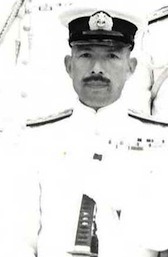
Jiji prints a photograph of him beside a calling card from the Musashi command, supplied by the family. The Japanese article uses a portrait, file name Bunzi Asakura, captioned as the Musashi period. The card and the portrait were not examined.