Ships
- USS Eaton (DD-510) Captain, 23 December 1944 – 5 September 1945
He is not C. R. Brown and he is not James Harvey Brown. He is not Bert Franklin Brown, not W. D. Brown, and not William Butler Brown. Chester F. Brown, an acting pay clerk in the 1 July 1944 Register, file number 396780, is a different officer, and so is Chester Horace Brown, a machinist's mate buried at the same cemetery decades later. No second Chesford Brown turned up in the registers, the directories, or the yearbook.
Those two dates are a compiled commanding-officer list. The same span is printed on NavSource and on uboat.net, which are lists of the same kind. No deck log, war diary, or Dictionary of American Naval Fighting Ships sentence naming him was opened. The dates are kept as the list's dates. They are not narrated as a cruise.
What follows is the life the Register of Commissioned and Warrant Officers, the Navy Directory, the 1928 Lucky Bag, and one cemetery transcription will support. Where they stop, the blank stays in the sentence.
Origins
The Navy's own books give a birthday and almost nothing else that a birth certificate would give. The Register of 1 July 1943, in the lieutenant commanders, prints 15 July 1905 in the date-of-birth column on the line of Chesford Brown, signal number 3405. The Register of 1 July 1944 prints the same day on his line in the commanders. The Register of 1 July 1947 prints 15 July 1905 again. The retired list of 1 January 1950 prints 15 July 1905 again. None of those books prints a town, a county, or a parent's name.
The 1928 Lucky Bag does not print a hometown under his name. It prints "At Large." In that book the line under a man's name is the source of his appointment, the same place where another man's page prints a town. "At Large" is how the Academy listed him, not a city he came from. The Register of 1926, in the midshipmen, puts the same words on him, "At large," with 18 August 1924 as the date beside the name. The Register of 1 July 1943 uses that day as his date of entry, and the footnote on the double dagger is the ensign's commission, not a birthplace.
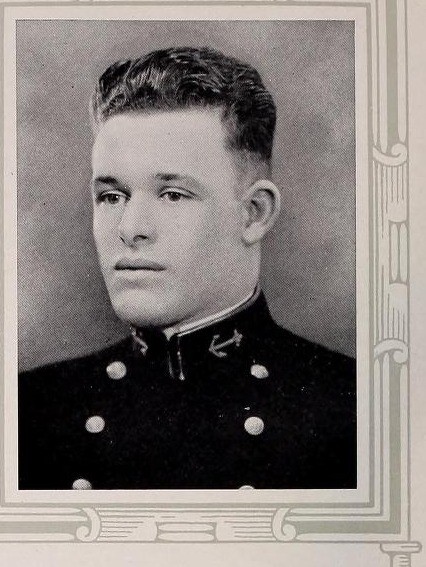
The yearbook is the only page that puts him on a map before Annapolis, and it does it in a sentence that is careful. "His last place of residence being Coronado, California, he made a long and weary journey across the continent to enter the Academy." Last residence is not a birthplace. uboat.net prints "?, California" beside 15 July 1905. That question mark is the website's, and it is not used here. Coronado is used as the yearbook's last address. Where he was born is not in these papers.
The same sketch calls him a Navy junior. "As a Navy Junior he wandered from place to place, and in these wanderings he eventually absorbed enough education to join the ranks of the spoiled and pampered pets." Navy junior, in that book, means a son of the service, a boy moved with a parent's duty. The "spoiled and pampered pets" is the class laughing at itself. The sketch does not name the parent, the rank, or the ships the household followed. No register line read here names a wife or a child. No obituary was found. What he left a household, if he had one, is not in these papers.
The Academy, and the man the class thought he was
He entered the Naval Academy on 18 August 1924, appointed at large. That day is the date of entry on the registers of 1 July 1943 and 1 July 1944, and it is the day beside his name in the 1926 midshipmen list. He was commissioned ensign on 7 June 1928. The Register of 1 July 1943 prints that day as a footnote to the double dagger on his entry date: "Commissioned ensign June 7, 1928." The Register of 1 January 1931 still carries him in the ensigns, date of rank a ditto of 7 June 1928, the date printed on the class above him. The Register of 1 July 1947 uses 7 June 1928 as his pay-entry base date. He is of the class of 1928. The Lucky Bag of that class is the book that shows what the four years felt like to the men who lived them with him. It is classmate prose, written to be remembered, and it should be read that way.
They called him Ched. The sketch says he "endured many trials and tribulations in attaining his goal," and then it makes the Navy-junior wandering the explanation of how he got enough schooling to get in. The journey from Coronado is "long and weary." That is the class's picture of a boy who had no single town to stand for him, crossing the country to a school that would give him one.
As a plebe, they wrote, "Ched was perfect in our estimation and succeeded in getting through the year with only minor injuries." The injuries are the yearbook's joke and its claim. No conduct report and no medical report was opened. They did not call him an all-American. They did call him "a good Lacrosse man." The credit line under the sketch does not list lacrosse. It lists class swimming in the youngster year and class water polo in the youngster year. The prose and the credit line do not match, and this essay does not pick a winner. Both are what the class printed.
The academic departments, they said, took the rest of his time. "Owing to the Academic Departments, much of his time is spent in reading." That is not a class standing. No order-of-merit number was recovered cleanly from the annual registers. It is the class saying he was not a man who floated. At the card table they were surer. "In bridge he is one of the skilled members of our class and has few superiors."
The sentence they wanted kept is the one about the temper. "But 'Ched' is what we all know as a good friend. He gripes some but usually finishes up with a smile and decides the Navy is pretty fair after all." That is 1928, before any of the ships below. It is the only picture of him under a small pressure that anybody wrote down and that was found. He complained, and then he stayed. The later Navy, which kept his ranks and his stations and did not keep his voice, never improved on it.
The long apprenticeship
The first directory that names him as an officer is 1 January 1929. He is an ensign on USS New Mexico. He is still an ensign on New Mexico on 1 January 1930 and on 1 July 1930. The ship is a battleship. The directories do not say what he did aboard her, and this essay does not invent a billet. On 1 October 1930 the directory moves him, still an ensign, to the Sixteenth Naval District, and names no ship. By the Register of 1 January 1931 he is an ensign, date of rank 7 June 1928, and his present duty is USS Tulsa. On 1 January 1932 the directory has him as lieutenant (junior grade), still on Tulsa. The day he left the ensign's rank was not copied off a register line read here. It falls between those two dates. uboat.net prints 7 June 1931. That day was not taken from a register opened for this essay, and it is not used.
Tulsa was a gunboat. The directories do not say what the months felt like. They do say he was there long enough to change a rank on her.
On 1 January 1933 he is a lieutenant (junior grade) on USS Pecos, an oiler. On 1 April 1933 he is a lieutenant (junior grade) on USS Nevada, a battleship. On 1 April 1934, on 1 October 1934, and on 1 January 1935 he is a lieutenant (junior grade) on USS Ramapo, another oiler. The pattern is the Navy's, not a story he told: a battleship, a district, a gunboat, an oiler, a battleship, an oiler. No fitness report was opened. No letter says whether he asked for engineering or was sent.
By 1 October 1935 the directory has taken him off Ramapo and put him at the Naval Academy as an instructor, still a lieutenant (junior grade). He is there on 1 April 1936. The Register of 1 July 1936 indexes him as lieutenant (junior grade). The annual register of the Academy for the academic year 1936–37 prints his name in a list of officers. The optical text of that list is two columns smashed together, and it is not used for a department or a rank. The directories are the clean source, and they say instructor.
His permanent lieutenant's date of rank is 1 November 1936. That day is the permanent-status date on his line in the registers of 1 July 1943, 1 July 1944, and 1 July 1947. On 1 January 1937 and on 1 April 1937 the directory calls him lieutenant, still an instructor at the Academy. The promotion and the teaching overlap. The books do not say what he taught.
By 1 July 1943 the Register gives him two special-course numbers, 22-f and 32, and they are still on his line on 1 July 1944. In that register's own key, 22-f is a completed postgraduate course in naval engineering, operating, and 32 is a completed course in chemical warfare. The numbers are qualifications, not orders to a battle. The year he finished either course was not found. The directories of his Academy years say instructor, not postgraduate student, so the teaching tour is not turned into a student tour. The chemical-warfare course is not turned into a story about gas. It is a line in a key.
The destroyer, and the war the books do not tell
On 1 January 1938 the directory puts him, a lieutenant, on USS Maury, and it adds the word the Navy used for the engineer officer: eng. He is lieutenant, Maury, engineer, on 1 January 1939, on 1 June 1940, and on 1 November 1940. Maury was a destroyer. The directories do not say which watches, which breakdowns, or which men. They say the billet was the engines, and that he held it across three years that ended as the country was already choosing a war.
The directory of 1 April 1941 has a line for Lieutenant Chesford Brown on a ship the optical text reads as "Maurw." The rest of the line is smashed. "Maurw" is the same ship the cleaner lines call Maury, and it is read that way, with the damage stated. The billet word is not readable on that page. It is not asserted that he was still the engineer in April 1941. It is asserted that the directory still had a Lieutenant Chesford Brown on that ship.
Then the public directories stop. There is no Navy Directory station for him in 1942, 1943, 1944, or 1945 in the set that was read. The wartime registers drop the present-duty column. From the spring of 1941 until a compiled list puts him on Eaton in December 1944, his war is a blank of ships. Maury fought in that blank. This essay does not put him on her bridge, or in her engine room, for Pearl Harbor or for anything after the damaged April 1941 line. A man can leave a ship in a month. The books do not say whether he did.
What the registers do keep is the climb of temporary rank, which was the wartime Navy's way of making lieutenants into commanding officers without changing the permanent list.
On 1 July 1943 he is in the lieutenant commanders. His temporary-rank date is a ditto. The date it dittos, at the top of that block, is 15 June 1942. His permanent rank on the same line is lieutenant, date of rank 1 November 1936. Birth 15 July 1905. Entry 18 August 1924. Special courses 22-f and 32.
On 1 July 1944 he is in the commanders, signal 3115, file number 62018. The index of that register calls him commander. The courses are still 22-f and 32. The permanent date of rank is still 1 November 1936. Birth and entry are unchanged. The temporary-rank date on his line is again a ditto. The last explicit temporary-rank date read above him on that page is 15 October 1942. If the ditto holds, the Register of 1 July 1944 dates his temporary commander's rank from 15 October 1942. That does not sit easily with the Register of 1 July 1943, which still had him in the lieutenant commanders. A ditto can hide a new date the eye missed, and a later register can print a date the earlier one had not yet accepted. The 15 October 1942 day is therefore not used as a settled fact. What is settled is that by 1 July 1944 the Navy listed him as a commander, and that on 1 July 1945 the index still listed him as a commander.
The compiled list gives him Eaton from 23 December 1944 to 5 September 1945, which is inside the months when the registers call him commander and before the captain's date below. Eaton was a destroyer, DD-510. No log was read for a change of command, a night action, a grounding, a letter of censure, or a letter of praise. It is not a deck log. What Eaton did in those eight and a half months is not told here as his cruise, because nothing opened for this essay puts his hand on it.
No award citation was found. The lines of the registers that were read do not print a decoration beside his name. That is not a finding that he received none. It is a finding that none was on the pages used.
The only sentence about his character under pressure remains the yearbook's: he griped, and then he decided the Navy was pretty fair. The war, which is where that habit would have cost something or saved something, left no letter.
The captain's date, and the retired list
On 1 July 1947 he is in the captains. The permanent-status columns still say lieutenant, 1 November 1936. The temporary date of rank is 15 November 1945, the same day printed on the men immediately above and below him, a block of the list and not a private anniversary. Birth 15 July 1905. Pay-entry base date 7 June 1928. He had been a permanent lieutenant for almost eleven years. The wartime temporary ranks had carried him from lieutenant commander to commander to captain. The permanent rank had not moved. That is how the temporary system was built. It is not, on these pages, a board's opinion of him.
He did not stay. The retired list in the Register of 1 January 1950 prints Chesford Brown, rank rear admiral, date retired 1 August 1947, date of birth 15 July 1905. The notes column on that line is 4. The legend in the same register says that 4 means "Date of rank as captain." The date in the date-of-rank column is 15 November 1945, which is the temporary captain's date already read on the 1 July 1947 list. The rear-admiral grade is what the retired list prints. The legend says the date beside it is the captain's date, not a date of rank as rear admiral. No separate rear-admiral date was read. The line does not print the statute. Note O in that register's retirement legend is the note for an officer advanced on the retired list for a special commendation in combat. His line, as read, carries 4, not O. A combat commendation is not inferred. He is not described as having served on active duty as a rear admiral. The retirement date printed later is 1 August 1947. He was forty-two.
Why the retired rank is rear admiral, if the note only identifies a captain's date, is not answered by the line. The blank is left.
What survived, and the grave the transcription gives
No wife is named. No child is named. No house, no town after Coronado, no letter to a son, no second career. The directories stop. The registers keep a rank. The cemetery transcription is the last date.
Interment.net's compilation of Fort Rosecrans National Cemetery, Point Loma, San Diego, prints: Brown, Chesford, born 15 July 1905, died 23 January 1953, R/ADM USN, plot N 384, buried 27 January 1953. The page marks that record with an asterisk. The page says an asterisk means the record has not been verified as accurate by the Department of Veterans Affairs. The birth date is the register's date, to the day. The rank is the retired list's rank. The name is not a common one. The identification is strong, and the transcription is still starred. No death certificate and no San Diego obituary were opened. Place of death is not the same thing as place of burial, and the transcription does not give a place of death. Cause is not given. He would have been forty-seven.
The class had said he finished a gripe with a smile and stayed in the Navy. He stayed until the temporary ranks had made him a captain and the retired list had made him a rear admiral, and then he lived five and a half years that these papers do not describe. What survived of him, in the sources that could be read, is the birthday, the appointment at large, the Coronado sentence, the engineer billet on Maury, the permanent lieutenant's date that never moved, the captain's date of 15 November 1945, the retirement of 1 August 1947, and a starred line in a cemetery index. The war he was in the Navy to fight is the part that did not survive in a form that can be told without inventing it.