Ships
- USS Prichett (DD-561) Captain, 25 October 1944 – 20 May 1945
He is none of those other men, and he is not Harold Gardiner Bowen. The registers support the name, the navy, and a command of that destroyer in the Okinawa spring of 1945. They also show that by the summer of 1945 the Navy was already listing him as a captain. The October and May dates are a commanding-officer list, not a deck log. What follows is the life the registers, the Navy Directory, the Academy yearbook, the ship's history, and one award citation will support. Where they stop, or where they disagree, the blank stays in the sentence.
Origins
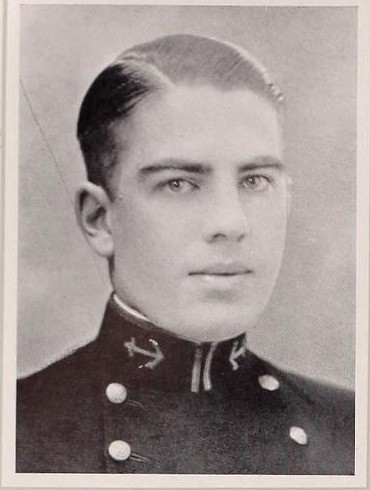
He came to the Naval Academy from Provincetown, Massachusetts. The 1928 Lucky Bag heads his page with that town, spelled in the optical text as "Province-town," and with the nicknames "Bow" and "Clarence." The same optical text prints his middle name as Mathesen. Every Navy Register read for this essay prints Matheson: 1 July 1935, the 1939 register, the 1941 register, and the registers of 1943, 1 July 1944, 1 July 1945, and 1 January 1958. Matheson is the spelling used here. The yearbook page itself was not opened as an image, so the one-letter difference is an optical reading, not a second man.
The Register of 1 July 1944 and the Register of 1 July 1945 both put a birth date on his line, after the dittos in the rank columns: 1 August 1906. The 1 January 1958 register, in the line captains' list, stacks the digits 8, 01, 06 under date of birth on the line of Bowley, Clarence Matheson. The month is spelled out in 1944 and 1945. Those are the books followed. The registers do not print a town beside the day. Provincetown is the home a midshipman claimed. It is not, by itself, a birthplace.
A Provincetown house history says that by 1910 the mansard-roofed house at 12 Center Street was the Bowley family's, and that his father was Commander George W. Bowley, a superintendent in the Life-Saving Service. The Annual Report of the United States Coast Guard for the fiscal year ended 30 June 1922 lists a District Superintendent George W. Bowley, United States Coast Guard, as present at a board in Washington. That report does not mention a son, a wife, or Provincetown. No birth record, marriage record, or obituary was found that ties the district superintendent to the midshipman. The relationship is what the house history says. It is not a line in the Navy Register.
Nothing read here names a mother, brothers, sisters, a wife, or a child. The Lucky Bag says that for four years he "held faithfully to the same ideals — and incidentally to the same young lady." The young lady is not named. The sketch does not say he married her. No later directory, register, or citation prints a next of kin. That is a blank, not a conclusion that he died without a family.
Formation
He entered the Naval Academy on 23 August 1924. The registers of 1 July 1944 and 1 July 1945 print that day as his date of entry, on the same line as the birth date. He is in the Lucky Bag of the class of 1928. The Navy Directory of 1 January 1928, issued before graduation, does not list him. The Directory of 1 January 1929 lists him as an ensign. A class footnote in the 1941 register records that ensigns of the cohort marked with that note were commissioned on 7 June 1928. His own later register lines do not reprint that day beside his name. Seven June 1928 is the class date, not a date set in type on his personal line in the books that were read. He was an ensign by New Year's Day 1929.
The yearbook is classmate prose, written to be clever, and it should be read that way. "Bow came to us late in Plebe Summer and it took him a year and a half and a re-exam to catch up with the Math Department." The sketch says he learned, and that he learned something else: the less worried a man looked in class, the better the daily marks. It calls him "positively one of the most active men at the Naval Academy" and then says his activities belied it. The Executive Department, and "Henry Ortland's well known squad," kept him "plugging away." The credit line is short. Submarine squad in the last three years of his course, and class soccer as a plebe. No stripes. No varsity letter. The registers do not give his class standing. They do not say he was turned back. He finished with the class whose book he is in.
The sentences his classmates wanted kept are not about marks. "Clarence in love is as steady as we've yet found in the Navy." As a roommate he had "all the virtues possible — the same brand of cigarettes — same size collar." "He's the kind of a man a fellow stays a friend of and we all want him with us on board ship." The tag they put in his mouth, "How was Mrs. Feetlebaum — H'm — so dun't esk," is a joke in dialect. It is not a record of what he said. They also made him a Republican who could not appreciate Al Smith, and then took it back: as a political enemy he made a good friend. The politics are the yearbook's. The thing that can be checked is the thin record under the joke. He was late, he failed mathematics once and passed it, he stayed with one girl for four years, and the men who lived with him asked to have him on a ship.
The registers add two courses, not dated. In the key printed in the registers of 1939, 1941, and 1944, qualification 22-f is a completed postgraduate course in naval engineering (operating). Qualification 32 is a completed course in chemical warfare. Both numbers are on his line by the Register of 1 July 1935, and they are still there in 1941, 1943, 1944, and 1945. He does not carry the number for "qualified in submarines." The Academy submarine squad and the chemical-warfare course are different things. The books do not say where the engineering course was taught, or whether he asked for it. They do say that before he was a lieutenant he had finished the operating engineer's course. That is the schooling behind the billet he held later, engineer officer of a destroyer.
The sea duty that can be dated comes from the Navy Directory, which is a snapshot of orders, not a cruise.
On 1 January 1929 he was an ensign on Utah. The ship's roster in that directory places Ensign C. M. Bowley under the Utah heading. On 1 January 1930 the alphabetical directory still has him an ensign on Utah. Utah was then the battleship BB-31, not yet the target ship she became. The directories do not give his billet. They do not say he made any particular cruise. They keep a new ensign on a battleship across two New Year's Days. He was not her captain. He was an ensign.
On 1 January 1931 he was an ensign on Barry. On 1 January 1932 he was a lieutenant (junior grade) on Barry. The ship's roster in both of those directories places him under the Barry heading. This is the destroyer of that name then in commission, DD-248, not a later Barry. The lieutenant (junior grade) rank falls between the two directories: ensign on 1 January 1931, lieutenant (junior grade) on 1 January 1932. No register line with the exact day of that promotion was recovered. A secondary list says 7 June 1931, three years after the class commissioning day. That day was not found printed beside his name. It is not used here.
On 1 January 1933 the alphabetical directory has him a lieutenant (junior grade) on Herbert. The ship's roster in the same volume is scrambled in the block for Destroyer Division 9. A heading for Herbert is followed by a heading for Hale and then by a list of officers that includes Lieutenant (junior grade) C. M. Bowley, with Commander E. S. Stone as commander of the division and Lieutenant Commander H. K. Fenn in command of the ship whose list it is. Because the columns are broken, that roster is not used to move him from Herbert to Hale. The alphabetical line is the one followed: Herbert. She was a destroyer, DD-160. The directory does not say what he did on board.
By 1 July 1934 the ship's roster of the directory has him a lieutenant (junior grade) under the Pensacola heading. The alphabetical pages of that volume did not yield a second line; the roster is the evidence for that date. On 1 January 1935 the alphabetical directory is plain: Lieutenant (junior grade) Clarence M. Bowley, USS Pensacola. The 1941 Register, in the column headed date of expiration of the last cruise or tour of sea service, prints "June 35" on his line. If that column is his, he left sea duty around June 1935. Pensacola (CA-24) was a heavy cruiser. The directories do not give his billet on her, and they do not say he was in any action. A lieutenant (junior grade) on a treaty cruiser, after a battleship and two destroyers, was learning somebody else's ship. The books do not say he had yet commanded anything.
On 1 January 1936 he was a lieutenant (junior grade), instructor, at the Naval Academy. On 1 January 1937 he was still there, still a lieutenant (junior grade). On 1 April 1937 he was still an instructor at Annapolis. The 1941 Register prints, in the column for the date his present cruise or shore duty began, 25 July 1937. The next directory that names a ship is 1 January 1938: lieutenant, USS Arizona. The July date fits a man leaving the Academy in the summer of 1937 and being at sea by the new year. It is a column on a register page, not a set of orders. The ship's roster of 1 January 1938 places Lieutenant C. M. Bowley on Arizona (BB-39), well down a list that begins with Captain A. W. Brown in command and Commander F. S. Craven as executive officer. He was a lieutenant on a battleship. He was not her captain, and he was not on her four years later.
The lieutenant's rank is printed. In the 1941 Register, lieutenants' section, signal 3349, Clarence Matheson Bowley, qualifications 22-f and 32, date of rank 1 December 1936. The same day sits in the date-of-rank column of the 1939 register's lieutenant pages near his name, in a block the optical text does not keep perfectly straight; the 1941 line is the clean one. He had been a lieutenant (junior grade) on 1 April 1937 and was a lieutenant on 1 January 1938. First December 1936 is inside that bracket.
On 1 January 1939 he was a lieutenant on MacDonough, engineer officer. On 1 June 1940 he was still her engineer officer. On 1 April 1941 the alphabetical directory says lieutenant, USS MacDonough, and the ship's roster is more exact: Lieutenant Commander Raymond D. Tarbuck commanding, Lieutenant C. M. Bowley, executive officer. MacDonough (DD-351) was a Farragut-class destroyer, commissioned in 1935, not the earlier ships of that name. The engineering course on his register line and the "eng" on the 1939 and 1940 directory lines are the same trade. By the spring of 1941 he had moved from the engineer's desk to the executive officer's. That is the last station the Navy Directory records. The series ends there.
The war, as the paper has it
From 1 April 1941 until the autumn of 1944 there is no directory and, in the registers examined, no station. Wartime registers dropped the ship. No letter, no fitness report, and no deck-log signature from those months was found.
MacDonough was at Pearl Harbor on 7 December 1941. Whether her executive officer of April was still aboard in December is not established by any source read for this essay. He may have stayed, gone to a school, or gone to another ship. The books do not say where he was when the war began, or where he was for the next three years. That silence is the largest hole in the life.
The ranks across the hole are printed.
On 1 July 1943 the Register places him in the lieutenant commanders' list, which in that book is a list of temporary rank. Signal 3037, Clarence Matheson Bowley, qualifications 22-f and 32, the rank dates dittoed. The index calls him a lieutenant commander. He was not yet, on that date, a commander.
On 1 July 1944 the Register places him in the commanders' list. The index reads "Bowley, Clarence M., Cdr." The section opens with a temporary rank of 15 September 1942 for an older officer, and his own temporary-rank field is a ditto. That opening date cannot be his. A man who was still a lieutenant commander on 1 July 1943 was not a commander in September 1942. Neighboring lines carry explicit dates in the spring and summer of 1942; those sit where the permanent lieutenant commander's date belongs, and they were not read as his promotion to commander. What the two registers do establish is the bracket. Lieutenant commander on 1 July 1943. Commander on 1 July 1944. The day in between was not recovered.
NavSource, crediting Wolfgang Hechler and Ron Reeves, lists Commander Clarence Matheson Bowley from 25 October 1944 to 20 May 1945, between Cecil Thilman Caufield and John Frederick Miller, Jr. uboat.net prints the same dates and calls the rank temporary commander. Neither site is a deck log. The Dictionary of American Naval Fighting Ships does not name him. The dates stay a list until something stronger is cited, and something stronger exists for only part of the span.
Prichett (DD-561), a Fletcher-class destroyer, had been commissioned on 15 January 1944 at Seattle, with Commander Cecil T. Caufield in command. The ship's history, the public-domain DANFS text as reproduced in the Wikipedia article that says it incorporates DANFS — the Navy's own DANFS page did not open — has her in the Marianas in June and July 1944, then with the fast carriers through the Palaus, the Philippines, and Formosa. Off Formosa, between 12 and 15 October 1944, a unit of Task Group 38.4 fired on her by mistake, and she went to Manus for repairs. If the list date is right, that shell was not his. He would have taken a ship already repaired, or still repairing, and already a veteran. The history does not say who signed for her at the change of command.
What the same history gives the ship, after Manus, is the work of the winter and the early spring: back to Ulithi, strikes on Luzon and the Visayas, support of the fighting on Leyte at the end of November, the Mindoro landings in December, a sortie from Ulithi on 30 December, strikes on Luzon and Formosa, a run into the South China Sea, Okinawa, then Ulithi again, and on 10 February 1945 the raid on the industrial plants of Honshu. She covered the landings on Iwo Jima on 19 February and stayed in the Iwo Jima–Chichi Jima area, with Task Unit 52.2.5, until 9 March. She was at Ulithi on 12 March to prepare for Okinawa. None of those sentences names her captain. They are the ship's movements during the months the lists assign to him. They are not a log of his decisions. A sailor's son, writing years later about his own father, remembered Prichett in Typhoon Cobra in December 1944, heeled over until she nearly lay on her side. DANFS, in the text that was read, does not describe that storm for this ship. The memory is not used as a cruise.
Okinawa is different, because a citation puts his name on it.
Attached to Task Force 54, Prichett arrived off the island on 25 March 1945, covered minesweeping and underwater demolition work, fired on Kerama Retto, joined the demonstration against southern Okinawa on 1 April, and then screened transports off the Hagushi beaches. Just after 0100 on 3 April the air attacks began. At 0142, the ship's history says, two aircraft closed her. The first veered off. The second pressed in and dropped a 500-pound bomb on the fantail. It exploded close under the counter, holed her below the waterline, flooded her aft, and started a fire in a 20-millimeter clipping room. She kept a speed above 28 knots to hold the flooding down, got the fire under control, stayed in the area, and kept off other planes until she was relieved shortly before noon. She went to Kerama Retto for emergency repairs, sailed for Guam on 7 April, and was back on radar-picket duty off Okinawa on 7 May.
The citation that names him is known from reprints, not from the original order. Hall of Valor and Home of Heroes both print it, and both give the authority as Commander Destroyers, Pacific Fleet, serial 04160, of 25 November 1945. The magazine page, if there was one, was not seen. The serial itself was not seen. The text those sites agree on is this. The President presented the Navy Cross to Captain Clarence Matheson Bowley, service number given as 0-62015, for service as commanding officer of Prichett and as commander of Destroyer Division 48, during operations against enemy forces near Okinawa from 1 April 1945 to 23 June 1945. On 3 April his ship was under heavy air attack for more than three hours. By courage, skill, and determination he caused her to drive off the attacks, destroy three enemy planes, and damage others. The ship was severely damaged. He continued to fight so that further damage was prevented, and he caused damage control that let her stay on her mission until she was relieved.
The file number 0-62015 is in that reprint. In the 1944 register's alphabetical index the digits 62015 appear in the broken column beside the Bowley and Bowlin lines. The alignment is not clean enough to prove the number from the register. It is left as what the citation reprints say.
Read against the ship's history, the citation and the DANFS account are the same morning told from two desks. The history has the clock, the bomb, the hole, the fire, the speed, and the relief before noon. The citation has the captain, three planes, a fight of more than three hours, and the decision to stay until relieved. Neither document says where he stood, what he said, or who was killed. No casualty list with his signature was found. The Navy's judgment, months later, was that the morning was his: he kept a damaged destroyer in the fight and on the station she had been given.
He is in the captains' list of the Register of 1 July 1945. Signal 2406, Clarence Matheson Bowley, qualifications 22-f and 32, birth 1 August 1906, entry 23 August 1924. The captains' block opens, for Robert Edgar Braddy, Jr., with temporary rank dated 20 March 1945 and permanent status lieutenant commander. Bowley's temporary rank, permanent rank, and permanent date of rank are dittos. The ditto is not a date set beside his name, and the optical columns in that block drop and add "do" often enough that 20 March 1945 should not be treated as proved for him. What is proved is the section. On 1 July 1944 he was a commander. On 1 July 1945 he was carried as a captain, with the permanent rank in that block still the lieutenant commander's. The Navy Cross citation, written in November, styles him captain for the Okinawa period. Both can be true if he was promoted during the command. The day of the promotion was not nailed down.
The end of the command is a conflict, not a date.
The same compilations that start him on 25 October 1944 end him on 20 May 1945 and start Lieutenant Commander John Frederick Miller, Jr., that day. Miller's Legion of Merit, as pasted into a family compilation of Prichett papers, says he was commanding officer from 20 May 1945 to 21 June 1945, on radar-picket duty, and that the ship destroyed planes without casualty to herself. Bowley's Navy Cross, in the reprints, calls him commanding officer, and commander of Destroyer Division 48, from 1 April through 23 June. The two citations overlap from 20 May to 21 June if both are read literally. One way to read them is that he left the ship about 20 May and remained division commander into June, while Miller had the destroyer. The Bowley citation does not say that. It says he was commanding officer across the whole period. Miller's citation says Miller was commanding officer from 20 May. No deck log was found to decide it. The July night, when a kamikaze exploded alongside Prichett as she stood by the sinking Callaghan, is dated 29 July 1945 in DANFS. That is after both citations' windows for Bowley as commanding officer, and after the list date. It is not narrated as his.
A Navy Unit Commendation for the ship, signed for the President by James Forrestal and transcribed in the same family compilation, covers radar-picket duty from 24 March to 7 April 1945 and again from 8 May to 13 August, including the night of 29–30 July beside Callaghan. If he was her captain on 3 April, and back aboard after 7 May until about 20 May, part of that commendation is the crew he commanded. The commendation is the ship's. It does not name him. The later weeks of it are another man's command, if the Miller citation is right.
One document has to be kept off his name entirely. "Dad and the Prichett," written by a child of Bill Lucking and saved with the research for this essay, is a son's memory of a sailor who worked in the combat information center, relied on a man named Venturino, and said that he and "the captain" agreed not to fire on civilians swimming off Saipan. Saipan was June 1944, before the listed start of Bowley's command. The same memoir puts its father in a whaleboat on the night Callaghan was sunk, which is July 1945, after the listed end. The father hated moonlit nights, the son wrote, because the ship was a sitting duck. That sentence is about a CIC sailor's household, not about the captain's. The Navy Cross text was pasted onto the end of the memoir. It is not evidence that the anecdotes are Bowley's.
Cost
The cost that can be documented is the ship, not a private grief.
On 3 April 1945 he was the man the Navy later held responsible for a destroyer with her stern blown open, taking water, on fire, still shooting, still on an invasion screen, for hours, until someone relieved her. The citation's word is "severely damaged." The history's words are a hole below the waterline, flooding aft, and a fire in the clipping room. She was not sunk. She was out of the operation for about a month, under repair at Guam, and then sent back to the picket line. What that morning cost the men in the after part of the ship is not in any report that was opened. The citation does not list the dead. It lists planes and a ship that remained.
The other cost is the one the paper will not price. Four years at Annapolis he kept to one young woman, and then the record never names her again. No wife, no child, no letter home, no obituary saying who survived him, turned up in the sources read. A local history says he sold the Center Street house about fourteen years before a death it places in 1988, which would be about 1974, and that by his death the house was a guest house. That is a change of ownership in a blog, not a will. If he left anyone the house, or left anyone the story of 3 April, the Navy's printed record does not say so. The classmates who wanted him on a ship are the last people who described his character in words that were not a citation.
There is also the cost of the missing years. A lieutenant who was executive officer of a Pacific destroyer in April 1941 disappears from the station lists until a commander appears on Prichett in a list dated October 1944. Whatever he did in the interval — and a war was fought in it — is not a story that can be told from the books in hand. Inventing it would be a worse failure than leaving it blank.
After
He remained a captain. The Register of 1 January 1958 lists him among the line captains: Bowley, Clarence Matheson, source code and year group reading as the Naval Academy class of 1928, designator 1100, the unrestricted line. The date-of-present-rank digits on that line can be read as 25 March 1945, which is five days off the 20 March 1945 ditto at the head of the 1945 captains' block. The 1958 columns are broken into single digits. Neither day is used as a proved promotion date. The fact used is the rank. He was a line captain on the active list on 1 January 1958.
He is not in the active registers of 1 January 1959, 1960, 1961, 1962, 1966, or 1970, under this name. Other Bowleys are: George Andrew and Frederick Charles. They are different men. His absence after 1958 means he was no longer on the active list that those books print. It does not print a retirement day, and the retired list was not found in a form that named him.
Secondary compilations say he retired as a rear admiral on 1 July 1958. Hall of Valor's biographical line says he retired as a rear admiral. uboat.net says rear admiral, retired, 1 July 1958, and adds a death on 30 December 1988 at Dennis, Massachusetts, at the age of eighty-two. The Provincetown house history says rear admiral, and says he died in 1988, without a day or a town. No retirement order, no tombstone photograph, and no obituary were opened. The 1958 register still has him a captain. A tombstone promotion on retirement would explain a rear admiral's title that was never an active-duty rank. That is a possible reading of the conflict. It is not a document. The flag rank and the death day are reported as what those secondary pages say. They are not used as proved.
The same secondary pages say he commissioned the destroyer leader Norfolk (DL-1) on 4 March 1953. Wikipedia's article on Norfolk says she was commissioned that day with Captain Clarence Matheson Bowley in command, and marks the sentence "citation needed." uboat.net repeats it and points at Wikipedia. NavSource's commanding-officer list gives him the ship from 1 March 1953 to 9 October 1954. The DANFS page for Norfolk did not open. No commissioning program, no newspaper, and no Navy Directory of the 1950s was found with his name on her. He was a captain in those years, which is the rank a ship of that size would have. The command itself is not treated as proved. Her later career as an Atlantic flagship is not narrated. If he had her, the books read here do not say what he did with her.
No second decoration, besides the Navy Cross, was found under his name. The 1 July 1945 register's own note says distinctions are those recorded through 1 May 1945. The Navy Cross order is dated 25 November 1945, so its absence from that register is what one would expect. He is not in that register with a parenthetical award mark on his name.