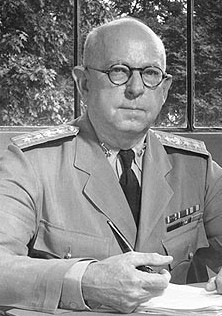
Ships
- USS Conway (DD-507) Captain, 16 October 1943 – 1 May 1944
The Navy Department Library's modern biographical-file list does not treat Harold Gardiner Bowen as one man. It keeps three files apart: Bowdey, George Hall, 1886–1975; Bowen, Harold Gardiner, 1883–1965; Bowen, Harold Gardiner, Jr., 1912–2000. He is not George Hall Bowdey. The question is which Bowen had the destroyer.
The registers answer by rank and by date of birth, not by a deck log. On 1 July 1943, 1 July 1944, and 1 July 1945, Harold Gardiner Bowen, born 6 November 1883, entered 8 June 1901, is a rear admiral, marked for engineering duty only, with the postgraduate course in mechanical engineering. On those same dates Harold Gardiner Bowen, Jr., born 15 October 1912, entered 15 July 1929, is a lieutenant commander and then a commander, a line officer of the class of 1933, with Spanish and the postgraduate course in ordnance engineering (metallurgy). A rear admiral on engineering duty is not the commander of Conway. No source read for this essay puts the father on that ship. The compiled lists that do name a commanding officer for those dates name the son, and they put the junior back on him. The short forms leave the junior off. This account does not. It also does not pretend the junior was printed where it was not.
What holds is the navy, the ship, and the rough season. Conway is a Fletcher-class destroyer, and the Dictionary of American Naval Fighting Ships has her in the Solomons from the return out of overhaul in October 1943 until 4 May 1944. What does not hold cleanly is the rank, the last day, and the man's presence in the ship's own history. DANFS commissions her on 9 October 1942 with Commander N. S. Prime in command and never prints another captain. NavSource's compiled list gives CDR Harold Gardiner Bowen, Jr., the ship from 16 October 1943 to 1 May 1944, and calls him later a vice admiral. uboat.net gives the same man, as a temporary lieutenant commander, from 16 October 1943 to 25 May 1944, and cites that NavSource page, which does not say 25 May. Tin Can Sailors' Conway page says "Cdr. Harold C. Bowen, Jr.," took command on 16 October 1943. The middle initial is not his. No deck log and no war diary were in hand. The father is not a candidate for the bridge. The son is the only officer the rank, the age, and the compiled lists will bear. The proof that he was the man who relieved Prime on the sixteenth, and the proof of the day he was relieved, are not in a log read here.
He had already been written, under the junior, as the compiled predecessor of John Henry Besson on this same ship. That account had to leave the May seam open, because DANFS names neither of them. The seam is still open.
Origins
The older man is the one the bare name fits first, and he has to be set down so he can be set aside. The Register of 1 July 1943 prints Harold Gardiner Bowen with birth 6 November 1883 and entry 8 June 1901, qualifications 4 and 22, engineering duty only and mechanical engineering, and the marks (I) and (X): a special letter of commendation for war service, and an additional number in grade. The Register of 1 July 1945 prints the same birth, the same entry, the same qualifications, and the same two marks, and still lists him among the rear admirals. The Register of 1 July 1936, in the Navy Department roster, calls him Rear Admiral, Engineer in Chief, Chief of the Bureau of Engineering. The Navy Directory of 1 April 1934 and of 1 January 1935 has him a captain, assistant chief of that bureau. The directories of 1 January 1937, 1 September 1937, 1 January 1938, and 1 January 1939 have him rear admiral, engineer in chief and chief of the bureau. By the directory of 1 November 1940, and again on 1 April 1941, he is rear admiral, director of the Naval Research Laboratory at Anacostia, and technical aide to the Secretary of the Navy. Hall of Valor's citation for his Navy Distinguished Service Medal, which that site attaches to the father and not the son, describes ten years as chief of the Bureau of Engineering, chief of the Naval Research Laboratory, special assistant to the Secretary, and chief of the Office of Research and Inventions: propulsion machinery, radar, and the running of munitions plants. That is a Washington war. It is not a destroyer in the Solomons. Hall of Valor also says he was Naval Academy class of 1905 and that his home was Rhode Island. The class year is that site's. The entry date in the register is the Navy's.
The son was born on 15 October 1912. The date is not a classmate's recollection. It is on his line in the Register of 1 July 1943, signal 4122, and again on 1 July 1944, signal 4393, and again on 1 July 1945, signal 3761. The registers do not give a town. The Lucky Bag of 1933 prints, under HAROLD GARDINER BOWEN, JR., the line "Suisun, California." In that book the line under the name is the home the class used, not a sentence that says he was born there. Hall of Valor says he was born in Annapolis, Maryland. The Washington Post obituary, in the portion fetched for this essay, does not reach a birthplace. Suisun and Annapolis are both left standing. Suisun is the yearbook. Annapolis is a compiled decorations site. Neither is a birth certificate.
He was a Navy junior in the yearbook's own words, and the registers make the phrase concrete. On 1 January 1933, when the midshipman list gives him to California and dates his entry 15 July 1929, his father is already a captain and assistant chief of the Bureau of Engineering. The son came into the Academy from a house the Navy was already running. The yearbook does not name the father, the mother, or a school before Annapolis. It says he had learned enough of sea life, as a Navy junior, to leave what it calls the sunshine of California. The rest of the sketch is the voice of a roommate or a classmate, written to be remembered, and it should be read as that. They called him Hal and Mercury. He had worn a star on the full-dress collar since he arrived, through a youngster year in which the Steam Department, they said, tried to founder him on blueprints. He ran, slept when he could, did what had to be done in the least time, and explained the work to men who were often at the trees. They said the pursuit of the ladies had not been fruitless, that letters kept coming to his side of the room, and that he seemed to like Rhode Island, especially Providence, and they added "we wonder why?" They also said that when he went to sea his ship should keep off the rocks, but that he would have to watch the grin that always played around his mouth. The activities line under the sketch is Track 4, 3, 2, 1; Cross Country 2, 1; Basketball 4, 3; Glee Club 3, 2; Musical Clubs Show 3, 2; Star 4, 3, 2, 1; one stripe. The team chapters mention a runner named Bowen in the two-mile and, at West Virginia, a Bowen who finished seventh and was the third Navy man. Those sentences do not print an initial. Robert Oliver Bowen was in the same class. The signed claim is the line under Harold's own sketch.
The grin, the star, and the one stripe are the whole character the classmates were willing to write down. There is no letter of his from Bancroft Hall, and no conduct record was read. What the star means, in that book, is that the Navy junior kept the academic mark for four years. What the one stripe means is that he was not a cadet officer of any higher grade. The class book does not say whether he wanted the stripe he did not get.
Formation
The Register of 1 January 1933 still has him a midshipman. The next firm rank in a book read here is ensign. The Navy Directory of 1 April 1934 lists Harold G. Bowen, Jr., ensign, USS New Orleans, and the ship's own roster in that directory lists Ens. H. G. Bowen, Jr., among her officers. The directory of 1 January 1935 lists him the same way, ensign in New Orleans, and again in the wardroom. She was a new heavy cruiser. His billet on her is not in these pages, and her later war is not his story. The point of the two directories is that the first sea duty the Navy printed for him was an ensign's duty in her, not a staff job in his father's bureau.
On 1 April 1936 the directory's alphabetical list, in a bad optical reading that is still readable, places ENS Harold G. Bowen, Jr., at the Massachusetts Institute of Technology in Cambridge. The Register of 1 July 1936 indexes him as an ensign. The directory of 1 January 1937 has him a lieutenant (junior grade) in USS Balch. So does 1 September 1937, 1 January 1938, and 1 January 1939, and the wardroom lists in those books put Lt. (jg) H. G. Bowen, Jr., in her. The Register of 1 July 1938 lists him among the lieutenants (junior grade), signal 4826, qualification 5-b, Spanish, with duty in Balch. The date-of-rank field on his line is a ditto. The officer above him shows 1 June 1936. If the ditto means what ditto marks usually mean, that is his date as lieutenant (junior grade). The July 1936 register still indexing him as an ensign does not sit easily beside a 1 June 1936 promotion, and this essay does not force the day. What is solid is the ship and the grade across four directories and one register: from the start of 1937 through the start of 1939 he was a jaygee in the destroyer Balch. Balch's cruise is not retold. No log was opened to see whether he was the engineer, the gun boss, or the communicator. The directory only says he was aboard.
By 1 July 1940 the Register has moved him into the lieutenants, signal 4585, still with 5-b, and with the mark (Y), subject to examination and confirmation. The Navy Directory of 1 November 1940 lists him a lieutenant, instructor at the Naval Academy. The directory of 1 April 1941 lists the same duty. His father, in those same two directories, is at the Research Laboratory in Anacostia, aide to the Secretary for technical matters. The son is teaching midshipmen. The registers do not say what he taught.
The Register of 1 July 1942 still has him a lieutenant, and it is the first of these books to add 26-d to the Spanish: completed postgraduate course in ordnance engineering (metallurgy). The April 1936 directory had him at MIT. The July 1942 register has the completed course. Nothing read here says the Cambridge duty was that course, or says where he finished it, or says when. The metallurgy mark is simply on him before the war's middle year. It is the schooling of a gunnery and steel man, not the mechanical-engineering mark his father had carried since the 1920s. The careers had already split. The documents do not say that either man chose the split, or that the son was getting out from under a famous name. They say only where each one was ordered.
On 1 July 1943 he is a lieutenant commander. His temporary-rank date is not printed as his own digits. It is three dittos under Robert Bowman Madden, whose line in that book shows 1 October 1942, permanent rank lieutenant, permanent date 1 July 1940, then birth and entry. Bowen's own digits, after the dittos, are birth 15 October 1912 and entry 15 July 1929. Read that way, he had been a temporary lieutenant commander since 1 October 1942 and a lieutenant since 1 July 1940. The 1 July 1940 book already has him in the lieutenant section, so the grade is right even if a ditto is a fragile way to date it. File number, from the 1944 index, is 72395. That number is the one Hall of Valor later prints as NSN 0-72395.
Between the April 1941 directory and 16 October 1943 there is no duty station in any book read here. The metallurgy course was done by July 1942. Where he was for the fifteen months after that, and where he was when the Pacific war came to him, the registers do not say. The first dated job that can be put against his name after the Academy is the compiled list's.
The war, as the dates allow it
If the compiled list and NavSource are right about the day, he relieved Prime on 16 October 1943. He was then, on the July books on either side of that month, a lieutenant commander, not a commander. The compiled list's navy line says Commander. NavSource says CDR for the whole tour, including the October he took her. uboat.net says temporary lieutenant commander for the tour and temporary commander from 1 January 1944, which is a date this essay has to come back to, because the Navy's own July 1944 book does not yet agree with it. Tin Can Sailors' "Harold C. Bowen" is not used.
DANFS, which never says his name, brings Conway back from overhaul in the Fiji Islands and at Sydney "in October 1943," and then dates her. On 27 October she took part in the initial landings in the Treasury Islands, and then in landings on Choiseul. She supported the landings at Bougainville on 29 October, the day DANFS prints, and until 10 February 1944 she stayed in support of the troops ashore there, escorting reinforcement convoys and firing on shore targets. Between 11 and 17 February she was in the landings on Green Island, and then she went back to the Bougainville work. Between 28 February and 17 March she bombarded targets in New Britain and New Ireland by day and searched for enemy shipping by night in the waters off those islands. Until 4 May she stayed in the Solomons on escort, patrol, and exercises with cruisers. On 8 May, at Majuro, she joined the Fifth Fleet. She sailed from Majuro on 14 May.
That is the ship's chapter, not a captain's diary. If he had her from 16 October, the overhaul was Prime's or was already over, and the first operation with a date, Treasury Islands on the twenty-seventh, was his. Choiseul, the long Bougainville support, Green Island, the night searches off New Britain and New Ireland, and the escort and cruiser exercises down to the first days of May were inside the compiled list's window. DANFS's "29 October" for the Bougainville landings is the date in that text. It was not checked against a log. The ship's association page adds a Betty shot down on 17 November and a repair period alongside Medusa in early December. That page already misnames him. Those two details are not used as fact.
What the itinerary describes, if he was the captain of it, is seven months of a destroyer working close to an army that was trying to stay ashore. Reinforcement convoys, shore fire, a diversionary landing, a new landing at Green Island, then the shift from the beach to hunting ships at night off the next islands, then the duller and not safer work of escort and patrol while the Solomons campaign ran down. DANFS gives him none of the decisions. It does not say whether Conway was hit, whether she lost men, or whether her captain was commended for any one of those nights. The only decoration the registers attach to him inside the war is the mark (H-1) on the Register of 1 July 1944, and still on 1 July 1945. In the 1944 book's own key, (H-1) is a special letter of commendation, with authority to wear the commendation ribbon. The letter was not found. It may have been for Conway. It may have been for the unnamed duty before Conway. By 1 July 1944 the compiled list's tour was over, so the ribbon was on the record within about two months of the compiled relief, or it was older than the ship. There is no way, in the sources read here, to know which.
The end of the tour is the argument already left open for Besson. The compiled list and NavSource relieve Bowen on 1 May 1944 and give Besson the ship that day. uboat.net relieves him on 25 May and cites the page that says 1 May. DANFS has Conway still in the Solomons until 4 May and at Majuro on 8 May. If the first pair is right, he left her in the last of the Solomons work, and Majuro, the sailing, and everything after belonged to the next captain. If uboat.net is right, Majuro and the 14 May departure were still his, and the Marianas were not, because Saipan is 15 June in DANFS and both compiled lists have Besson in command long before that. No log decides it. This essay does not take the ship past the disagreement. Saipan, Guam, Tinian, Leyte, and the rest of Conway's famous war are not his on any of the dates in hand. Prime's war before 16 October is not his either. Rennell Island, the rescue of Chicago's men, Kula Gulf, New Georgia, Vella Lavella: DANFS puts all of that before the overhaul, and the compiled lists put all of that under Prime.
On 1 July 1944, six weeks after the compiled list's relief date, the Register still lists him among the lieutenant commanders, with the same ditto chain back to 1 October 1942, the same permanent lieutenancy of 1 July 1940, and the new (H-1). On 1 July 1945 the Register lists him among the commanders. The temporary-rank date on that page is again a ditto, and the first explicit date the chain runs back to, on Easton Seville Noble's line, is 1 January 1944. Permanent rank is still lieutenant, and the permanent date the chain still carries is 1 July 1940. If that 1 January 1944 is really his date as temporary commander, the July 1944 book is late, or the July 1945 ditto is wrong, or the Navy dated the rank backward after the book of record had already closed. The two registers cannot both be a plain statement of the rank he held in the spring of 1944. The compiled list's "Commander" matches the 1945 book and the compiled lists. It does not match the 1943 book or the 1944 book. For the night he would have taken Conway, the rank the Navy had printed and had not yet revised was lieutenant commander.
Nothing in his hand was found from those months. No letter, no endorsement, no action report with his signature. The grin the classmates told him to watch is not in a war diary. The only pressure the documents put on him in 1943 and 1944 is the pressure of the itinerary itself, and even that is pressure on the ship. Whether he slept, whether he was afraid off New Ireland, whether the commendation ribbon was the Navy's word for one of those bombardments, is not written down in anything read here. That absence is the cost the file will actually support. Men were ashore on Bougainville, and a destroyer was told to keep them supplied and to shoot at the shore. If he was her captain, that was his work. The Navy's ship history did not think his name was part of the story.
uboat.net also lists him in command of USS Samuel N. Moore (DD-747) from 28 July 1945 to 10 May 1946. That is a compiled page. It was not traced to a log, and the Moore DANFS was not read. The compiled list does not have the ship. The war ended two weeks after the date that page gives him her. If the date is real, he was a destroyer captain at the surrender and into the first winter of the peace, and the registers' July 1945 rank of commander would fit the start of it. It is not narrated here, because a weak list is not a cruise.
What remained
The war did not end his sea time, and the one moment under fire that a citation actually describes is not a World War II moment. Hall of Valor reprints, as from All Hands of October 1954, a Legion of Merit with Combat "V" to Captain Harold Gardiner Bowen, Jr., for duty as commander of the Wonsan Defense and Blockading Unit, embarked in his flagship Maddox (DD-622), from 27 February 1953 to 15 August 1953. The citation says that on one occasion, under fire from four enemy guns of large caliber in Wonsan harbor, Maddox took a direct hit and many near misses. It says Bowen remained on the bridge and ordered the ship to return the fire until she had to withdraw to attend a critically wounded man, and that the return fire gained one hit on the enemy guns. The magazine page was not seen. The words are the citation as that site prints them. They are the only picture in this whole record of what he did when the ship was hit: he stayed, he shot back, and he took her out when a man's life required it. The classmates had told him to watch his grin. The citation does not mention a grin. It mentions a bridge and a withdrawal he ordered. Between the two descriptions there are twenty years and no private papers.
On 1 January 1956 the Register still has him a captain, line designator 1100, in the same run of 1933 classmates as Raymond Webb Thompson, Jr., Jack Willhoit Roe, and James Stephen Bethea. The digit columns around the name are broken by the optical reading. A date of rank as captain is not claimed off them. Hall of Valor's later citations call him rear admiral and then vice admiral. The dates those ranks began were not found in a register that could be read cleanly. uboat.net prints 1 July 1951 as captain, 1 June 1961 as rear admiral, and 7 July 1967 as vice admiral. Those three days are that site's, and they are not used as fact. What the citations themselves say is enough for the shape of the second career.
A Gold Star in lieu of a second Legion of Merit, which Hall of Valor dates to All Hands of November 1968 and which calls him rear admiral, covers duty as Deputy Chief of Naval Operations (Development) from June 1965 to May 1967, including the chair of the NATO Naval Armaments Group. A Navy Distinguished Service Medal, as vice admiral, covers command of Antisubmarine Warfare Force, Pacific, from July 1967 to November 1969. Inside that citation the Navy also records that from 20 January to 11 April 1969 he was president of the court of inquiry convened by the Commander in Chief, Pacific Fleet, into the boarding and detention of Pueblo (AGER-2). The citation says the performance was flawless and that the country and the Navy then had a complete record of the incident. The Washington Post, in the obituary fetched for this essay, says the same thing in plainer language: in 1969 he presided over the inquiry into the 1968 surrender of the spy ship to North Korea without a shot fired in her own defense. A second Distinguished Service Medal covers November 1969 to October 1972, first as Deputy Assistant Secretary of Defense (Intelligence) and then as Deputy Assistant Secretary of Defense (Resources and Management), over the management of defense intelligence resources. The Post says he had been deputy chief of naval operations for research and development and had commanded the Pacific antisubmarine force. It says he died of cancer on 17 August 2000, at home in Alexandria, at eighty-seven.
The father, in the retired section of the 1 January 1956 Register, is a vice admiral on the retired list, file 5745 beside the son's 72395. The library's file closes the father's years at 1965. The day and the place of that death were not opened for this essay. The two lives stay apart to the end of the files: one vice admiral who spent the Second World War on engineering, radar, and research, and one vice admiral who spent the Solomons, if the compiled dates are right, on a destroyer's bridge, and who spent 1969 sitting in judgment on a ship that had given itself up.
What he left a family is the thinnest part of the record. The Post paragraphs actually retrieved name no wife and no child. A genealogy forum quotes what it says is the rest of that obituary: a wife, Constance Baker Bowen, dead in 1999 after sixty-one years, and daughters, one of them already dead. That quotation was not reopened in the paper itself. A compiled marriage index says he married Constance Kathryn Baker in 1938. Neither is used here as fact. The yearbook's letters from "some femme," and its wink at Providence, are not a marriage. No will was found. If the forum is quoting the Post accurately, he died a widower and a father. If it is not, the public file closes on a rank, a cancer, and a house in Alexandria. The commendation ribbon of 1944, the Korean Legion of Merit, the later Legion and the two Distinguished Service Medals, are what the Navy counted. They are not a measure of what the Solomons cost the men on Conway, and they are not a measure of what the Pueblo court cost him. The citation is proud of the record he produced. It does not say whether he slept after it.