Ships
- USS Pensacola (CA-24) Captain, 16 June 1936 – 6 December 1937
Captain, on the command line, is both a rank he did hold and the billet. He is not Harold Gardiner Bowen, and he is not Harold Gardiner Bowen, Jr. The Navy Department Library's modern biographical-file list keeps the three men apart: Bowdey, George Hall, 1886–1975; Bowen, Harold Gardiner, 1883–1965; Bowen, Harold Gardiner, Jr., 1912–2000. In the Navy Directories of the 1920s the two older men sit on adjacent lines, Bowdey in Naval Operations or in a ship, Bowen as aide and fleet engineer and later as chief of the Bureau of Engineering.
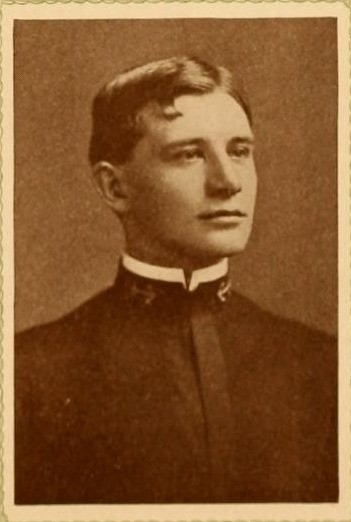
The Lucky Bag of 1907 prints George Hall Bowdey, over "Pittsburg, Pa." The Register of Commissioned and Warrant Officers prints "George Hall Bowdey." The Navy Directory often shortens him to George H. or G. H. Those are the Directory's abbreviations, not a correction. A younger officer, George W. Bowdey, Naval Reserve, appears in the directories of 1 July 1940 and 1 April 1941 as an ensign in Nashville. He is not this man.
Pittsburgh, and the boy who watched the bulletin board
The Academy knew him as a Pittsburgh boy, spelled Pittsburg, the form the city still used. The Evening Star of 13 June 1906, listing the "star" midshipmen, those who had averaged 85 or over for the year, put George H. Bowdey of Pittsburg, Pa., fourth among the thirteen stars in a class of 265 that was then becoming the first class. His mark for the year was 210.39, behind Gardner L. Caskey, Philip G. Lauman, and John B. Rhodes, and just ahead of Albert C. Read. The same paper, on 17 December 1908, printed the Navy Department's merit roll of the first section of the class of 1907 "at final graduation." Sixth on that list is George Hall Bowdey, Pittsburg, after Albert Cushing Read and before Ralph Trowbridge Hanson. The two lists are not the same measurement. One is a year's academic stars. The other is the order at the end. Both put him near the top, and both send him home to Pittsburgh. Neither is a birth certificate.
The birth date has to come from a later book, and it does not come clean. The Register of 1947, on the retired commodores' page, prints a line the clearest optical reading renders as birth 8 September 1886 and as entry into the service 7 September 1903. A second look at the same digits has wavered between the 8th and the 9th of September. The entry date does not waver, and it fits: a midshipman who reported in September 1903 graduated, in the ordinary four-year course, with the class of 1907. The Navy Department Library's file list gives the years 1886–1975 and nothing finer. No city directory, no baptismal line, and no obituary were found that would fix the day or the state of birth. Pittsburgh is where the Academy and the Star placed him. It is not yet proved to be where he was born.
The Lucky Bag of 1907, the class's own book, is the only portrait of him before the Navy started moving him by signal number. It calls him Bill, Hog-Face, and Bowditch, and it hangs under the nicknames a couplet about a man who would not assert, in a peremptory tone, that the nose on his face was his own. The jest is the yearbook's. The record under it is plainer. "Buzzard (1); Star (3, 2, 1); Santee (3)." Star for third-class, second-class, and first-class years matches the newspaper. Buzzard, in that book's shorthand, is a class mark he shared with a great many classmates; the volume never stops to define it, and this essay will not invent a definition. Santee was the Academy's old disciplinary hulk, and a "Santee" with a class year beside it is the Lucky Bag's usual way of saying a midshipman had been sent there. The book does not say for what. There is no conduct sheet here to turn the joke into an offense.
The sketch that follows is classmate prose, which means it is a roast with a memory inside it. "Was quite a lamb when we first saw him, but has since acquired a blustering voice and a tyrannical frown highly useful in terrifying instructors. An excited scrutinizer of the bulletin boards when marks are posted and then sings 'Soaked Again' with much pathos. Spent several sleepless nights youngster year after the temporary loss of a very large and beautiful photograph. Can give forty-four reasons why he didn't get a P.O. the first term Second Class year and forty-four more why he got the black hook instead of three stripes, second term." The last sentences of the sketch are smashed in the digital text and are not used. What survives is a boy who had been mild, who learned a voice that worked on instructors, who cared enough about a photograph to lose sleep over it, and who could argue, at comic length, about the stripes he did not get. His roommate, in the sketch of Charles Churchill Slayton of Springfield, Ohio, is given one line: "Roomed with Bowdey — and still alive and kicking." A cruise ballad later in the same book has "Bill Bowdey" and a slush pot and a grease that would not come. That is doggerel. It is not a deck log.
He was good at the work and noisy about the marks. The Navy kept the first fact. The second is only in the yearbook, and the yearbook is not a fitness report. Nothing later, no letter, no diary, no quoted wardroom remark, says whether the bluster stayed or whether the photograph was of anyone who mattered. The file goes official, and the face goes away.
Olongapo, and the war that is not in the books read here
On 31 May 1914, by the Register of 1 January 1915, Lieutenant George Hall Bowdey, signal number 762, was aide to the commandant and inspection officer at the Naval Station, Olongapo. The station's own page in that Register names the commandant, Captain Benjamin Tappan, and under him "Lieutenant George H. Bowdey, Aid to Commandant and Inspection Officer." The same line gives 12 September 1912 as the expiration of his last cruise or tour of sea service. That sea tour had already been over for twenty months when he reported to Olongapo, and for more than two years when the Register went to press. The ship it had been is not named. He was a lieutenant in the grade list, not an ensign. The aide's job at Olongapo, on Subic Bay, was inspection and the commandant's business. It was not a command.
Secondary lists say something else. The Dreadnought Project, citing the 1915 Register at page 36, makes him captain of the old destroyer Chauncey from 31 May 1914 to 9 May 1916, and in the next line aide at Cavite on the same May day. A Croatian compilation and at least one photographic index repeat a Chauncey command. The Register actually read here, on the lieutenants' page and on the Olongapo station page, puts him at Olongapo on that date, not on Chauncey's bridge and not at Cavite. Two jobs on one day was always the weak point in that story. The Register picks the station. Chauncey is not used.
The war that began while he was that lieutenant is the largest hole in the career. The Register of 1918 has him in the lieutenant commanders' list, signal number about 694, in a long run of "do," the ditto that means "same duty as the officer above." The ditto runs back for pages through classmates and through officers who were not classmates, and the station at the head of the chain could not be recovered from the copy. The Register of 1921 still has him in a ditto block. Dates sitting near his name read 23 July 1919 and July 1919. Which column they belong to, present duty or present rank, is not legible enough to assert. He got through the First World War. The ship, the ocean, and the billet are not in the pages that could be read. Anyone who fills those years with a destroyer or a transport is guessing. This account does not.
The office that moved the ships, then Vega, then New York
He comes back into focus as a commander in Washington. Navy Directories of 1923, 1924, and 1925, the volumes whose Archive copies list him in the alphabetical section, place Commander George H. Bowdey at the Navy Department, Naval Operations. The 1923 and 1924 ship-movement pages are more precise than the alphabetical line. Under Ships' Movements Division, beneath Captain H. E. Lackey, they print Commander G. H. Bowdey. The title-page day of those three volumes was not recovered from the digital text. The billet was. For a stretch of years in the middle of the 1920s he was one of the officers who kept the list of where the Navy's ships were going. It is a shore job, and it is not a small one. The man who had watched bulletin boards for his own marks was now, in a sense, writing other men's orders of movement. The directories do not say whether he liked the work. They say he did it, and they say when it stopped.
The Navy Directory of 1 January 1926 has him at sea again: Commander George H. Bowdey, commanding USS Vega. The ship's own roster in that volume, under a heading the scanner turned into "TEQA," lists "Comdr. G. H. Bowdey, Comdg.," with Lieutenant Commander W. H. Booth as executive. Vega was the cargo ship AK-17, a Hog Island freighter the Navy had commissioned in 1921. Her later war, Pearl Harbor and the island campaigns, is not his. He had her in the middle of the 1920s, when she was a naval cargo ship in ordinary peacetime employment. NavSource's commanding-officer table gives him the ship from 12 November 1925 into 1926 and then hands her to another officer, but that same table overlaps him with Isaac C. Kidd and with other captains whose dates collide. It is not used for the day he took her or the day he left.
The Directory of 1 January 1927 does not agree with itself. The alphabetical line still reads "comdr, comdg u s s Vega." The battleship page, under New York, Captain C. A. Abele commanding, lists "Comdr. G. H. Bowdey (exec.)." The Directory of 1 January 1928 has dropped Vega and is consistent: "comdr, u s s New York (exec)," and the ship's roster again shows him as executive under Captain C. A. Abele. So by the first day of 1928 he was executive officer of the battleship New York. On the first day of 1927 the book was still catching up, or it was wrong in one of its two places. Both readings are left standing. What is not in doubt is the job he held once the two halves of the directory agree. Executive officer of a battleship is the officer who runs the ship's routine under the captain. The directories name the captain and name the exec. They do not say where New York steamed in those months, and her famous career, in 1917 and again after 1941, is not borrowed to decorate a peacetime exec tour.
The district, a stores ship, the Base Force, Seattle
The Directory of 1 January 1929 has moved him ashore on the Pacific side: "Bowdey, George H, comdr, 11th naval dist." The district roster prints him among the staff under the command that sat at San Diego, with a port director and with the inspector of naval petroleum reserves at Los Angeles on the same page. A 1930 Directory did not yield a clean alphabetical line; its district roster still carries "Comdr. G. H. Bowdey" in that same Eleventh District block. A 1931 Directory's alphabetical entry again reads "comdr, 11th naval dist," and the staff page repeats him. The title-page days of the 1930 and 1931 volumes were not nailed down beyond the year in the Archive identifier. The station is the fact. He spent the turn of the decade on the staff of the naval district whose headquarters were in San Diego, the port that was about to be Pensacola's home.
Then the ranks and the ships cross. The Navy Directory of 1 January 1932 lists him as commander, commanding USS Arctic. The Register of 1 January 1934, in the captains' table, gives George Hall Bowdey, signal 271, date of rank 1 January 1932, and present duty "Do.," meaning the same as the officer above him, Claude Banks Mayo: Thirteenth Naval District, Seattle. The date in that register is the date of rank, not the date he reported to Seattle. He could be a commander in command of Arctic on the day the 1932 Directory was compiled and a captain, by date of rank, from the first day of that year. The two books do not have to be fighting. They do say that within a short time he had both a promotion to captain and a command of Arctic, the Navy's stores ship, and that by the first day of 1934 the Register had him in Seattle.
Between those points the Directory whose dates cluster on 1 April 1933 lists "Bowdey, George H, capt, chf of staff of comdr, Base Force (u s s Antares)." The Base Force page names the commander, Rear Admiral H. H. Hough, flag in Antares, and the staff: "Capt. G. H. Bowdey, chief of staff," with a force operations officer, a personnel officer, an aide and flag secretary, a radio officer, and an assistant whose name on that page is Lieutenant A. A. Burke. Bowdey was the chief of staff of the force that fed and repaired the fleet, embarked in a stores ship used as a flagship. It is a captain's job, and it is a staff job. He was not commanding Antares. He was the officer through whom a rear admiral ran the Base Force. How long the tour lasted is the gap between this directory and the Seattle entries. It is not filled by a detachment letter.
By 1 April 1934 and again in the Directory of 1 January 1935 he is "capt, conn NR, 13th naval dist, Seattle." The Seattle headquarters page of the 1935 volume lists Captain C. B. Mayo as chief of staff and "Capt. G. H. Bowdey, duty conn. N. R." Duty in connection with the Naval Reserve, in the Thirteenth Naval District, is what the books actually say. It is not command of a ship. It is the reserve establishment of the Pacific Northwest, the drills and the paperwork and the officers who were not on active ships. He had gone from chief of staff of a fleet force to that. The directories do not give a reason. Fitness reports would. They were not in hand.
Pensacola, without her war
The compiled list's ship comes next, and the directories are finally on the compiled list's side. On 1 January 1937 Captain George H. Bowdey is "comdg u s s Pensacola," and the cruiser's roster lists "Capt. G. H. Bowdey, comdg," with Commander A. G. Zimermann, as the roster spells him, as executive. On 1 September 1937 he is still "comdg," now with Commander O. M. Forster as executive. On 1 January 1938 he is gone from her, "capt, staff, naval war college, Newport, R. I." If he relieved Russell Sydnor Crenshaw on 16 June 1936 and was himself relieved by Andrew Daniel Denney on 6 December 1937, those days sit where the directories say a command sat. Crenshaw is a classmate; he is two places above Bowdey on the June 1906 star list and further down the 1908 merit roll. The relief, if the secondary date is right, was one class of 1907 captain handing a heavy cruiser to another. The order was not read. The coincidence of the class is noted because both names are in the same newspaper column, not because a ceremony was described.
What the ship was doing in his months has to be kept inside what DANFS actually dates. The Dictionary of American Naval Fighting Ships says Pensacola left Norfolk on 15 January 1935, joined the Pacific Fleet, and reached San Diego, her new home port, on 30 January. "Fleet problems ranged to Hawaii, one cruise took her to Alaska, and combined fleet maneuvers returned her briefly to the Caribbean Sea" before she sailed on 5 October 1939 to base at Pearl Harbor. That paragraph covers 1935 through 1939. It covers captains before him and the captain after him. It does not say which cruise fell between the summer of 1936 and December 1937. Fleet Problem numbers assigned to him by encyclopedia articles are not repeated here. DANFS does not give them dates inside his window, and DANFS does not mention him at all.
So the command that put him on a Pacific-ships list was a peacetime heavy cruiser out of San Diego, a ship that in those years went where the fleet problems went, including Hawaii and, in some year that may or may not be his, Alaska, and once, briefly, back to the Caribbean. He was her captain. The logs that would say what he demanded of her, how he handled a breakdown, whether he was the blustering midshipman grown up or a quieter man, were not read. Eighteen months in the directories, perhaps a little more if the June 1936 date holds, and then Newport.
The war that came to Pensacola is told in the same DANFS entry, and it is told so that it will not be told as his. She left Pearl Harbor on 29 November 1941 in a convoy for Manila, was diverted to Brisbane after the raid, screened Lexington and then Enterprise, was at Midway, was in the Solomons, and on the night of 30 November 1942 took a torpedo at Tassafaronga that killed 7 officers and 118 men. None of that was done under George Hall Bowdey. The captain who had her in 1937 was, by then, either at home or already back in a school. The cruiser's thirteen battle stars are not his.
Newport, the retired list, and a lecture in the last month of the war
The Directory of 1 January 1938 puts him on the staff of the Naval War College. The staff list on that page includes Captain J. W. Wilcox, Jr., as chief of staff and aide, and among the captains Captain R. A. Spruance and Captain R. K. Turner. Spruance had been number twenty-something on the same 1908 merit roll that had Bowdey sixth. Turner would have the amphibious forces in the Pacific war that was still three years off. The directory does not say they worked in the same room. It says they were on the same staff on the first day of 1938. That is as far as the sentence goes.
The Directory of 1 January 1939 promotes the billet. "Bowdey, George H, capt, chf of staff and aide to pres, naval war college, Newport, R. I." The college page names the president, Rear Admiral C. P. Snyder, and under him "Capt. G. H. Bowdey, chief of staff and aide." He had become the officer who ran the college's staff for its president. It is the second time the books show him as a chief of staff, first of the Base Force, then of the War College. The pattern is real. Whether he sought it is not in the paper.
The Directory of 1 July 1940 is the turn. The alphabetical line reads "Bowdey, George H, capt, home, w o." Home, waiting orders. In the Navy's shorthand that is the status of an officer who has been detached and has not yet been sent to the next job, and it is also the status of an officer about to leave active duty. The Directory of 1 April 1941 no longer gives him a station. It gives him an address, in the section of the book that prints officers by their homes: "Bowdey, George H, capt, p o box 1049, Long Beach, Calif." The men around that line are printed the same way, with street addresses, the retired list's form rather than a ship or a bureau.
The Register of 1947, retired commodores, confirms the retirement date the directory had been pointing at. The line, read off an enlarged scan, is George Hall Bowdey, rank commodore, a date of rank that the OCR gives as 10 July 1946, and a date retired of 1 January 1941. A separate temporary-rank date was not recovered from that line. What the columns support is this: he left active duty, as a captain, on the first day of 1941, with a mailing address in Long Beach by April, and on 10 July 1946 the retired list carried him as a commodore. Officers of that generation were often advanced one grade on the retired list for wartime service. The register prints the result. It does not print the statute, and it does not print a citation. No decoration for George Hall Bowdey turned up in the sources read here. If he received one, it is not in this essay because it was not found, not because a search proved a negative against every file in the Navy Department.
The war, for him, is what happened after that retirement date, and the evidence is thinner than the peacetime career.
Martha Mitchell's Encyclopedia Brunoniana, in the article on military education, says a Naval Reserve Officers Training Corps unit was established at Brown in the fall of 1940, with Captain Chester H. J. Keppler as executive officer and chairman of the Department of Naval Science and Tactics, headquarters in the basement of Maxcy Hall. "Keppler was followed by Capt. George H. Bowdey in 1941–42," and Bowdey was followed by Captain Henry M. Briggs from 1942 to 1944. The sentence sits in the sequence of the officers who headed the unit. It does not give the month he reported, the month he left, or the order that would show a retired captain recalled to active duty. The fit is obvious and it is not proved. A man retired on 1 January 1941 could have been ordered back to Providence later that year to run naval science for undergraduates who would be ensigns by the time the fleet needed them. Brunoniana is a university encyclopedia, not a Bureau of Navigation order. It is the only source in hand that puts him anywhere in 1941 or 1942. The Navy Registers of 1942 and 1945, in the copies that could be searched, did not yield a clean duty line for him. The 1942 index knows a Captain Bowdey, George, and distinguishes him from Midshipman Harland R. Bowdey and from Floyd D. Bowdey. The station is not on that index line.
Then the archives, at the end. The Naval War College Archives hold a two-part instructional lecture, "The Battle of Guadalcanal," creator Bowdey, George H., dated 22 August 1945, the digital object dated 22–29 August 1945, forty-six pages. The scope note says it was delivered by Commodore G. H. Bowdey, U.S. Navy, and that it was based on operational reports and command correspondence. Part I, in the archive's summary, is the night of 12–13 November 1942, command decisions, dispositions, radar, coordination failures. Part II is 13–15 November, the battleship actions, the air attacks, the Japanese reinforcement effort broken up. The finding aid calls the file a faculty and staff presentation. The lecture text itself was not opened. The archives' site returned a refusal to the machine that asked for the file, so nothing in this essay is his sentence, his judgment of an admiral, or his account of a radar plot. What can be said is that in the last month of the war, or in the days just after the surrender, a George H. Bowdey whom the archives style as commodore stood in Newport and taught the November 1942 surface actions off Guadalcanal.
That title is a problem, and it is left as a problem. The 1947 Register's date of rank as commodore, as read, is 10 July 1946, eleven months after the lecture. The archives in 1945 already call him commodore. One of those is using a temporary wartime rank the register line did not yield. One of them is styling him by the rank he held when the file was described. Both cannot be tightened without the cover sheet of the lecture or a Bureau letter. He is not promoted by this essay to a rank on a date the register does not support, and the archive is not overruled.
The substance of the moment does not need the star. He had commanded the cruiser that would be in those same waters, under other men, in November 1942. He had been chief of staff at the college that was now hearing him. He had been retired before Pearl Harbor, had apparently spent a year with midshipmen at Brown, and had come back to Newport not as a task-force commander but as a lecturer on a battle fought by the generation he had helped school. Spruance, the classmate who had been a captain on the same staff list in 1938, was by then the admiral whose name DANFS attaches to the carriers at Midway, with Pensacola in the screen. Bowdey's name is on the lecture, not on the operation order. That is the shape of his war. It is not a consolation and it is not a slight. It is where the documents put him.
What he left, and what the documents will not say
No wife is proved by a record read here. A researcher, Kathy Franz, writing on the Naval Academy Virtual Memorial Hall page for Commander William Hutton Potts, class of 1927, killed in Houston on 14 October 1944, says Potts was survived by three sisters, one of them "Mrs. Ethel Bowdey (1886–1954)," and that "Ethel's husband was George Bowdey ('07), a commander in the U.S. Navy." The same note says she lived in Hong Kong and England from 1889 to 1912 and in the Philippines and China from 1914 to 1917. A WikiTree page that could not be opened from this machine is said, by search summaries, to give Ethyl Hutton Potts, a marriage to George Hall Bowdey in Hong Kong on 11 June 1911, and a death in Los Angeles in February 1954. None of that was seen in a marriage register, a consular return, or a death certificate. The Memorial Hall note calls him a commander, which was true in the 1920s and untrue by 1932, so the note is family memory or a clipped biography, not a rank as of Potts's death. It is included because it is the only account of a household, and it is labeled as that.
If the note is right, the marriage sits just before the Olongapo tour, and the years in the Philippines and China overlap the aide's job at Subic and whatever sea duty the 1912 cruise-expiration date points back to. She would have been the person waiting on the photograph the midshipman lost sleep over only if she knew him that early, and nothing says she did. The yearbook's "very large and beautiful photograph" is not identified. No child is named anywhere in the sources read here. William Hutton Potts had a son. George Hall Bowdey's children, if he had any, are not in the Memorial Hall note and not in the registers.
The cost that can be documented is not a wound and not a letter home. It is the shape of the service. He stood near the top of a large class, spent the First World War in a billet the registers no longer disclose, did the Navy's chore of moving ships on paper, went back to sea in a freighter and then as executive of a battleship, served a district staff, commanded a stores ship, was chief of staff of the Base Force, did the Naval Reserve's business in Seattle, commanded a heavy cruiser in peacetime, ran the War College staff for its president, and was retired, a captain, on 1 January 1941, still short of fifty-five if the September 1886 birth date is the right one, and eleven months before Pearl Harbor in any case. The war he had trained other men for arrived after the Navy had already sent him home to wait for orders and then, by the register, had retired him. Brown, if Brunoniana has the year right, was a recall into a classroom. The Guadalcanal lecture was a recall into the college he had helped run, to explain a defeat and a grinding victory he had not been at sea to see.
He lived a long time after that, if the library file is right. Bowdey, George Hall, 1886–1975. Thirty years past the lecture. No obituary was found in the search that produced the registers, the directories, the yearbook, and the Star. No cemetery record was opened. No will. The Long Beach post-office box is an address in April 1941, not a proof that he died there. Ethel's death in 1954, if the unopened genealogy is right, would have left him a widower for about twenty years. That sentence is conditional on purpose.
The character under pressure, the only one the documents allow, is the midshipman's and the staff officer's. He watched the marks go up and sang that he had been soaked. He built a voice that classmates thought was for intimidating instructors, and then he spent his authority, in the jobs the Navy actually gave him, as executive officer, chief of staff, reserve-duty captain, cruiser captain, and chief of staff again. The jobs are decisions only in the sense that he accepted them and performed them. No letter resigns a command. No letter asks for a ship in 1942. The absence of that letter is a gap, not evidence that he was content to be ashore. Men do not file their disappointments in the Navy Directory.