Ships
- USS Perch (SS-176) In command on the patrol that ended 3 March 1942
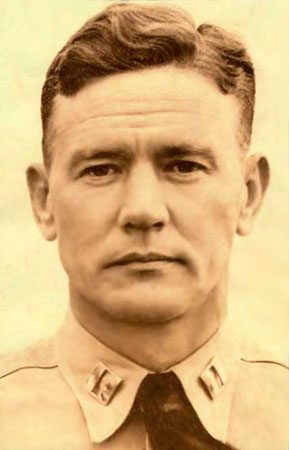
David Albert Hurt was born in 1903 at Pounding Mill, in Tazewell County, Virginia. He was a member of the United States Naval Academy class of 1925 and served in the United States Navy. He took command of Perch in June 1939 and held the rank of lieutenant commander from 1 August 1939. The boat was the Porpoise-class submarine SS-176, commissioned in 1936. This is that submarine, not a later boat of the same name.
Hurt had Perch at the Cavite Navy Yard when the Pacific war began. On 10 December 1941 he took her out of Manila on her first war patrol. On 27 December, in the South China Sea, he torpedoed the Japanese supply ship Noshima and damaged her. Depth charges damaged Perch during the counterattack, and he brought the boat south to Darwin for repairs.
Repairs finished, Perch left Darwin on 3 February 1942 for a second patrol in the Java Sea, as Japanese forces closed in on Java. Lieutenant Commander Hurt still had Perch on the patrol that ended her.
On the night of 1 March 1942, about thirty miles northwest of Surabaya, the destroyers Amatsukaze and Hatsukaze found Perch on the surface. Hurt was working into position for a torpedo attack when one destroyer swung straight toward him. He ordered the boat deep. She was left on the bottom. The destroyers did not sink her.
The pounding left Perch unable to dive. Before sunrise on 3 March, destroyers came into sight and opened fire. Ushio and Sazanami are the ships named for that morning, and Ushio is the one said to have fired. The Navy's loss report, written from the crew, says three destroyers opened fire and names none of them. With the boat unable to submerge, Hurt ordered the crew off and had Perch scuttled. She went down in the Java Sea with her colors flying.
All 59 men got off. Ushio took them aboard, and they spent the rest of the war as prisoners. Hurt was sent on to Japan and held at the Omori camp, where he was remembered as a steady older officer among the younger men. He remained a prisoner until Japan surrendered in August 1945 and was released from the Kawasaki branch camp on Tokyo Bay. Six of the crew died later as prisoners. Fifty-three came home.
Hurt's time at home was short. On 23 November 1945, at age 42, he was killed in a hunting accident near Elk Garden, Virginia. He was buried at Jeffersonville Cemetery in Tazewell County, and his name is carried on the Virginia War Memorial in Richmond.