Ships
- USS Saratoga (CV-3) Captain from 27 April 1945 · Relieved on 4 February 1946
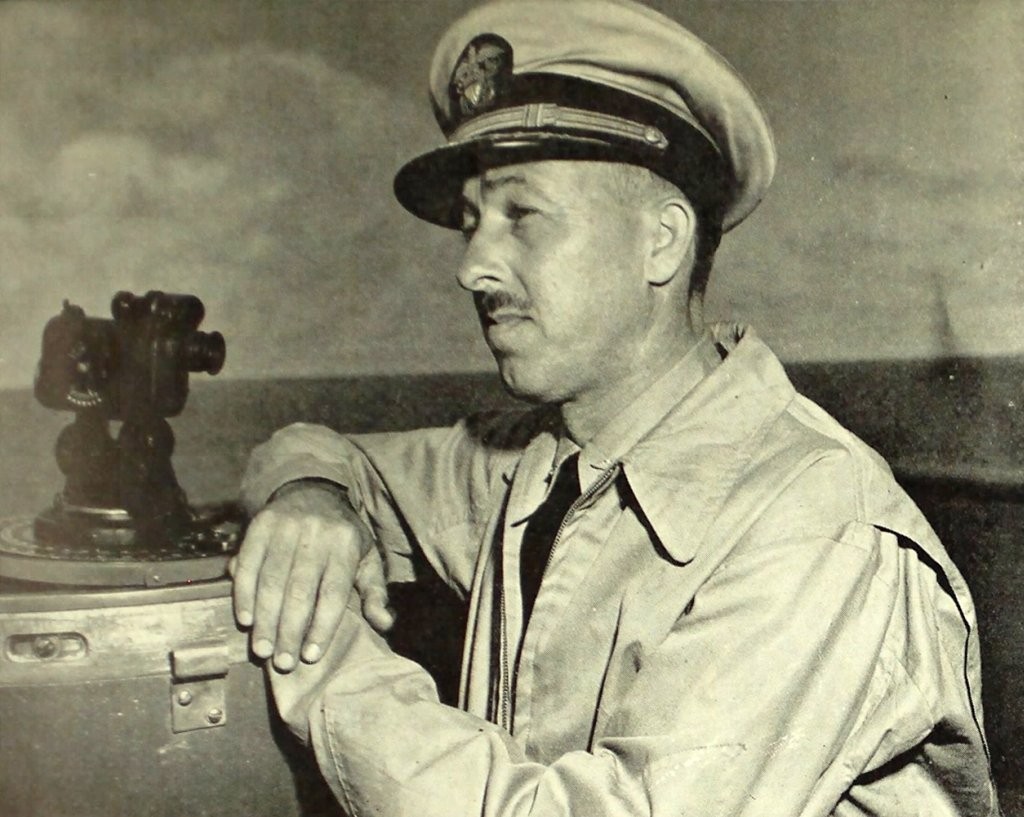
Frank Peak Akers (28 March 1901 – 22 March 1988) was a naval aviator and rear admiral. He made the first blind landing on a carrier, navigated Hornet (CV-8) for the Doolittle Raid and Midway, and commanded Saratoga in the last year of her life, when she set the single-day landing record.
Nashville to a hooded cockpit
He was born in Nashville on 28 March 1901, the second of four sons of Albert Warren Akers, a lawyer, and Lillian Crenshaw Akers. He graduated from the Naval Academy in 1922 and went to the destroyer Sumner in the Pacific. On 11 September 1925 he won his wings. In 1933 he took a master’s degree in electronic communications at Harvard, then became a flight-test officer at Naval Air Station San Diego.
The Navy was trying to land airplanes in weather and at night, when the deck disappeared. The gear came from the Washington Institute of Technology, built by men out of the Bureau of Standards. On 1 May 1934 Akers took an OJ-2 off from Anacostia with a hood over the cockpit, found College Park on the radio range, and landed on the localizer and glide path. He opened the hood only after the airplane stopped. He showed the cockpit to Rear Admiral Ernest J. King, then chief of the Bureau of Aeronautics.
The harder test was a moving deck. On 30 July 1935 he took off from San Diego in the same type of hooded OJ-2, found Langley about 150 miles at sea with no view of the outside, and landed aboard. It was the first instrument landing on a carrier. He received the Distinguished Flying Cross.
Hornet, then the radio shop
In 1942 he was navigator of the carrier Hornet (CV-8). He was aboard for the Doolittle Raid in April and for Midway in June. Hornet was sunk that October at Santa Cruz. Akers was already ashore.
In July 1942 he became head of the Aircraft Radio and Electrical Branch in the Bureau of Aeronautics. From September 1942 to 27 March 1945 he ran the development of the electronic gear the fleet was hanging on its airplanes: night-fighter radar, blind bombing, airborne fire-control radar, and the VHF radios that went into every fleet aircraft. The point of the work was to make the sets simpler to install and maintain, not just more capable. He received the Legion of Merit. He was a temporary captain from 1 April 1943.
Saratoga, 1945–46
On 27 April 1945 he took command of Saratoga. She had just come out of repair at Puget Sound after a kamikaze hit off Iwo Jima on 21 February that killed 123 men and wrecked the forward flight deck. She was too old and too hurt for the fast-carrier war. Akers used her as a training carrier.
In August 1945, at Pearl Harbor, she took 642 landings in one day, a record. By the end of the war she had logged close to 100,000 landings, more than any other carrier. The Pacific Fleet commended him for the pilot-training work. After the surrender she joined the Magic Carpet fleet and brought more men home from the Pacific than any other single ship. He left her on 4 February 1946.
Under the sea, then the Gray Eagle
In March 1946 he became chief of staff to Commander, Carrier Division 5, and to Task Force 77. The odd assignment came later. From 1951 to 1954 he was Assistant Chief of Naval Operations for Undersea Warfare, the only aviator ever put in that job. On 11 January 1962 he received the Gray Eagle, given to the naval aviator longest in flying status. He kept it until he retired on 1 April 1963 as a rear admiral.
He had married Bayliss House Akers. They had a son, Albert B. Akers. He settled in the Washington area and died on 22 March 1988, six days short of his eighty-seventh birthday.