Ships
- USS Hoggatt Bay (CVE-75) Captain, 14 September 1945 – 30 January 1946
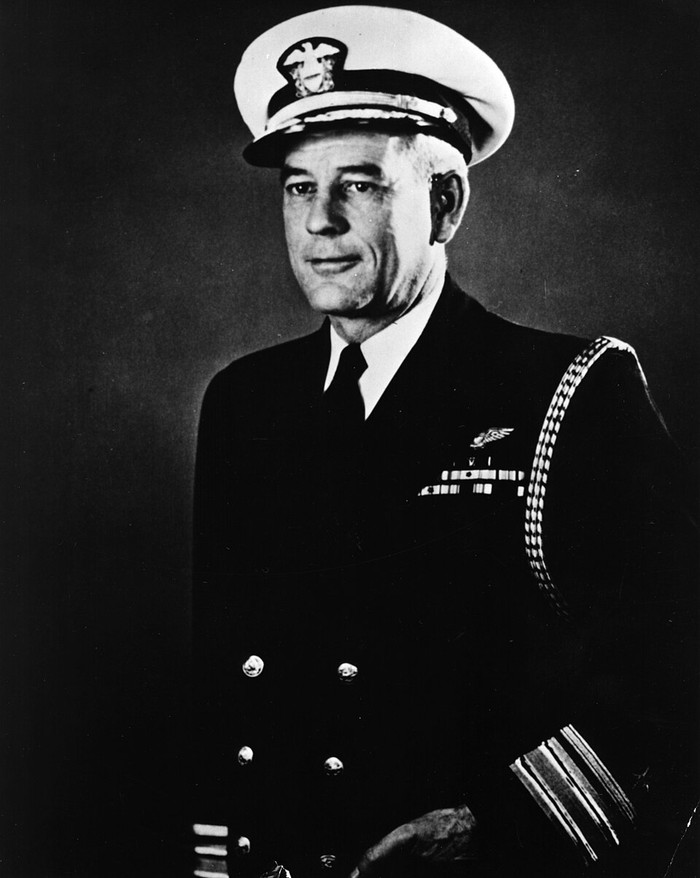
Frederick Norman Kivette was born in Idaho on 7 July 1902. He came out of the Naval Academy in 1925 and qualified as a naval aviator in 1928. Other pilots knew him as Nappy. The name stayed with him through a career spent in naval aviation, from single-seat fighters in the years after he won his wings to command of a fleet near the end of his service.
His early flying was at San Diego. From 1929 through 1932 he served in the air group of Saratoga and flew with the stunt section of Fighting Squadron 1, the High Hats, an exhibition unit that performed formation aerobatics around the country. In the late 1920s he also flew in public air shows with Charles A. Lindbergh. He then joined the heavier-than-air detachments of the rigid airships Akron and Macon. Those units, nicknamed the Belly Bumpers, flew Curtiss Sparrowhawk fighters that hooked onto a trapeze under the airship, rode with her on cruise, and could be released to scout. Kivette flew that fighter. In 1937 he was assigned to Fighting Squadron 4, the Red Rippers, aboard Ranger. He returned to Annapolis for 1938 and 1939 with Training Squadron 8, and in 1940 he went to Patrol Squadron 44.
On 20 January 1941, as a lieutenant commander, he took command of Williamson, a destroyer converted for duty as a seaplane tender. He still had her when the United States entered the war, and during 1942 the ship worked in Alaskan waters. At the time of the Battle of Midway he was in the north with the air-search group, while the carrier battle was fought much farther south. He was promoted to commander on 1 August 1942 and left Williamson on 10 August. On 20 July 1943 he was promoted to captain.
He was a captain when he took Hoggatt Bay on 14 September 1945, relieving Josephus Asa Briggs. William Vincent Saunders had commanded the escort carrier from January 1944 into December of that year, and Briggs had held her from that December until the day of the relief. Japan had already surrendered. On 15 September, the day after Kivette took the ship, Lieutenant Colonel James Devereux came aboard. Devereux had commanded the Marines on Wake Island when the garrison fell in December 1941, and he had remained a prisoner until the surrender. He was flown home from Hoggatt Bay.
The carrier’s work under Kivette was the occupation and the passage home. She took part in the landings at Aomori, in northern Honshu, and in Tokyo Bay, putting occupation troops ashore. She then sailed on the first Magic Carpet voyages, the early lift of servicemen back across the Pacific. He kept her on that duty until she reached the California coast. On 30 January 1946, at San Francisco, Marvin Pabodie Evenson relieved him. Evenson remained in command until 11 June 1946. William Paul Schroeder then commanded Hoggatt Bay until 20 July 1946, with the additional duty of executive officer.
Kivette went back to aviation on shore. In the late 1940s, still a captain, he commanded the naval air station at Floyd Bennett Field in Brooklyn. In July 1948 he became chief of staff of the Naval Air Reserve Training Command at Glenview, Illinois, the command that kept reserve squadrons in the air. Sea duty returned on 1 July 1950, when he took command of Midway. The carrier was in the Mediterranean. From November 1950 she lay at the Norfolk Naval Shipyard for overhaul and modernization, and he saw that yard period through, leaving the ship on 8 March 1951. He next served in Washington as an assistant to the Chief of Naval Operations for naval aviation.
In the latter part of 1958 he took command of the Seventh Fleet in the western Pacific and served there until March 1960. The sensitive station was the Taiwan Strait. He was charged with keeping a large force of ships, aircraft, and Marines ready to move, and with having them near the place a crisis was likely to break. In March 1960 he shifted to the West Coast as Commander, Western Sea Frontier, and as Commander, Pacific Reserve Fleet. He held those commands until he retired on 1 October 1961 as a vice admiral, closing a career that had run thirty-six years from his graduation at Annapolis. The Navy Distinguished Service Medal recognized the Seventh Fleet command and the Western Sea Frontier tour together, for the fleet’s readiness and for his work on logistic support and the control of shipping from the West Coast. He died in Auburn, California, on 17 May 1975, at the age of seventy-two. His wife, Elizabeth, and two grandchildren survived him.