Ships
- HMAS Quickmatch (G92) Captain from March 1944
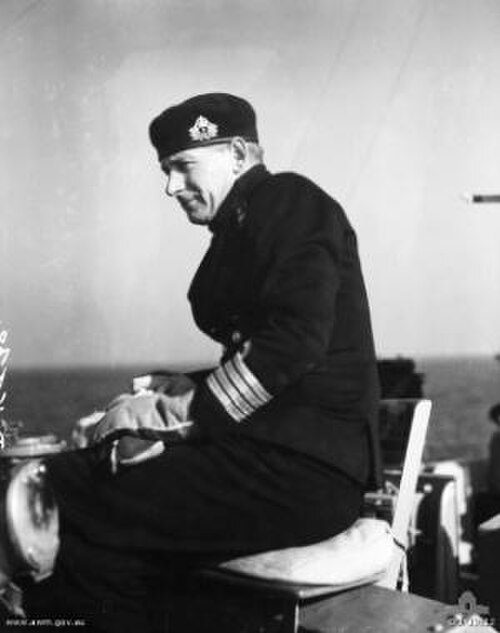
He was Royal Australian Navy, not United States Navy and not Royal Navy on loan the other way. The Australian War Memorial photograph DUKJ3812, "Otto Becher on HMAS Warramunga," is not a picture of the 1944 command. Tom Frame's Australian Dictionary of Biography reproduces it as a portrait by Harold Vaughan Dunkley, about 1951, Becher on Warramunga during the Korean War. The records do put him in Quickmatch. They do not leave the name, the month, or the rank tidy.
No source read for this essay spells him Humphry. The London Gazette, from the Distinguished Service Cross in 1940 through the Legion of Merit in 1955, prints Otto Humphrey Becher. G. Hermon Gill's official history footnotes him as O. H. Becher, born at Harvey, Western Australia, on 13 September 1908. A Quickmatch report of June 1945 is signed H. Becher. The ship's July 1945 report, in typescript, names "Commander O. H. Becher, R.A.N." His own sketch of another captain, published in 1978, is bylined Becher, O. H. Frame's biography uses the headword Otto Humphrey Becher and, once in the narrative, calls him Humphrey. The Sea Power Centre's page is titled "Rear Admiral Humphrey Otto Becher" and opens in that order. Both orders are in print. When the King was told the name, the order was Otto Humphrey. Humphrey was the name he lived under, and H. was the initial he signed.
The Sea Power Centre text is not a second witness. It tracks Frame's 1993 article very closely. Where they agree, that is one biographer, echoed. Where a ship's report or a Gazette disagrees with either, the report or the Gazette is preferred below.
Origins
He was born on 13 September 1908 at Harvey, in the south-west of Western Australia, son of Francis Joseph Becher, an orchardist, and Antonia Amalie, née Vetter. Frame says both parents were native-born. A later family tree circulated by email and printed on thepeerage.com adds dates, a Melbourne birth for the father, a Fremantle marriage in 1905, and three siblings. That tree rests on one correspondent in 2008. It is not used here. The parents’ names and the father’s occupation are Frame’s, and Gill independently gives Harvey and the birthday.
Nothing in the naval sources describes the orchard, the house, or what sort of child he was before the Navy took him. He went to the Royal Australian Naval College at Jervis Bay in 1922, at thirteen. Frame says he had a good scholastic record and won colours for hockey and tennis. F. B. Eldridge’s history of the college is in Frame’s bibliography and was not read for this essay, so the colours and the “good” record stand as Frame’s summary, not as a term list. There is no passing-out place, no house, no punishment, no letter home.
In 1926 he was a midshipman in the light cruisers Adelaide and Brisbane, then went to Britain for sea training and courses with the Royal Navy. Frame does not name the ships of that English time. He was back in Australia in 1930 as a lieutenant, in the heavy cruisers Australia and Canberra. He chose gunnery. From 1932 to 1934 he was in England again, on the long course at the gunnery school in Excellent. The course result is not stated.
On 7 January 1935, at St Michael’s Anglican Church, Vaucluse, Sydney, he married Valerie Chisholm Baird. Frame says they were to have three sons. The sons are not named in any source used here. A Wikipedia page for an actor called Michael Beecher asserts one son and misspells the mother’s middle name. It is not relied on. What the marriage cost them in separations is not in the record. The Navy’s habit was long absence. That is a general fact, not a fact about this household.
After the wedding he was at Cerberus, the depot at Westernport, and then in Canberra and Stuart. He was promoted lieutenant commander on 16 June 1938, a date Frame gives and that fits the rank the Gazette used two years later. He sailed again for Britain, on loan to the Royal Navy. At the outbreak of war he was squadron gunnery officer in the heavy cruiser Devonshire. He was not her captain. The captain named in the same Gazette list is John Maurice Mansfield.
Norway, then somebody else’s destroyer
In May 1940 Devonshire supported the withdrawal of troops from the Namsos area. The London Gazette of 19 July 1940 awards the Distinguished Service Cross to “Lieutenant Commander Otto Humphrey Becher, Royal Australian Navy, H.M.S. Devonshire,” under the heading “For good services in the withdrawal of troops from the Namsos Area.” There is no further sentence saying what he did with the guns, the boats, or the soldiers. A longer phrase about “daring, resource and devotion,” quoted on a veterans’ website, is not in the Gazette and was not found in a recommendation file opened for this essay. The award is real. The picture of the man on the bridge is not. He was a lieutenant commander, a specialist, in a cruiser somebody else commanded, in an evacuation that failed on land and had to be taken off by sea. That is as far as the citation goes.
By November 1940 he was in the new destroyer Napier. Frame says he joined her then and saw action in the Mediterranean. He did not command her. Her captain was Stephen Arliss, Royal Navy — Becher calls him Steve — Captain (D) of the 7th Destroyer Flotilla. Becher’s own account of that captain was written late and published after Becher was dead: the Naval Historical Review of June 1978 prints a sketch “prepared by the late Rear-Admiral Becher” as guidance for a history of the N-class ships. He signs it as memory, and once he says so. The Clyde raid was “in, if I remember rightly, March 1941.”
The sketch is not fond at the start. Arliss had come from the naval attaché’s post in Chile, had missed the early part of the war, and “was breathing fire when he joined.” Becher called him one of the old type of destroyer officer, a hard-doer, physically tough, a fine ship-handler when he concentrated, a man who “did not know the word fear,” a driver rather than a leader. The Australian sailors, he wrote, did not like being made to change into Number Twos for entering and leaving Scapa Flow in the middle of winter. It took Arliss a while, Becher thought, to see that some peacetime routines could not survive. An editorial postscript by a man who had been on board says that when Arliss joined he was highly critical of the Royal Australian Navy, and that in time he accepted the judgement had been faulty. That sentence is the postscript, not Becher’s. Becher’s own later memory of the same man is milder, and it is dealt with below. What the 1978 piece shows, before any of the battles, is a junior officer watching a captain and being willing, decades on, to say the sailors were right to resent him.
He was in the ship for Crete. The sketch says “we.” Napier reached the Mediterranean, via the Cape, too late for Greece and in time for the evacuation. The first lift from Sfakia, he remembered, was comparatively uneventful, about 250 soldiers a ship. On the second trip Cunningham had ordered them not to load more than 250 because of the aircraft. Kandahar and then Kelvin fell out. Napier and Nizam went on, made Sfakia about midnight, and left nearer 5 a.m. than the ordered 4, with about 750 men each. Becher remembered Napier’s as mostly New Zealanders. Lieutenant Hinchliffe, he wrote, got a DSC for the embarkation. After daylight the Ju 88s came. He remembered about a dozen attacks, Nizam disappearing in spray and coming out firing, and a last aircraft from right ahead, where the 4.7-inch guns could not elevate. Arliss put the wheel hard over. The bomb, Becher wrote, fell about ten feet to starboard, abreast the engine room. The cast-iron turbine feet broke. The ship stopped. The engineer, “Bug” Oliver, came to the bridge “quite unperturbed” and said, in Becher’s memory, “Give me half an hour and we will be going again.” They made sixteen knots, no further attack, Alexandria about 7 p.m., tugs because she could not go astern, and Cunningham over the guardrail to clap Arliss on the back. Becher thought Oliver’s mention in despatches was one of the most deserved of the war and should have been at least a DSC.
That is one officer’s memory, published in 1978, of a night in May 1941. H. G. D. Oliver’s own account, printed in 1983, does not contain the half-hour sentence. Oliver remembered a different passenger list and a different thing said on the bridge. Cunningham’s despatch and the ship’s history put the numbers differently again. The conflict is real and is marked at the end. What survives as Becher’s, because he chose to write it, is the shape of the night as he kept it: the order not to overload, the overloading, the blind spot ahead, the captain’s wheel order, the engineer’s calm, and his own view that the engineer was under-rewarded. He was not the man who gave the wheel order. He was close enough to remember it as “we.”
Frame’s next date is 26 April 1942, when Becher returned to Cerberus as officer-in-charge of the gunnery school. A later compilation says 17 May. The service card was not read. Either way, the Mediterranean was over for him, and for nearly two years he taught gunnery at Westernport while other men took the destroyers. Frame gives no reason. There is no letter saying whether he asked for the school or was sent.
Quickmatch
Frame and the Sea Power Centre, following him, say Becher was posted in command of the destroyer Quickmatch on 3 March 1944. A compilation on uboat.net says the command ran from 12 March 1944. The two dates can both be true — an appointment, and the day he actually took her — and neither has been checked against a Navy List page or the service card. What the ship’s own paper shows is that by late April he was already her commanding officer, if the signature on the convoy report is his.
Quickmatch was a Q-class destroyer, built by J. Samuel White at Cowes, commissioned into the RAN on 14 September 1942 under Lieutenant Commander Rodney Rhoades. Her first year, including the capture of the Italian blockade runner Cortellazzo, was Rhoades’s. It is not Becher’s, and it is not told here. The digitised reports of proceedings jump. In the main AWM78 file, a report dated 28 April 1944, reference 60/26, is a convoy proceeding: Bombay to Addu Atoll and back, escorting the American transports Mount Vernon and Mariposa with Quality and Raider, then a meeting with Suffolk and the transports Ruys and Athos II. It is signed over the typed rank “Lieutenant Commander, R.A.N.” The handwritten name is the same hand that, on the report dated 4 February 1945, signs over the typed rank “Commander, R.A.N.” That later signature reads as his. The April hand is the same shape. It is a reading of a signature, not a typed name. Taken with everything after, he was in Quickmatch by the last week of April 1944, as a lieutenant commander.
The action the biographies hang on him is Sabang, 25 July 1944, Operation Crimson. Gill’s official history is the fullest account of what the fleet did, and it names the wrong captain, or Becher was not there. The Eastern Fleet sailed from Trincomalee on 22 July under Admiral Somerville, flag in Queen Elizabeth, with Valiant, the French Richelieu, Renown, the carriers Illustrious and Victorious, seven cruisers, and ten destroyers under Commodore A. L. Poland. Gill’s parenthesis is “including the Australian Quickmatch (Lieut-Commander Rhoades).” The fleet approached during the night of 24–25 July. Fighters went off at first light against the airfields. At 6.55 a.m. the ships opened fire. An inshore force — the destroyers Quilliam, Quality and Quickmatch, and the Dutch cruiser Tromp — entered the harbour and bombarded at close range, then withdrew under the cruisers Gambia and Kenya. Tromp and the two Royal Navy destroyers were hit. Each of those destroyers had a fatal casualty. Gill does not say Quickmatch was hit. Somerville, whom Gill quotes, called the entry “spectacular and inspiring,” and gave the ammunition as 208 rounds of 5.9-inch and 717 of 4.7-inch for the group, not for one ship. The Sea Power Centre’s ship history says Quickmatch fired several hundred rounds and escaped without damage or casualties, and it names “Commander Otto Becher” as her commanding officer. The rank in that sentence is the rank he held later, not in July.
The Gazette of 31 October 1944, under “For outstanding courage, skill and determination in pressing home a successful attack on the Japanese Naval base at Sabang,” gives a bar to the Distinguished Service Cross to “Lieutenant-Commander Otto Humphrey Becher, D.S.C., Royal Australian Navy (Sydney, New South Wales).” It does not name Quickmatch. Frame writes that Becher showed coolness, skilful ship-handling and courage in the face of the batteries. That sentence is Frame’s gloss on the citation, not a quotation from a recommendation read here. The bar is not in doubt. Whose hands were on Quickmatch at Sabang is the doubt, and it is set out with the other conflicts at the end. If it was Becher, it is the first time the records show him taking a ship in close to guns that could kill her, rather than remembering someone else do it. If it was still Rhoades, the bar still belongs to Becher and the biographies have attached it to the wrong bridge. Gill’s footnote on the same page is about Poland and Rhoades knowing each other from the Western Desert in 1941, when Rhoades had Vendetta. That footnote may be why Rhoades’s name stayed in the sentence after he had left the ship. It is a possible explanation, not a proof.
In October 1944 Quickmatch reached Australian waters. The Sea Power Centre says that was the first time. She refitted at Sydney from November into December. The report Becher dated 4 February 1945 calls itself his first report to the Captain (D) of the 4th Destroyer Flotilla and covers 25 December 1944 to 31 January 1945. It refers back to a minute of 14 November 1944 and to a letter of 9 November. He was in command through the refit. Christmas Day, the report says, found her in dockyard hands in Sydney, the refit finishing, the company except a care-and-maintenance party on extended weekend leave.
At 2.52 a.m. on 25 December the Navy Office in Melbourne had an emergency signal from the American Liberty ship Robert J. Walker, Fremantle to Sydney, torpedoed about forty miles off the New South Wales coast. Gill tells the rest from the signals and from the master’s later account. A second torpedo was exploded short by her 20-millimetre guns. A third, just before 6 a.m., blew out both sides at No. 4 hold. Captain M. D. MacRae said two army trucks could have been driven in one side and out the other. Abandon ship was ordered at 6.01. Two men were lost. The rest got away in three boats and four rafts. MacRae was angry that the first aircraft did not reach him until 6.15, nearly four hours after he had asked for air cover, and he thought an aircraft even at 5 a.m. might have saved the ship for a tow.
Becher’s report is the other end of that morning. At 0500 the ship, still in dockyard hands, was ordered to prepare for sea. Steam was up by 1300. By 1500 enough of his own men were back, or had been lent from ships in harbour, for her to sail. She and Kiama reached the wreck between 11.30 p.m. and midnight. There were no survivors on board or close by. Walker sank about 3 a.m. on the 26th. At about 5.30, directed by aircraft, the boats and rafts were found. Gill says sixty-seven men were taken on board Quickmatch. The search for the submarine, with Yandra and then the 4th Flotilla, found nothing. U-862 is the boat later accounts name. Gill, in the passage read here, does not. Becher’s report does not philosophise. It records a ship pulled off a weekend leave, a wreck, a patrol, an embarkation. He had been a gunnery specialist for a decade. This night the work was finding men in boats.
He signed that February report as Commander, R.A.N. Frame says the promotion was 31 December 1944. The Gazette has not been found for the promotion itself. By 4 February 1945 the ship’s office was typing “Commander” under his name. Gill, narrating 25 December, already calls him Commander. If Frame’s date is right, that is the historian’s later rank, and on Christmas morning he was still a lieutenant commander. The report does not say which rank he held when he took her to sea that afternoon.
In January the same report has her escorting, among other ships, Rimutaka, with the Duke and Duchess of Gloucester and their children on board, and the escorts manning and cheering ship as they passed. Then she joined the British Pacific Fleet. On 28 February the fleet sailed from Sydney for Manus: King George V and Howe, four fleet carriers, cruisers, and three destroyer flotillas. Quickmatch, Gill writes, Commander Becher, and Quiberon, Lieutenant Commander Knox, were in the 4th Flotilla. In the absence of Quilliam, refitting in Sydney, Quickmatch was flotilla leader, with Captain R. G. Onslow, Royal Navy, Captain (D), and his staff on board. Becher commanded the ship. He did not command the flotilla. For two months the senior officer lived in his ship.
The fleet exercised at Manus, went to Ulithi, and on 23 March became Task Force 57 under the American Fifth Fleet. The task was the airfields on Ishigaki and Miyako in the Sakishima group, the left flank of the Okinawa landing. Becher’s report, which Gill quotes, said of 26 and 27 March: “These two days’ operations were successful, the enemy airstrips being neutralised and a number of aircraft being destroyed on the ground.” Through April the force alternated strikes and fuelling. Onslow and his staff left at Leyte and went back to Quilliam. Of that month Becher wrote, again as Gill quotes him:
> The airstrikes were successful in neutralising the enemy aerodromes concerned. The Fleet was occasionally threatened by aircraft but fighter interception was usually so effective that the enemy were driven off or shot down before making contact. Minor damage to two carriers was caused by aircraft which got through. A dull time was had by Quickmatch and the excellent air warning meant that the operational periods were in no way arduous.
That is the sentence worth keeping. The man who, if the bar is rightly attached to this ship, had taken her into Sabang harbour, now described the Okinawa screen as dull, and said the air warning made it not arduous. He was not boasting and he was not complaining. He was a gunnery officer measuring a campaign by whether anything reached the ship. Off Okinawa, for Quickmatch, it mostly did not. The Americans on the other side of the same operation were being hit by kamikazes in a way the British fleet, that month, was not. Gill sets the two experiences next to each other. Becher’s adjective is “dull.”
He was still in her in June. The report he signed H. Becher, dated 1 July 1945, brings her from Manus to Sydney on the morning of the 5th, sends most of the ship’s company on four days’ leave, docks her at Cockatoo from the 9th to the 16th, and notes that Commander J. K. Walton joined on 26 June, additionally, and would in due course take command. The July report, written by Walton and read here from the ship’s file, is explicit: “Commander J. K. Walton, R.A.N. assumed command on 20th July, when Commander O. H. Becher, R.A.N. was transferred to ‘Nizam’ for onward passage to ‘Penguin’.” The compilations that end his command on 25 June are wrong. He left on 20 July, into another destroyer only as a passenger, bound for the Sydney depot. Walton’s report says that during July’s strikes few Japanese aircraft came out and none reached the fleet, and that the ship saw no action that month. The strikes of 24 July and after were Walton’s. Becher’s last days in Quickmatch were the passage back to the operating area and the first of those July strikes, and then a transfer. The war against Japan had about three weeks left to run. He did not see the end of it from a bridge.
On 11 June 1946 the Gazette lists “Commander Otto Humphrey Becher, D.S.C., Royal Australian Navy,” among mentions in despatches “for distinguished service during the War in the Far East.” There is no ship and no sentence of his own. Frame says the mention was for service in Quickmatch. The Gazette line is only the Far East list. The recommendation file was not opened.
After the destroyer
From 1945 to 1948 Frame has him on staff at Navy Office in Melbourne, then back to sea to commission the light fleet carrier Sydney. He does not say what the staff work was, or what Becher thought of a desk after Quickmatch. In January 1950 he was appointed to command the Sydney shore establishment Watson. On 28 July 1950 that posting was cut short. He relieved Captain Alan McNicoll as commanding officer of Warramunga, about to sail for Korea. Frame, who later had his own public life in the Navy and the church, is the source for the hurry. The Sea Power Centre repeats him.
Warramunga’s Korean year is a second war, and it is not told here from her reports. Those files exist at the Australian War Memorial and were not read. What Frame gives is the shape: poorly charted water, bad weather, and a command arrangement in which British and American seniors both had a hand. On 5–6 December 1950 she took part in the evacuation of Chinnampo. In August 1951 her bombardment of Haeju was specially praised. He had been promoted captain on 31 December 1950, so the later months of the deployment were a captain’s, and the first months a commander’s. The London Gazette of 18 September 1951 makes “Captain Otto Humphrey Becher, D.S.C., Royal Australian Navy” a Companion of the Distinguished Service Order, “for distinguished service in operations in Korean waters.” The printed post-nominal is D.S.C., not a D.S.O. already held. There is no individual citation on the page. On 15 February 1955 the Gazette records the Queen’s permission to wear the American Legion of Merit, Degree of Officer, bestowed for distinguished services in Korea, on “Captain Otto Humphrey Becher, D.S.O., D.S.C., Royal Australian Navy, H.M.A.S. Warramunga.”
A story told in later compilations, citing Robert O’Neill’s official history, has Warramunga aground for thirty-five minutes in a badly charted channel on the way up to Chinnampo, and has Becher asking the captain of Bataan, by megaphone, to keep quiet about it because a promotion was due. That story is not in Frame. O’Neill was not opened for this essay. It is not repeated here as fact. If it is in the ship’s report, it can be read there. Until then it is a story about a man protecting a promotion, which may be true and may be the sort of story a fleet tells. The D.S.O. and the Legion of Merit do not describe a grounding. They describe, in the bare language of those lists, distinguished service in Korean waters, in Warramunga.
Frame’s summary of the next decade is staff, and then carriers, and then a flag. Deputy Chief of Naval Staff in 1952–54 and again in 1959–62. Imperial Defence College, London, in 1956. Command of the carrier Vengeance in 1954–55, and of Melbourne in 1957–58. He had acted as rear admiral for twelve months when the rank was made substantive on 7 January 1960. A compilation gives the acting rank as 3 January 1959, which would make the substantive date a year later and a few days off Frame’s. The Navy List was not checked. In the Birthday Honours of 10 June 1961, on the advice of Australian ministers, he was made a Commander of the Order of the British Empire, military division, as Rear-Admiral Otto Humphrey Becher, D.S.O., D.S.C. He was head of the Australian Joint Services Staff in London in 1962–63.
In January 1964 he succeeded McNicoll as Flag Officer Commanding the Australian Fleet. The next month, on 10 February, Melbourne and the destroyer Voyager collided off the southern coast of New South Wales, and Voyager was lost. Becher was the flag officer, and the Sea Power Centre says he was at sea in Melbourne when it happened. Frame says the collision made him a controversial figure. Before he gave evidence to the royal commission, he discussed that evidence with Melbourne’s commanding officer, Captain R. J. Robertson. Frame writes that this “gave rise to speculation of collusion.” He also writes that Becher’s contention — that Melbourne should have challenged Voyager’s final movements — may have helped the royal commissioner, Sir John Spicer, to blame Robertson unduly. Those two sentences are Frame’s judgement, published in 1993. The transcript, the Sydney Morning Herald of 18 and 19 March 1964, and Harold Hickling’s One Minute of Time, all in Frame’s notes, were not read for this essay. What can be said without them is that the fleet’s commander talked to the carrier’s captain about the evidence both would give, that people called it collusion, and that Becher’s own evidence put a share of the fault on the carrier not having questioned the destroyer’s last turn. Whether that talk was ordinary preparation or something worse is the argument Frame points at and does not settle. Becher did not, afterwards, argue it in public. Frame says that in retirement he refrained from public comment on naval matters.
In 1965 he was Flag Officer-in-Charge, East Australia Area. He retired on 6 March 1966, forty-four years after he had entered the college at Jervis Bay, if 1922 is counted as the start. Frame’s phrase for the officer is “popular, personable and an accomplished ship’s captain with vast operational experience,” with “dash and occasional flamboyance.” That is an obituary adjective, not a quotation. The flamboyance is not illustrated.
From 1966 to 1969 he was director-general of recruiting for the armed forces, in the years of the Vietnam-era conscription ballot. Frame says he opposed conscription, believing it lowered professional standards. The “believing” is Frame’s. A sentence about competing with industry for labour, attributed to him in a newspaper of 6 October 1966, was not read in the paper. He was also chairman of the council of the Institute of Marine Sciences at the University of New South Wales. He played golf and tennis. The college colours had been hockey and tennis. The tennis, at least, lasted.
He died of a myocardial infarction on 15 June 1977 in Sydney Hospital, aged sixty-eight, and was cremated. Frame says he was survived by his wife and sons. The sons are still unnamed. Valerie Becher’s later life is not in the biography, which was written while the question of her survival had already been answered and before any later death. What he left them, in money or in papers, is not stated. What he left on paper that can still be read is the 1978 sketch: a destroyer officer’s memory of another destroyer officer, sharp about drivers and uniforms, generous about an engineer, and wrong, at the end, about the name of Arliss’s cruiser, which he remembered as Australian. The sketch was guidance for someone else’s history. He did not write his own.