Ships
- HMAS Sydney (D48) Captain from 16 November 1939
- HMAS Shropshire (73) Captain from 7 April 1943
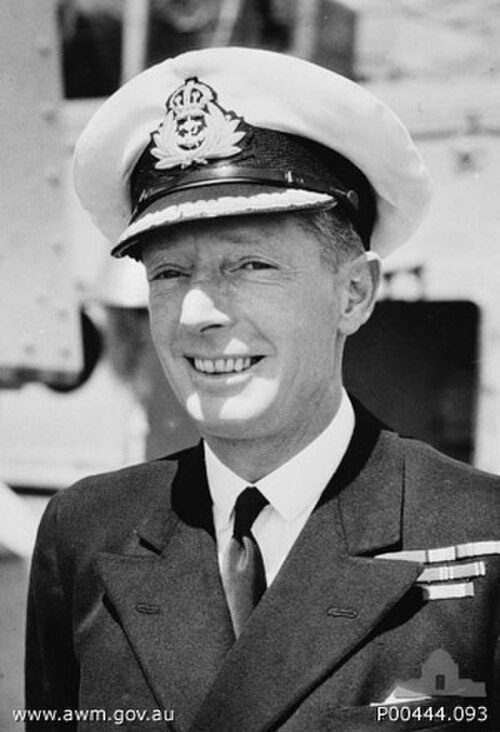
The middle name, the navy, and those two commands belong to one officer, and the Australian Dictionary of Biography, the Sea Power Centre, and the Australian War Memorial are describing the same man. He is Vice-Admiral Sir John Augustine Collins, KBE, CB, Royal Australian Navy, born at Deloraine, Tasmania, on 7 January 1899, and dead in Sydney on 3 September 1989. He is not Walter Daniel Coleman and not John Barr Colwell. He is not his elder brother, the novelist Cuthbert Quinlan Dale Collins. He is not any of the other John Collinses in the United States Navy Registers checked for this essay, and he is not the civilian John Augustine Collins named in a London Gazette of 1982. The Sydney he made famous was lost, with another captain and every man in her, after he had left. That loss is part of what his war cost. It was not his last command, and it was not how he died.
Origins
He was the fourth son. His father, Michael John Collins, was an Irish doctor who had been a ship's surgeon in the Royal Mail Steam Packet Company. His mother, Esther, was English, born Copeland. Michael died of typhoid at Launceston on 31 May 1898, which the naval biographer counts as seven months before the birth, and which the novelist's biographer uses as the date that left Dale's younger brother fatherless. The child was born at Deloraine on 7 January 1899. Dale, born Cuthbert Quinlan Dale Collins at Balmain on 9 April 1897, was the third son. His own biography already points at the younger brother as "the future vice admiral and chief of the Australian Naval Staff." The two elder sons are not named in either article. The family moved to Melbourne. John was sent to Christian Brothers' College, East Melbourne. The Dictionary's life summary files the house as Irish and English, and as Catholic and Anglican. The funeral, ninety years on, was Anglican. Nothing read here says what he himself believed, or whether the Christian Brothers' schooling was his mother's choice or his dead father's.
Formation
In 1913 he entered the Royal Australian Naval College with its first intake, at Osborne House, Geelong. The War Memorial's timeline also gives an enlistment date of 31 December 1912, which may be the paperwork before the term began. In 1915 the college moved to Jervis Bay. He became a cadet captain, won colours in Rugby and athletics, and at the end of 1916 passed out with prizes for seamanship and for the theory of engineering, and with what the college called maximum time gained. That last award brought his promotion to lieutenant forward. He was made a midshipman on 1 January 1917 and sent to Britain. The Memorial's timeline also has an embarkation on 17 April 1916. That date was not tied here to a named ship.
His first sea posting was the battleship HMS Canada, in the Grand Fleet. The Memorial says that service was out of Scapa Flow. In September 1918 he was promoted sub-lieutenant and, as the war closed, joined the destroyer HMS Spenser as gun control officer. The Memorial spells the ship Spencer, and says he was at gunnery school when the war ended. The Dictionary, written from his service file, puts him in Spenser and then in the destroyer HMAS Stalwart, and makes him a lieutenant in December 1919. He came home in 1921 to the cruiser HMAS Melbourne. No action of that first war is named for him in the sources used here. He joined the Grand Fleet after Jutland.
In 1922 he went back to England for the long gunnery course, topped it, and won the Commander Egerton prize, given each year for the highest marks in practical gunnery to an officer of the Royal Navy or of a Commonwealth navy qualifying in England as a gunnery lieutenant. The Sea Power Centre dates the prize to 1923. He completed the advanced course and in 1925 came home again to Melbourne, this time as her gunnery officer. The Memorial says 1926, and adds that he qualified as a deep-sea diver. The diver is not in the Dictionary. Melbourne went to the Mediterranean Fleet on an exchange with the Royal Navy. Back in Australia, he was naval liaison officer for the 1927 visit of the Duke and Duchess of York, with them for the opening of Parliament House in Canberra, and with them in the battlecruiser HMS Renown on the way back to Britain.
From December 1927 he was a lieutenant-commander. He joined the new heavy cruiser HMAS Australia, fitting out at Clydebank, and served two years in her as squadron gunnery officer. In 1930 the navy gave him the destroyer leader HMAS Anzac. The Dictionary reads that command as a deliberate rounding-out of a man already marked for higher rank. On 3 June 1930, at St Mark's Church of England, Darling Point, Sydney, he married Phyllis Laishley McLachlan. The Memorial spells her Phyllis MacLachlan, and in the same breath promotes him to commander. The Dictionary's date for commander is June 1932, after the staff course. That is the date followed here.
In 1931 he was first lieutenant of Flinders Naval Depot, at Westernport in Victoria. In 1932 he took the staff course at the Royal Naval College, Greenwich, and was promoted commander in June. In 1933 he joined the Plans Division at the Admiralty, with Imperial port defences as his work. In 1934, on leave at Portwrinkle in Cornwall, a girl was swept away by a rip and he went in after her. Phyllis manned an improvised lifeline. The Royal Humane Society in London gave him a testimonial on parchment. It is the one recorded choice, before the war, in which he stayed when he could have stood on the beach.
In 1935 he was executive officer of the new light cruiser HMAS Sydney. Her captain was J. U. P. Fitzgerald, Royal Navy, whom the Dictionary calls at times brilliant and unpredictable, and who made the commander's job harder than the appointment already was. For the Abyssinian crisis Sydney was held with the Mediterranean Fleet, and she did not reach Australian waters until August 1936. Collins was promoted captain in December 1937. In February 1938 he became assistant chief of the Naval Staff and director of naval intelligence, at Navy Office in Melbourne. The Memorial puts a liaison job for Sydney's 150th anniversary in front of that appointment. The Dictionary does not mention it. What the Dictionary does say is that he had an important staffing part in getting anti-submarine escorts, that the Bathurst-class corvettes were the result, and that mobilisation plans were the other paper that would not wait. Those are a biographer's judgments of staff years. They are not a claim that he designed a class of ship himself.
War years as lived
He assumed command of Sydney in November 1939. It was not re-read here from a log or a Navy List. The ship was already on war stations at Fremantle. She had taken an extra draft and was up to a war complement of 645, and through the rest of 1939 and the first months of 1940 she patrolled and escorted in the Indian Ocean. On 1 May 1940 she was ordered to Colombo, and from there to Alexandria. She joined the Mediterranean Fleet on 26 May.
Italy came in on 10 June. Within hours Admiral Sir Andrew Cunningham had the fleet at sea, and it came back into Alexandria two days later through a minefield laid off the entrance. Through June Sydney patrolled, and later in the month she bombarded Bardia. Her amphibian Seagull was spotting when fighters set about her. She got away full of holes. Flight Lieutenant T. M. Price, of the RAAF, force-landed at a British field some miles off. The aircraft was written off. Price was awarded the Distinguished Flying Cross. The Sea Power Centre's short life of Collins says that this bombardment made Sydney the first British warship to open an attack on an Italian colony in the war, and that she was the first ship through the mined Strait of Otranto. The same centre's longer history of the ship narrates Bardia and does not say either of those things. They are not used here as fact.
On 28 June reconnaissance aircraft found three Italian destroyers. Sydney damaged one, Espero. As the cruiser closed, the unit history says, the destroyer fired guns and torpedoes, and Sydney's 6-inch left her a burning wreck. She sank. The War Memorial's short biography adds what that history does not: that he stayed for survivors in spite of submarines, and that when he had to leave he left a cutter and provisions. That story is not staged below. It has not been set against a report, or against Gill.
On the evening of 7 July the fleet sailed again. Next day Italian bombers hit HMS Gloucester and killed her captain and seventeen other men. On 9 July, off Calabria, Sydney was in the cruiser line ahead of the battle fleet. At 3.14 in the afternoon Italian heavy cruisers opened on that line. Cunningham, in Warspite, came up. Warspite hit the Italian flagship, which the unit history spells Guilio Cesare, and the Italians turned away under smoke. By about 4.40 the surface fight was nearly done. Sydney had not been hit. A few signal halyards were shot away. She had fired more than four hundred rounds of 6-inch, and by the time she reached Alexandria on 13 July she had emptied her 4-inch anti-aircraft magazines on the bombers that followed the ships in. She docked, had the hull cleaned, and filled up again.
On 18 July she left Alexandria with the destroyer HMS Havock, to back Commander H. St. L. Nicolson's flotilla, Hyperion, Hero, Hasty and Ilex, in the Aegean. Nicolson was to sweep west along the north coast of Crete and to catch traffic to and from the Dodecanese. Collins changed his own course and speed so as to be near those destroyers while they were still in the narrow water, instead of holding the more distant station the first plan had given him. He did not break wireless silence to say so. On the morning of 19 July the destroyers met two Italian cruisers of the Condottieri type, Bartolomeo Colleoni and Giovanni delle Bande Nere, and turned away, reporting the enemy toward a Sydney they believed was hours off. She was not. At 8.20 the cruisers were in sight. Eight minutes later she hoisted battle ensigns and opened fire at about ten miles. Italians and British destroyers were both surprised. She hit Bande Nere, and then both ships. North of Cape Spada the Italians tried for the Antikythera Channel under smoke. Colleoni caught fire, lost way, and stopped. Hyperion and Ilex were sent to finish her with torpedoes and to take off survivors. Havock stayed until aircraft drove her off. The unit history says the Italian captain was among those picked up, and it prints a figure of 550 in a sentence that is broken on the page. The number is not used here as an exact count.
Sydney chased Bande Nere and at 10.25 gave it up. She was short of ammunition and coming under the reach of bombers. One shell had hit the forward funnel. The unit history calls the damage minor and says there were no casualties. A Naval Historical Review article of 1991 times the hit at 9.21, puts the burst about ten feet from the top of the funnel, and says one man was slightly wounded by a splinter, the ship's only casualty of the action. Both accounts of the wounded cannot be strictly true. The surprise, the stop, and the sinking are not in dispute.
Italian aircraft attacked through the afternoon. Havock was damaged, not seriously. At 11 a.m. on 20 July Sydney entered Alexandria, and Cunningham came aboard from his barge. The unit history prints what it presents as his report to the Admiralty. The credit, it says, belonged mainly to Captain J. A. Collins, CB, RAN, for quick appreciation, offensive spirit, and resolute handling: a victory over a superior force, with important strategical effects, and, so far as was known, no Italian surface force back in or near the Aegean afterwards. The original paper was not opened for this essay. A later essay in the Naval Historical Review prints a shorter wording that is not identical. The London Gazette of 26 July 1940 does not depend on either transcription. The King appointed Captain John Augustine Collins, Royal Australian Navy, HMAS Sydney, an Additional Companion of the Order of the Bath, for distinguished service in the gallant and successful action against two Italian cruisers in which Bartolomeo Colleoni was destroyed.
For the rest of 1940 she patrolled, swept for submarines, escorted, and bombarded, in the Mediterranean and in the Adriatic. In January 1941 she was ordered home. The unit history quotes Cunningham's hope that "your countrymen will give you the reception you deserve." On Tuesday 11 February, in Sydney harbour, the premier of New South Wales and the lord mayor came on board with a plaque for the Colleoni action, two medallions mounted on oak, fixed under the sighting ports on Y turret. After the unveiling, the company marched through the city to the Town Hall. On 28 February she sailed for Fremantle and went back to convoy work off the western coast. In April she escorted the troopship Queen Mary to Jervis Bay, and then carried the First Naval Member, Admiral Sir Ragnar Colvin, at high speed to an Allied conference in Singapore. There it was decided that Collins would be assistant chief of staff to Vice-Admiral Sir Geoffrey Layton, commander-in-chief, China. On 15 May 1941, at Fremantle, he turned Sydney over to Captain Joseph Burnett. The unit history says the ship's company called him Colleoni John. The same history quotes him, years later: there had never been, and there would never again be, a ship quite to compare with the cruiser Sydney of the Second World War. The book that sentence comes from was not read here.
The Dictionary says he took up the Singapore post in June 1941, and that his wife and daughter went with him. The Memorial's timeline says August. His immediate work was planning how Allied air and naval forces would be used. He established a good understanding with Layton, and he was disappointed when Admiral Sir Tom Phillips relieved Layton. In December, on the news that Prince of Wales and Repulse had been sunk and that Phillips was dead, he went to the departing Dominion Monarch and brought Layton back to duty. He then got his family away. In January 1942 he became commodore commanding China Force, Royal Navy and RAN cruisers and destroyers based at Batavia, and he was made commodore, second class. The Dictionary says he was junior for the job. Inside the awkward Australian-British-Dutch-American command he used the ships as escorts on the Singapore run, or assigned them to a Dutch striking force. After Singapore surrendered, and after the Allied defeat in the Java Sea, he judged that Batavia would fall. He organised evacuations of civilians and of service people to Australia and to India, and he embarked in one of the last ships to leave. The London Gazette of 15 December 1942, a supplement to the Gazette of 11 December, lists Captain John Augustine Collins, CB, Royal Australian Navy, under Mention in Despatches. The words that say for which service sit on an earlier page of that supplement, and that page was not retrieved. The Dictionary connects the mention, and a commandership of the Netherlands Order of Oranje-Nassau, to this part of the war. The Sea Power Centre says Queen Wilhelmina conferred the Dutch honour for the same work. A London Gazette notice giving him permission to wear it was not found in the searches made here.
He arrived at Fremantle in March 1942 and became senior naval officer, Western Australia. One decision of that time the Dictionary calls controversial. Acting Commander Paul Hirst, a classmate from the naval college, commanded the corvette HMAS Toowoomba and considered her unfit, in her material state, to go to sea. His superiors, Collins included, did not share that view, and Hirst was relieved of the command. Late in 1942 Collins went to Britain to take the heavy cruiser that was to replace Canberra. After Canberra was lost at Savo Island on 9 August 1942, Churchill told the House of Commons on 8 September that the government would offer HMS Shropshire to the Commonwealth freely and unconditionally. A retired Royal Navy captain, writing the ship's story in 1981, says Collins assumed command on 7 April 1943, and that she commissioned in the RAN on 20 April at Chatham. The Memorial's timeline says 17 April. The pre-transfer refit ran on for months. On 25 June Admiral Sir George D'Oyly Lyon, commander-in-chief at the Nore, formally handed her over. She did not carry an aircraft in Australian service. The catapult had been landed.
In August 1943 she began the passage out, escorting a convoy bound for Gibraltar, and she reached Sydney on 2 October, by Cape Town and Fremantle. On 30 October, at Brisbane, she joined the Australian Squadron, Task Force 74, under Rear-Admiral V. A. C. Crutchley, flying his flag in Australia. While Collins was still captain she covered the landings at Arawe and Cape Gloucester in December 1943, the seizure of the Admiralty Islands in March 1944, and the Hollandia and Humboldt Bay operations in April. That is the ship's chronology under his command. It is not a record of what he decided on those days. No report of proceedings of his, and no letter, was read. On 2 May 1944 Captain Henry Arthur Showers, another of the 1913 entry, took Shropshire from him. What she did after that, at Wakde, at Morotai, in Surigao Strait, at Lingayen, was Showers's command or the next captain's, not his.
The Dictionary says that in May 1944, because John Curtin insisted, Collins was made commodore, first class, and given the Australian Squadron, the first time an Australian-born officer trained in Australia had commanded it. The Sea Power Centre's life of him, and the Memorial's timeline, date the commodore's rank to June. He had left Shropshire on 2 May in either case. His flagship was HMAS Australia. The Dictionary says the force took part in the New Guinea campaign and then in the Philippines. It does not list the days, and no list is filled in here from a ship's honours board.
On the morning of 21 October 1944, off Leyte, Australia had just weighed, to go in and fire for the troops ashore. A Japanese dive-bomber came low between Shropshire and Australia. Captain Nichols of Shropshire, in the account the War Memorial prints, reported that the aircraft was taken under fire, seemed to touch the water, recovered, turned back up Australia's port side, and crashed into the foremast at 6.05 a.m. The Showers biography spells that captain Nicholls. Lieutenant-Commander Richard Peek, Australia's gunnery officer, was on the bridge. He called Captain Emile Dechaineux over. A wing hit the tripod mast. Petrol went over the bridge and burned. The bomb the aircraft was carrying did not explode. Men who were there, talking sixty years later, thought that unexploded bomb was why more of them were not dead. The Memorial's count is thirty officers and men killed or died of wounds, and sixty-four wounded, twenty-six of them seriously. The Sea Power Centre says the captain and thirty others killed, and sixty-four wounded, Collins one of the sixty-four. An Age article of 2004, reprinted by the Naval Historical Society, says seven officers and twenty-three sailors killed, and fifty-six wounded or burned. Dechaineux and the navigator, Commander John Rayment, were mortally wounded. Dechaineux died later that day. Collins was burned, and wounded besides. Able Seaman Reg Walker, in the Memorial's account, remembered the captain, not the commodore: Dechaineux sitting with a hole in his stomach, asking whether the injured were being looked after, and making no sound of his own. Australia sailed for Manus at 11 a.m., with Warramunga as escort. A Memorial photograph shows Collins carried from an American merchant ship into an ambulance.
The same Memorial article records the argument about the name of the attack. G. Hermon Gill, the official naval historian, wrote that Australia was the first Allied ship hit by a suicide aircraft. Samuel Eliot Morison did not treat it as an organised kamikaze attack, and put the first organised one on 25 October, against the escort carriers Santee and Suwannee. Men on Australia who saw the aircraft did not doubt what the pilot meant to do. Collins's wounds do not depend on which historian is right about the organisation.
He was months out of the fleet. The Dictionary says that after convalescence he returned to command of the squadron in July 1945. The Sea Power Centre says the ship was Shropshire again, and that before he went back to sea he was temporarily naval officer-in-charge at Fremantle. The Dictionary has that Western Australian shore appointment in 1942, and does not give him a second one in 1945. One Naval Historical Society essay dates his return to the fleet 22 July 1945. He was the Royal Australian Navy's representative at the surrender on board USS Missouri in Tokyo Bay on 2 September 1945. The Sea Power Centre also places him in the bay in August, when the capitulation itself was announced. The Memorial's prose says he was then involved with the British Commonwealth Occupation Force, and, in the next sentence, that he became First Naval Member in February 1946. The timeline on that same page dates the chief of naval staff years from 1948 to 1955. The Dictionary and the Sea Power Centre agree with the timeline. The February 1946 date is a mistake in the prose. The occupation-force sentence is not in the Dictionary, and it is not told here as a story of where he went.
The United States appointed him an officer of the Legion of Merit. The Dictionary dates the appointment 1946. The Sea Power Centre connects it with his work in the South-West Pacific. The citation was not read. A Gazette notice of permission to wear the decoration was not found.
Cost
The cruiser that made his name did not survive him in command of her. On 19 November 1941, under Burnett, Sydney met the German raider Kormoran about 130 miles west of Shark Bay. She was lost with all hands. The unit history's figure is forty-two officers and 603 sailors, a number that includes six of the RAAF and four civilian canteen staff. Burnett had entered the naval college in the same first class as Collins. Collins had left the ship on 15 May. What he thought when she did not come back is not in any source read here. The sentence quoted from him later, that there would never be another ship like her, is not a sentence about the sinking. It is the nearest thing to one that these pages contain.
At Leyte the cost was beside him. Dechaineux died. Rayment died. On the Memorial's count, thirty men died, and Collins was carried off and was months out of a sea command while the squadron went on under the captain of Shropshire. The Dictionary, summing up the confidential reports on him, says the words his seniors kept using were professionalism, a cool head, and judgment, and that Cape Spada was where those words were earned in public. It also says he was brave and forceful, that he was conservative and kept the traditions of the service, and that bad work from subordinates tried his patience, so that companies respected him more often than they were fond of him. The same biographer says he was handsome and always well turned out, that unlike most naval officers he understood what the press was for, and that some of his peers accused him of promoting himself. The Hirst affair sits in that account without being softened. A classmate said a corvette was not fit to sail. Collins was one of the superiors who did not accept it, and the classmate lost the ship. How hard the relief was done is in a file that was not opened. The Dictionary says only that the decision was controversial, and that Collins did not share Hirst's view.
His wife and daughter had already been moved once under threat. They went with him to Singapore, and he got them out before he became commodore at Batavia. The daughter's name is not in the Dictionary. She outlived him. So did Phyllis. A reviewer, quoting the dedication of the memoirs, prints a single line: "To my wife: who packed and followed."
After
In November 1946 he turned the squadron over to Commodore H. B. Farncomb and left for the Imperial Defence College in England. On 7 January 1947 the Minister for the Navy announced that Collins and Farncomb would both be rear-admirals, the first graduates of the college to reach flag rank. The Dictionary says he held that rank from January 1947, and that he thought himself too young to be chief of the Naval Staff. Chifley wanted an Australian in the post. On 24 February 1948 Collins became First Naval Member of the Naval Board and chief of the Naval Staff, the first officer trained in Australia to do it. He stayed seven years. The Dictionary gives part of that long tenure to the dead of his own generation, who were not there to relieve him. On 10 May 1950 he was promoted vice-admiral. In the New Year honours published on 1 January 1951, on the advice of His Majesty's Australian ministers, the King appointed Vice-Admiral John Augustine Collins, CB, Royal Australian Navy, an Ordinary Knight Commander of the Military Division of the Order of the British Empire. The Sea Power Centre calls this the Birthday list. The Gazette is the New Year list.
As chief of staff he oversaw the bringing of aircraft carriers into the fleet, and the navy's part in the Korean War and the Malayan Emergency. He started coordinated planning with the Royal Navy and the Royal New Zealand Navy, and then arrangements of the same kind with the United States Navy. The Dictionary gives the name Radford-Collins Agreement to the American instrument of 1951, and treats it as the sign that the RAN's main working relationship had shifted. He left the post on 23 February 1955. The Dictionary says he retired from the navy on 16 March. The Sea Power Centre ends the service on 23 February, the day he gave up the office.
In 1956 he accepted the high commission in New Zealand. His wife's people were New Zealanders, and he already knew the country from the navy. The Dictionary says he watched its politics with some care, that he loved the look of the place without holding back, and that he fished. From 1957 he was also one of the Australian members of the South Pacific Commission. He retired from the post in 1962 and settled at Rose Bay, in Sydney. He kept up with former officers and men, particularly at the Royal Sydney Golf Club, and he bound books, which had been his hobby. In 1965 Angus and Robertson published As Luck Would Have It: The Reminiscences of an Australian Sailor. The book was not read for this essay. A maritime-history catalogue says that almost half of it is the war, and that he was more interested in what he remembered than in a detailed history. In the same year Menzies offered him the governor-generalship. He refused. The Dictionary records the refusal and not the reason. A Naval Historical Society review of a later biography adds that he refused with his wife's health in view.
He died on 3 September 1989 at St Luke's Hospital, Darlinghurst, aged ninety. The funeral was at St Andrew's Cathedral, full naval honours, Anglican rites, and he was cremated. His wife and their daughter survived him. In 1993 Lady Phyllis Collins launched HMAS Collins, name-ship of the submarine class. The Sea Power Centre dates the launch 28 August 1993. The submarine commissioned on 27 July 1996. The Dictionary notes portraits by Dennis Adams in 1945 and by William Dargie in 1958, both at the War Memorial. From the start of the career, the same biographer says, the confidential reports were strikingly glowing. He was, for a generation, the public face of the Australian navy. The accusation of self-promotion and the credit for that public standing are in one paragraph of the life. Both are part of the record his peers and his biographer left. Neither is a motive added here.