Ships
- USS Wasp (CV-7) Captain, 25 April 1940 – 31 May 1942
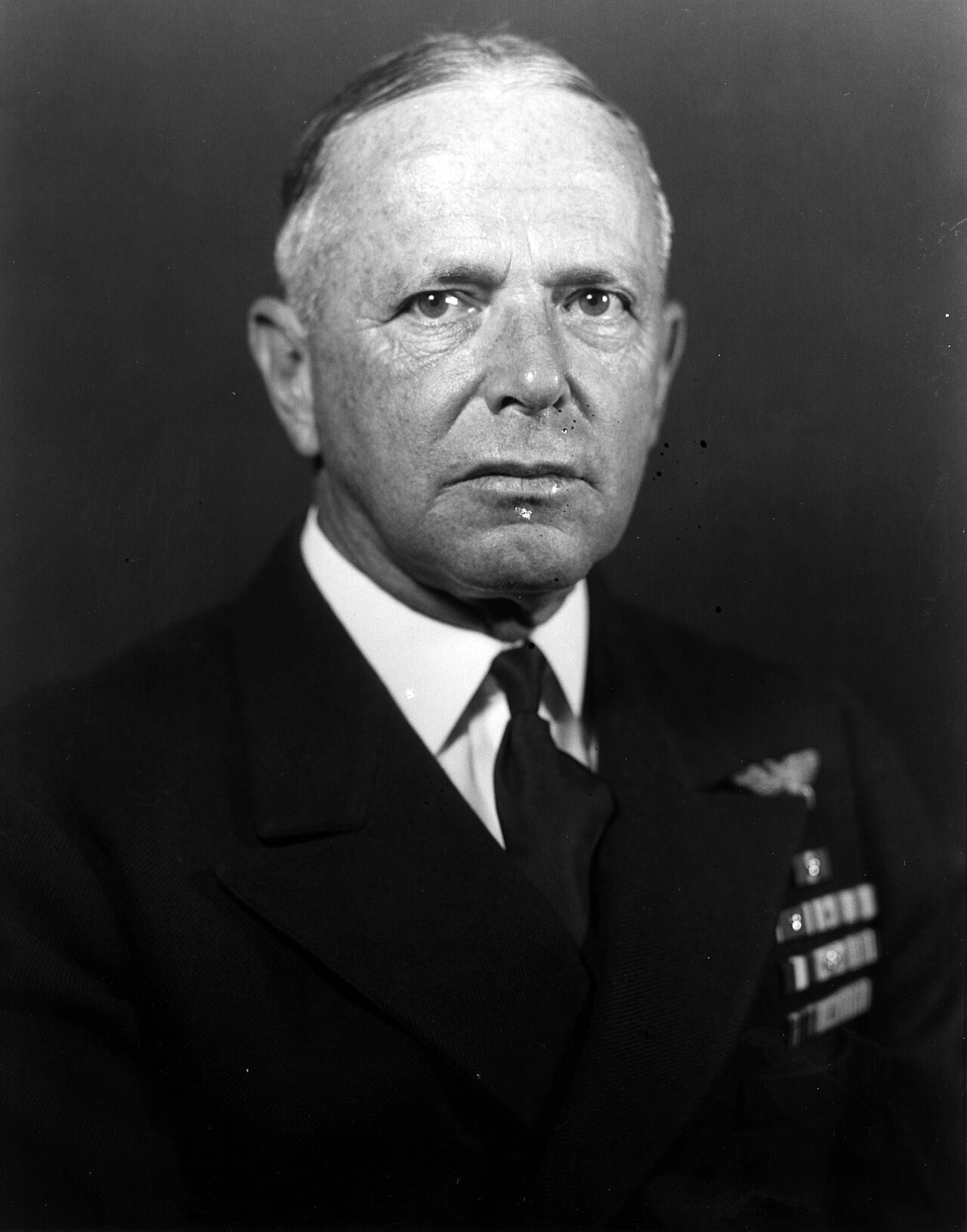
John W. Reeves Jr. was a United States Navy officer the fleet called Black Jack, a name that followed a hard and exacting manner. Born on 25 April 1888, he paired that strictness with a reputation for staying calm and pressing an action when a command was under strain. He served through two world wars, held a carrier command at the opening of the second, and retired as an admiral. He died in Pensacola, Florida, on 16 July 1967.
His early sea duty was in destroyers. As a lieutenant commander he commanded Parrott in 1928 and 1929. He came to aviation late. In 1936, at the age of forty-eight, he qualified as a naval aviator, then served as executive officer of the carrier Langley. That flying tour prepared him to put a new ship into commission.
On 25 April 1940 Reeves became captain of USS Wasp (CV-7) when the carrier entered service at the Army Quartermaster Base in South Boston. Built at Quincy, Massachusetts, she was a smaller fleet carrier, shaped by the treaty limits of the 1930s. He spent the rest of 1940 and the following year working her up between the Atlantic and the Caribbean. The ship dressed overall at Guantanamo Bay for Navy Day in October 1940, patrolled while the United States was still neutral, and in 1941 supported the occupation of Iceland. One night in the Atlantic he came to the bridge after flares were sighted, took the conn, and brought Wasp up to the lumber schooner George E. Klinck, which was in distress.
Reeves still had Wasp when the United States entered the war, and the carrier remained in the Atlantic through the first months of 1942. On 17 March, while she and her escorts steamed from the Maine coast toward Norfolk, Wasp collided with the destroyer Stack. The destroyer was badly damaged. Reeves reported that the other ship was believed to be Stack and directed her to make for Norfolk, while the carrier went on. In April he joined Wasp to the British Home Fleet. That spring the ship twice flew off loads of British fighters within reach of Malta, then under a heavy siege from the air. After the second delivery, Prime Minister Churchill thanked the carrier in a message that played on the idea a wasp could sting twice.
His command ended at Norfolk on 31 May 1942, when Forrest P. Sherman relieved him. Sherman took Wasp into the Pacific. The carrier covered the Guadalcanal landings in August 1942. On 15 September she was crippled by submarine torpedoes and scuttled that night. Reeves had already gone on to flag rank. Promoted to rear admiral in 1942, he was assigned to command the Alaskan Sector of the Northwest Sea Frontier.
From Alaska he shared in the campaign to clear Japanese garrisons from the Aleutians, where enemy troops held Attu and Kiska. On 12 January 1943 he commanded the Alaskan Sector escort group, a gunboat, a minesweeper, and three fast minesweepers, during the occupation of Amchitka. American forces used the island as a step in driving those garrisons out of the chain.
He returned to sea with the fast carriers in 1944 as commander of Carrier Division Four. He led Task Group 58.1 and later Task Group 58.3. His flag flew in Enterprise, with Lexington, San Jacinto, and Princeton in the same group. On 19 and 20 June 1944 that group fought in the Battle of the Philippine Sea. Carrier fighters broke up the Japanese air attacks in the action remembered as the Marianas Turkey Shoot, and Reeves's ships were in that fight.
Shore commands followed. Later in 1944 he commanded the Western Carolines Sub Area, and in 1945 he became head of the Naval Air Transport Service. His last post was Chief of Naval Air Training at Pensacola. He was promoted to vice admiral on 1 April 1949 and retired in May 1950, advanced on retirement to the rank of admiral for combat service. The war also brought him the Navy Distinguished Service Medal and the Legion of Merit.