Ships
- USS Wasp (CV-7) Captain, 31 May 1942 – 15 September 1942
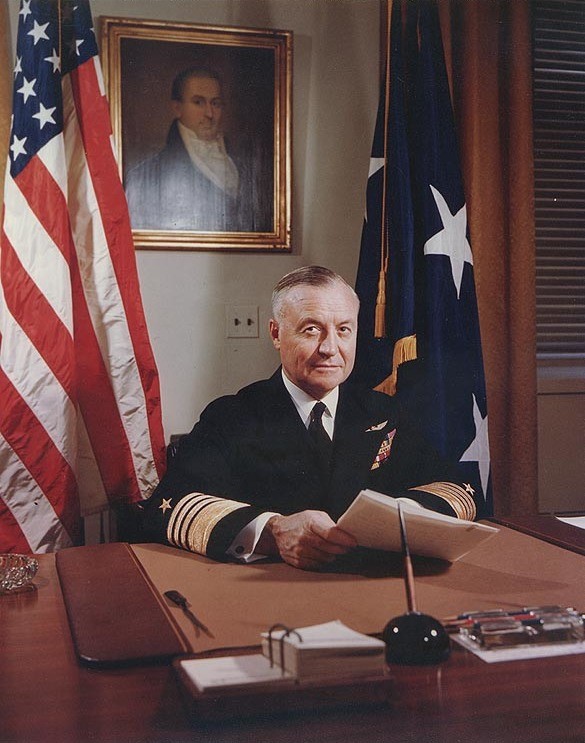
Forrest Percival Sherman was born on 30 October 1896 in Merrimack, New Hampshire. He entered the United States Naval Academy in 1914. The First World War cut the course short, and he graduated in June 1917 with the Class of 1918. His first cruises were in European waters, aboard the gunboat Nashville and the destroyer Murray. After the armistice he served as flag lieutenant to the commander of the Atlantic Fleet Control Force. In 1921 he was given his first ship, the destroyer Barry. He then trained at Pensacola and was designated a naval aviator on 22 December 1922.
From then until the Pacific war he divided his time between cockpits and planning staffs. He served in a fighting squadron, taught flying at Pensacola, and attended the Naval War College. In the late 1920s he went to the carriers Lexington and Saratoga, where he commanded Scouting Squadron Two and served as flag secretary to the commander of the Battle Fleet's aircraft squadrons. He became a lieutenant commander in 1930 and a commander in 1937. In that decade he taught at the Naval Academy, commanded Fighting Squadron One, headed the aviation ordnance section of the Bureau of Ordnance, and navigated the carrier Ranger. By 1941 he was in the Office of the Chief of Naval Operations, a member of the Permanent Joint Board on Defense with Canada, and a participant in the Atlantic Conference of August 1941.
On 31 May 1942, with the rank of captain, he took command of USS Wasp (CV-7). He relieved John W. Reeves Jr., who had been her captain since commissioning and was moving up to flag rank. The carrier had just returned from two runs that delivered British fighters to Malta. Early in June she left Norfolk in company with the battleship North Carolina, crossed the Panama Canal, and became the flagship of Rear Admiral Leigh Noyes. She reached San Diego on 19 June, embarked more aircraft, and on 1 July sailed for Tongatabu with a Marine convoy.
In the South Pacific, Wasp joined Saratoga and Enterprise under Vice Admiral Frank Jack Fletcher for the landings in the Solomons. Sherman was both commanding officer and Noyes's flag captain, and he supervised the air plan that covered the Marines at Guadalcanal and Tulagi on 7 August 1942. Her fighters and bombers hit Japanese positions ashore and fought enemy aircraft over the transports. On 24 August she was off the line, fueling, when the Battle of the Eastern Solomons was fought. Enterprise came out of that action damaged, and on 31 August a Japanese submarine torpedoed Saratoga and sent her home for repairs. For the weeks that followed, Wasp and Hornet were the only American carriers operating in the South Pacific.
On the afternoon of 15 September 1942, Wasp was southeast of San Cristobal Island, screening transports that carried the 7th Marine Regiment to Guadalcanal. Hornet and North Carolina were in the same force. The carrier was landing aircraft when the Japanese submarine I-19 fired six torpedoes. Sherman turned hard, but torpedoes struck forward, near gasoline tanks and magazines. Fires ran through the hangar, fire mains failed, and the ship listed. He conferred with his executive officer, Commander Fred C. Dickey, and with Admiral Noyes, then ordered abandon ship at about 3:20 p.m. Destroyers lifted off the survivors. The destroyer Lansdowne afterward sank the burning ship with torpedoes, and Wasp went down that evening. One hundred ninety-three of her men were killed and hundreds more were wounded. Torpedoes from the same spread also hit North Carolina, which reached port, and the destroyer O'Brien, which later sank on the way to repair. Sherman left the ship with his crew. His command ended that day.
In November 1942 he received the Navy Cross for his leadership of Wasp during the seizure of Tulagi and Guadalcanal and the operations that followed, including the search for the Japanese force retiring after the Eastern Solomons. He next became chief of staff to Admiral John H. Towers, commander of the Pacific Fleet's air force. Promoted to rear admiral in April 1943, he joined the staff of Admiral Chester W. Nimitz that November as deputy chief of staff. Through the rest of the war he helped plan the Central Pacific drive, from the Gilberts and Marshalls through the Marianas to Iwo Jima and Okinawa. In August 1945 he represented the Navy at the first surrender meetings with Japanese officers in Manila, and on 2 September he was present on Missouri in Tokyo Bay when the formal surrender was signed.
A short tour in command of a carrier division followed. Late in 1945 he went to Washington as Deputy Chief of Naval Operations for operations, in the rank of vice admiral. He worked on the Navy's place in the postwar defense establishment and on the first outlines of Cold War strategy, then commanded American naval forces in the Mediterranean. In November 1949, after a bitter public argument in Washington over the future of naval aviation and the role of the fleet, he was recalled and appointed Chief of Naval Operations with the rank of admiral, the youngest officer to hold the office up to that time. He steadied the service and directed its share of the first year of the Korean War, while also tying the fleet to the new North Atlantic alliance. On 22 July 1951, during a diplomatic trip in Europe, he died in Naples after a sudden series of heart attacks, still on active duty. The Navy named the destroyers Forrest Sherman (DD-931) and Forrest Sherman (DDG-98) for him, and the airfield at Naval Air Station Pensacola bears his name.