Ships
- USS Stanly (DD-478) Captain, 12 December 1942 – 1944
He is not one of the Cavanaughs who crowd the same indexes: not James Henry Cavanaugh, not John Owen Cavanaugh, not Earl Harley, Morrison Elmer, Joseph James, Richard Benedict, Edison Thomas, or Robert Bernard Cavanaugh. He is not Admiral Sir Arthur Cavenagh Leveson of the Royal Navy. The officer in the registers is Robert William Cavenagh, United States Naval Academy class of 1926, file number 60333, born 18 November 1904. That page is a list, not a record. What follows is the life the registers, the 1926 Lucky Bag, the ship histories, and the award texts will support. Where they stop, or where they disagree, the blank stays in the sentence.
Origins
He was born on 18 November 1904. The Register of Commissioned and Warrant Officers of 1 July 1944 prints that day on his line, after the dittos in the rank columns: 18 Nov. 04, and beside it the day he entered the service, 18 July 22. The Register of 1 July 1945 prints both dates again, in the captains' section. The Register of 1 January 1960, on the flag-officer list, prints the birth as the digits 11 18 04. The Register of 1 January 1966 prints 11 18 04 once more. The registers do not give a town.
The 1926 Lucky Bag heads his page "cleveland, ohio." That is the home a midshipman claimed. It is not, by itself, a birthplace. The Washington Post of 7 April 1995, in the obituary indexed on the same page as another man's death notice, calls him "a native of Cleveland." The indexed text is the one used here. The live page, when opened, now stops before his notice. Cleveland as a native place rests on that obituary, not on the registers.
Nothing in the registers names a father, a mother, brothers, or sisters. No marriage, no wife, and no children turned up in a source that could be read through, as distinct from a search engine's paraphrase of the obituary. That is a blank, not a conclusion that he had no family.
Formation
The Lucky Bag says he spent a year at Oberlin College before he entered the Academy. It does not give the year of that college term, or a degree, or a subject. The registers date his entry 18 July 1922. If the yearbook is right about Oberlin, that year sits just before the summer he was sworn in. The book does not say he finished a course there.
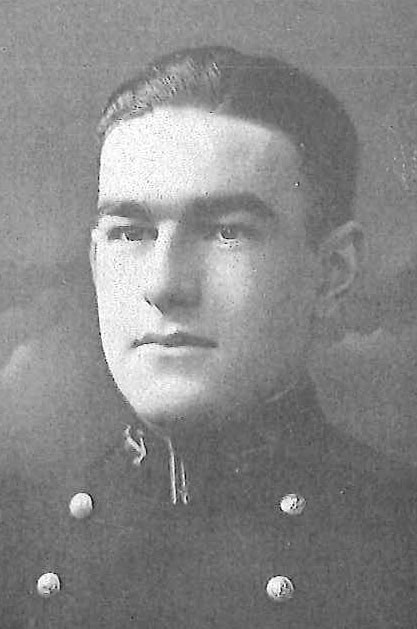
His classmates called him "Bob" and "Cav." The sketch is classmate prose, written to be liked, and it should be read that way. "Cav spent a year at Oberlin College before entering the Academy. Early in his career as a midshipman, he won the good will and respect of his classmates. His dignity and reserve marked him as a gentleman, while his pleasant disposition and unfailing sense of humor made his friendship a pleasure." The line they put in his mouth is, "I've an idea. If I could only work it out! How's this sound to you?" The yearbook says a good many of those ideas died on a drawing board and later turned up in the Log. It says he played piano in the orchestra for two years and helped more than one Musical Club show. "Conscientious effort and study have removed any difficulties the Academics have offered, and have placed him well toward the top in the class." That is their sentence. The registers do not print a class standing, and they do not say he was turned back. He finished with the class he entered with.
The same page is not consistent about the crew. The prose says that on his youngster cruise he showed the usual eagerness for working parties, that on his second-class cruise he was often on deck coaching the youngsters in holystoning, and that after three years on the crew squad he kept the old joke about a crew man needing a strong back and a weak mind, and claimed the weak mind. The credit line under the sketch reads "Crew (4, 3, 2, 1); Orchestra (3, 2, 1); Star (4)." Four numbers against three years is a disagreement inside one page. The parenthetical numbers are left as the yearbook printed them. "Star (4)" is not expanded on his page.
He was commissioned ensign on 3 June 1926. The Register of 1 July 1942, on the lieutenant commanders' page that contains him and his classmates, footnotes the block: commissioned ensign 3 June 1926. The Register of 1 January 1960 prints 6 03 26 in the column for date of first commission, on the same line as the birth date. On 1 January 1927 the ensigns' page lists him as signal 4864. The dates on that line are 15 September 1926 and a ditto of the preceding officer's "Aug. 25," and the station is Arkansas. The page header, once the words are put back in order, mixes "date of present grade," the commencement of a sea cruise, and the expiration of a last cruise. The September date is the one set beside his name. It is not the commissioning day. The station is a battleship. The register does not give his billet, and it does not say he was still on board the next month. He was an ensign on someone else's ship.
The next station the registers examined here will name is a submarine. On 1 January 1933 he is a lieutenant (junior grade). On that page the date of rank is printed once, beside George Theodore Mundorff, as 3 June 1929, and is then dittoed down a long run of the class of 1926. His own line, signal 3953, does not break the ditto. Three June 1929 is the block date, three years after the ensign's commission, not a day reprinted beside his name. The qualification numbers on the line are 7 and 30. In that volume's own key, 7 is "Qualified in submarines" and 30 is "Completed course in submarine instruction." The duty is Argonaut. The book does not say what he did on her, or where she was that winter.
On 1 January 1934 the index still has him a lieutenant (junior grade). In the body of that volume the block that carries his name puts "Naval Academy (instrn.)" where the neighboring lines put a ship or a school. The figures on his line read as courses 1 and 30 rather than as a date. The plain optical text of that page is column-scrambled, and the duty is trusted only because it sits in the same slot as the duties of the men above and below him. By 1 January 1936 the index still lists him a lieutenant (junior grade). No duty for 1936 was recovered from the scrambled text of that volume.
On 1 July 1938 he is a lieutenant, and the station is no longer a school. Signal 3047, Robert William Cavenagh, courses reading 1, 22-e, and 30, date of rank dittoed, "Commanding S-41." The date of rank at the head of that ditto, beside Nathaniel Scudder Prime, is 30 June 1936, and the "do" is not broken between Prime and Cavenagh. Thirty June 1936 is the block date for lieutenant. In the Register of 1 July 1940, number 1 is "Qualified for command of submarines" and 22-e is "Completed postgraduate course in naval engineering (design)." Number 30, already defined in the 1933 book, is the submarine course. The July 1938 line is the first that puts "commanding" next to his name.
S-41 (SS-146), in the Dictionary of American Naval Fighting Ships, had been an Asiatic Fleet boat since she reached Manila in November 1924. For the next fifteen years, that history says, her division spent summers in Chinese waters and winters in the Philippines, with occasional independent missions, and by the spring of 1938 the schedule had been extended to the East Indies. The ship history does not name Cavenagh. The register does not say he made the China summer or the East Indies extension. It says that on 1 July 1938 he was the lieutenant in command. The Washington Post obituary says he "served on submarines during the 1930s in the Far East." The sentence is general. It fits the fleet S-41 belonged to. It does not identify a patrol.
The same obituary says he "was engineering officer of a cruiser before World War II." No register line read for this essay puts him on a cruiser, or styles him an engineering officer. On 1 July 1940 he is a lieutenant commander at the Bureau of Ships. The date of rank on that page is printed beside Charles Broderick Hart as 1 July 1940 and dittoed. Many of the men around him carry "(Y)," which the registers of that era use for an officer still subject to examination or confirmation. His line is "do," without the "(Y)." The courses are again 1, 22-e, and 30: submarine command, the postgraduate course in naval engineering design, and the submarine school. The Bureau of Ships is a shore bureau, new that year out of the old construction and engineering bureaus. It is an engineer's desk, not a cruiser's fireroom. The obituary also says he "received a master's degree in engineering from the University of California at Berkeley" and that he attended the National War College. Neither sentence is dated. The Berkeley degree and course 22-e are two facts from two books. They are not identified here as the same year of school.
On 1 July 1942 he is still a lieutenant commander. The page is the wartime list: signal, name, courses, temporary rank, permanent rank, date of that permanent rank. Present duty is not on it. His courses are again 1, 22-e, and 30. The permanent rank, dittoed from the man at signal 2486, is lieutenant commander from 1 July 1940. The ship, if he had one that summer, is not in this book.
The war, as the paper has it
From the summer of 1940, when the register still had him at the Bureau of Ships, until a citation puts him on a destroyer's bridge in November 1943, the official list drops the station. The Register of 1 July 1942 names no ship. The Register of 1 July 1944 names no ship. No deck log, no war diary, and no action report signed by him was found. Two compiled commanding-officer lists, of the kind the encyclopedia's own standards set aside unless a better source confirms them, give him Dahlgren (DD-187) from 8 February 1942 to 10 December 1942, and Stanly (DD-478) from 12 December 1942 to 1 January 1944. Those dates are not narrated here as a cruise. They are listed, and left, in the gaps.
What the 1 July 1944 register does say is the rank. He is in the commanders' section, signal 2229, file number 60333. The page header separates date of temporary rank from permanent rank and the date of that permanent rank. Walking the dittos: a temporary-rank date of 15 August 1942 is printed, then carried; the permanent rank stays lieutenant commander; the permanent date, reset beside a classmate and then dittoed through Cavenagh's line, is 1 July 1940. The section he sits in is commanders, so the temporary rank dated 15 August 1942 is commander. The qualifications after his name are (E) and (G-1). In that volume's own key, (E) is "Awarded Silver Star Medal" and (G-1) is "Awarded Bronze Star Medal." He is not marked (B), the Navy Cross, and he is not marked (D), the Legion of Merit. The courses are still 1, 22-e, and 30. By the summer of 1944 the Navy's own book had given him two decorations and had not given him the cross.
The night that later citation texts attach to his name is 1–2 November 1943, off Bougainville. A compilation of award citations, the Hall of Valor, prints a Navy Cross to "Captain [then Commander] Robert William Cavenagh," Navy service number 0-60333, "as Commanding Officer of the Destroyer U.S.S. STANLEY (DD-478)," for the engagement with Japanese naval forces at Empress Augusta Bay. It cites Commander Southern Pacific Force serial 00162 of 14 January 1944. The ship is Stanly, not Stanley. The Dictionary of American Naval Fighting Ships uses Stanly throughout: laid down at the Charleston Navy Yard on 15 September 1941, launched 2 May 1942, commissioned 15 October 1942 with Lieutenant Commander James M. Robinson in command. The citation's spelling is the compiler's error. The file number is the register's.
The words of that Navy Cross are the words given, in the same compilation, to other destroyer captains of the same night: the task force met a Japanese force of superior fire power; he "hurled the full fighting strength of his ship against the enemy"; by leadership and tactics he aided the force in sinking five hostile warships, damaging four others, and routing the enemy, and so helped the beachhead on Bougainville. A second compilation, Home of Heroes, prints a different Navy Cross for the same man, the same ship, and the same night: he "sought out and engaged six Japanese warships," and his officers and men contributed to "the sinking of four ships and the serious damaging of two others." Those two paragraphs cannot both be the citation as issued. The second is the shape of language used, in the Hall of Valor's own pages, for a later fight, the night of 24–25 November, and not for this one. It is not used here as his text.
The ship history is more particular, and it does not name him. Late on 1 November, it says, Task Force 39 sighted an enemy surface force and could not engage until early the next morning, when that force came out against the landing area at Empress Augusta Bay. Radar contact at 0230 on 2 November. Stanly, with the other three destroyers in the van, opened the battle with a torpedo attack. The cruisers of Rear Admiral Merrill's task force, the history says, were the star of what followed. Captain Arleigh Burke's "Little Beavers," Stanly included, "contributed by finishing off the destroyer Hatsukaze and by showering a hail of 5 inch shells on the enemy." The battle, in that account, claimed the cruiser Sendai and Hatsukaze. Admiral Omori retired north without landing reinforcements at Cape Torokina. At dawn the American ships headed for a rendezvous with transports, beat off a raid the history numbers at about a hundred planes from Rabaul, and by the next day were in Tulagi. Five ships sunk and four damaged, which is what the first citation says the task force did, is not what this ship history says the battle cost the Japanese. The citation is a task-force paragraph with his name set into it. The ship history is a count of two ships, and a sentence that includes Stanly in the finishing of one destroyer. If he was her captain that night, as the citation says, those are the hours the paper will actually describe. It will not turn the citation's five and four into his personal score.
The same compilation prints a Legion of Merit with Combat "V" to Captain Robert William Cavenagh, for service as "Commander Destroyer Division FORTY-SIX" against Japanese forces in the South and West Pacific from 4 January 1944 to 9 January 1945. "Conducting many independent bombardments and other missions during this period, Captain Cavenagh maneuvered the ships under his command with skill and precision, inflicting heavy damage on the enemy," and so contributed to "the capture of Japanese held territory." No island is named. No ship of the division is named. The period begins three days after the date the compiled commanding-officer lists give for his leaving Stanly. That proximity is a reason to look. It is not a relief letter. The Register of 1 July 1945 still does not mark him with (D), the Legion of Merit. It lists him in the captains' section, still (E) and (G-1) only, Silver Star and Bronze Star, with the same birth and the same entry day. A captaincy by 1 July 1945 is what that book shows. The day he became a captain is not printed on the line that was read. The Hall of Valor's "Captain [then Commander]" for the November 1943 night says he was a commander when the fight happened and a captain by the time that text was styled. The July 1944 register, six months after the serial date on the Navy Cross, still has him a commander, and still has no Navy Cross on the line.
Stanly's own later war is in the ship history and is not claimed for him. The history takes her through the Bismarcks, the Palaus, the Marianas, a return to the United States in the summer of 1944, Leyte, Lingayen, Iwo Jima, and Okinawa, where on 12 April 1945 a baka bomb passed through her bow and, the history says, three men were wounded, and where later a gun burst in a drill killed two coxswains, "Stanly's only mortal casualties of the war." By 4 January 1944 the Legion of Merit text already has him in a division command, not on her bridge. The dead of 1945 are not written here as his.
Cost
No source read for this essay records a wound, a court, a reprimand, or a sentence of his own about a decision he regretted. The Lucky Bag's gentleman of dignity and humor is a midshipman's portrait. It is not evidence of how he behaved off Bougainville.
The cost that is on paper is a disagreement about what the night was worth, and about which medal followed it. One citation text has his task force sinking five ships and damaging four. Another citation text, under the same medal and the same date, has six ships engaged and four sunk and two badly damaged. The ship history has Sendai and Hatsukaze, a torpedo attack by the van, five-inch gunfire, a retirement by the Japanese admiral, and a hundred-plane raid on the way home. The Navy's register, both in July 1944 and in July 1945, credits him with a Silver Star and a Bronze Star and does not credit him with the Navy Cross or the Legion of Merit. The citation sites credit him with the cross for that November night and with the Legion of Merit for the division year that followed. No citation text for the Silver Star or the Bronze Star was found, so it is not possible to say from these books which decoration, if only one of them, belongs to Empress Augusta Bay. A man can be given the same night in two incompatible paragraphs, and the official list can omit the medal the paragraphs claim. That is the record. It is not a verdict that he did not fight the action, and it is not a verdict that the cross was never awarded. The award, if it came, had not been entered on the line by 1 July 1945.
The division citation, for all its length of service, is almost empty of events. A year of bombardments, "heavy damage," territory taken, and no place name. Whatever it cost the ships under him, the citation does not say. The ship he is actually placed on, for one night, came out of that night in the ship history without a sentence of damage or dead. The history's only deaths on Stanly fall in a gunnery drill long after the division citation has him elsewhere.
After
The Hall of Valor prints a second Legion of Merit, this one an Army award, a bronze oak-leaf cluster, to Rear Admiral Robert William Cavenagh, as Deputy Assistant Chief of Staff, J-3 Section, Headquarters, Far East and United Nations Command, in Japan, from 11 September 1953 to 27 July 1954. The text is staff work: joint plans, the armistice commission, plans for expanding Japanese and Korean forces, three joint war games, a minute of agreement with the Republic of Korea. It is not a sea command. It ends four days before the date the next register uses for his rank.
On 1 January 1955 the Register lists him in a run of names that begins with flag officers and continues into captains. His permanent rank on that line is captain. The date of present rank is 1 July 1954. Birth and first commission sit further along the same line, the birth digits damaged by the optical reading, the commission reading 6 03 26, which agrees with 3 June 1926. On 1 January 1960 the flag-officer list has him again, designator 1100, year-group 1926, and the date in the date-of-rank column is the same 1 July 1954, birth 11 18 04, first commission 6 03 26. A flag officer's date of present rank and a captain's date of present rank are not the same fact if they are the same day. Both books print that day. The conflict is left open below. What is not in doubt is that by the first day of 1960 the Navy was listing him among flag officers, and that the Post later called him a retired rear admiral.
The obituary says he "served as commander of the cruiser force in the Atlantic Fleet and commandant of the Fourth Naval District in Philadelphia." It does not date either job. A photograph caption on a private blog places him at a change-of-command ceremony for Commander Cruiser Force, U.S. Atlantic Fleet, on Canberra on 2 November 1960, in company with Rear Admiral John McNay Taylor and Admiral Robert L. Dennison. The caption does not say which flag officer was relieving and which was being relieved. It is not used here as the date he took that force.
The Hall of Valor prints a third Legion of Merit, for duty as "Chief, Military Assistance Command, Norway," from 15 January 1965 to 30 November 1966: the military-assistance program, closer ties between Norway and the United States, and Norwegian forces under the NATO alliance. The title is given as that compilation prints it. The Register of 1 January 1966 still carries him, Robert William Cavenagh, year-group 1926, designator 1100, the date 07 01 54, birth 11 18 04. He had not been dropped from that active list on New Year's Day of the year the Norway citation ends.
He died on 3 April 1995. The Post says he was 90, that he died of heart ailments at Bethesda Naval Hospital, that he had lived in the Washington area off and on since 1938, and that he lived at Carl Vinson Hall in McLean. It says he served more than forty years. From 18 July 1922 to a Norway tour dated through November 1966 is forty-four years if both ends are his, and the retirement date itself was not found in a register. The Hall of Valor adds Arlington National Cemetery. No cemetery register was opened to confirm the grave. The obituary's indexed text, as far as it could be read, does not name who survived him.
The sea that can be documented is a short list with long gaps: ensign in Arkansas, lieutenant (junior grade) in Argonaut, lieutenant commanding S-41 in the Asiatic pattern, lieutenant commander at the Bureau of Ships, commander in Stanly for one cited night, then a year in command of a destroyer division that the citation will not locate. The engineering course and the bureau, and the Berkeley degree the obituary adds, are the other half of the career, the half that does not show on a bridge. He lived to ninety.