Ships
- USS Dyson (DD-572) Captain, 30 December 1942 – 12 March 1944
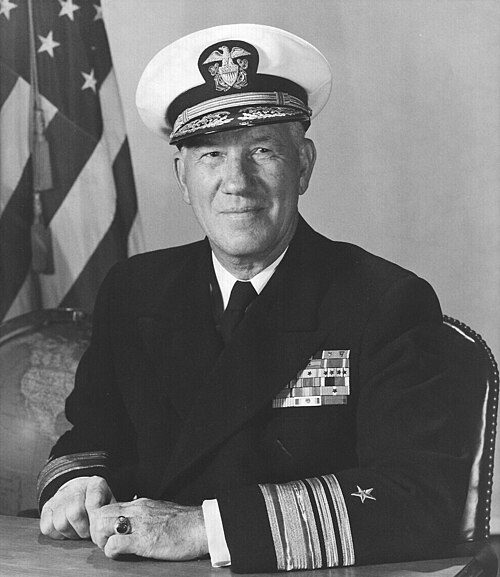
Roy Alexander Gano was born in Pipestone, Minnesota, on 3 December 1902. In the Navy he was known as Red. He graduated from the United States Naval Academy in 1926 and remained in the service until 1964, ending his career as a vice admiral.
His first sea duty was in the battleship Tennessee, from 1926 to 1929. He then served in the destroyers John D. Edwards, Edsall, and MacLeish. After postgraduate study at the Naval Academy in 1934, he was engineer officer of the destroyer Dewey until 1937. From 1937 to 1939 he worked as a special engineer at the Navy research laboratory in Bellevue, Washington. In 1941 he was material officer on the staff of the Destroyer Battle Force.
Early in the Pacific war he served as material officer with the task force in Alaskan waters. On 30 December 1942 he became captain of the new Fletcher-class destroyer Dyson (DD-572) when she was commissioned at Orange, Texas. He commanded her until 12 March 1944.
Dyson joined Destroyer Squadron 23 in the Solomon Islands. The squadron, nicknamed the Little Beavers and led by Captain Arleigh A. Burke, covered the landings on Bougainville in November 1943. On the night of 1–2 November, in the Battle of Empress Augusta Bay, a Japanese force of cruisers and destroyers tried to break up the beachhead. Gano took Dyson into the night fight with the American formation. The attack was turned back and the landing held. He received the Navy Cross for his leadership that night.
On the night of 24–25 November 1943, Dyson was with Burke’s destroyers again in the Battle of Cape St. George. The American ships intercepted a Japanese destroyer force, sank Onami, Makinami, and Yugiri, and came out of the action intact. Gano was awarded a gold star in lieu of a second Navy Cross. In the months after the Bougainville landings, while he still had Dyson, Squadron 23 fought twenty-two engagements. Over that span the squadron was credited with one Japanese cruiser, nine destroyers, one submarine, several smaller vessels, and about thirty aircraft.
From 1948 to 1950 he directed recruiting in the Bureau of Naval Personnel, and from 1950 to 1951 he directed the enlisted personnel division. He returned to sea in 1951 as commanding officer of the heavy cruiser Saint Paul and took her to Korean waters, remaining in command into 1952. In August and September 1954 he served with the logistic group that planned Passage to Freedom, the sealift that carried people out of northern Vietnam.
From 1955 to 1956 he was deputy chief of staff for administration of the Far East and United Nations commands. He was deputy commander of the Military Sea Transportation Service from 1956 to 1958, commanded Amphibious Group 2 from 1958 to 1959, and in 1959 took command of the Military Sea Transportation Service, the organization that moved troops and military cargo by sea. From 1961 he was also executive director for ocean transportation. He retired in 1964 as a vice admiral. The Navy Distinguished Service Medal recognized that last tour. His decorations also included two awards of the Legion of Merit and two Bronze Stars, together with the two Navy Crosses from the Solomons.
He married Harriet Pauline Howard on 18 July 1929. They had a daughter, Jeanne, and a son, James. Gano died in Falls Church, Virginia, on 20 January 1971, and was buried at Arlington National Cemetery.