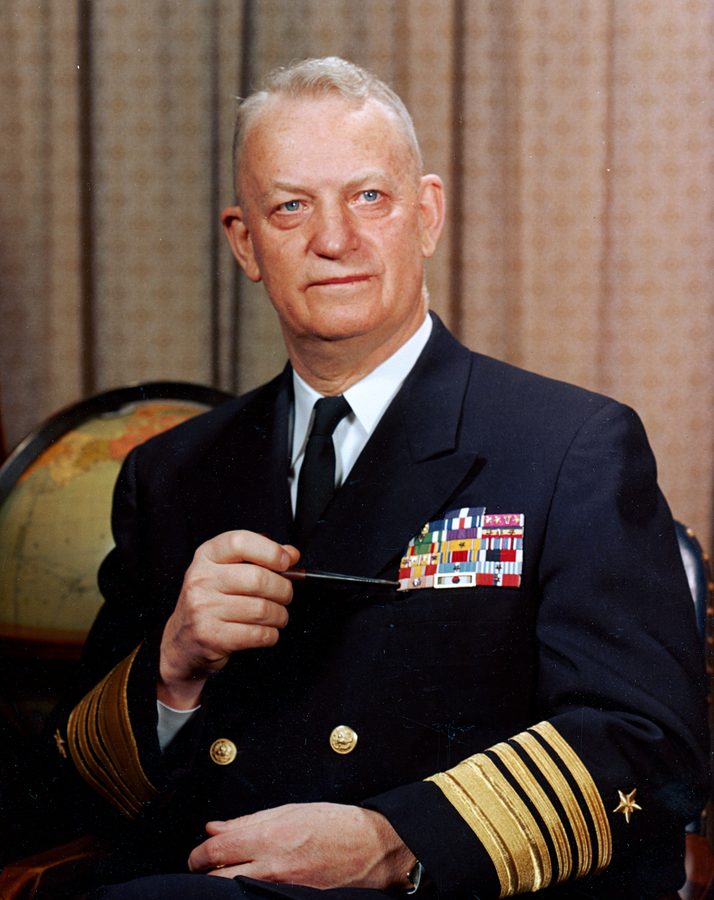
On the night of 1–2 November 1943 he was a captain commanding Destroyer Squadron 23, and his flag was in Charles Ausburne, in the van with Dyson, Stanly, and Claxton, at the Battle of Empress Augusta Bay. The Navy's own biographical sketch, the Dictionary of American Naval Fighting Ships biographical entry, and the Naval History and Heritage Command essay by David Alan Rosenberg all give it as Albert. He is Arleigh Albert Burke, born 19 October 1901, Naval Academy class of 1923, the destroyer officer who later served three terms as Chief of Naval Operations and died on 1 January 1996. He is not any other Burke.
What follows stays with his papers as Rosenberg used them, with the Navy sketch and the citation packet scanned at the Naval History and Heritage Command, with the DANFS biographical sketch, and with a few contemporary or near-contemporary printed accounts. The nickname, the squadron's credited score, and the Navy Cross citation all run past what the night actions will support. Those places are marked. The six years as Chief of Naval Operations are not a second life told here. They are what came after, dated, and then left.
Origins
He was born on 19 October 1901 on a farm near Boulder, Colorado. The Navy sketch says "far from the sea in Boulder." Rosenberg, whose essay is built on the Burke papers in the Navy's Operational Archives, puts the farm three miles east of town, on land his father Oscar owned or rented and hoped to buy, about 180 acres. The grandfather, in that same essay, was a Swedish immigrant, Anders Petter Bjorkegren, who shortened the name to Gus Burke and became, Rosenberg writes, the first baker in Denver. The mother was Clara Mokler, of Pennsylvania Dutch stock, and Rosenberg says she put the weight on education. Oscar wanted the first son to take the farm. A ship's-association biography calls Arleigh the first of six children. Rosenberg's footnoted essay says first-born son and does not count the others. The number six is used here only as that association's statement.
The schooling is his own story as Rosenberg recorded it, not a school-board minute. He went to State Preparatory High School in Boulder in 1916. The influenza epidemic of 1918 closed the school in his junior year. The Naval Academy's short public biography says the school closed in the epidemic of 1917. Rosenberg's date, 1918, is the one that matches the pandemic, and it is the one followed here. After a stretch on a threshing crew he competed for an Academy appointment. The night before his congressman's examination, he later told it, he rode into Boulder because the weather looked like snow and slept in the stable with his horse. The snow became a blizzard. Boys who were better prepared stayed home. He took the test and got the appointment. With the school still closed he studied with his teachers and with University of Colorado professors, and for a few months at a cram school in Columbia, Missouri. He passed the entrance examinations. His father contracted smallpox; he got on the train east just clear of the quarantine. He entered the Naval Academy with the class of 1923 on 26 June 1919. DANFS prints that day of entry. The blizzard and the stable are recollection, preserved by the biographer. They are not a weather report, and they are not treated here as one.
He stood, at graduation, 70th in a class of 412. That is Rosenberg's figure. The association biography says 71st of 413. The Academy's public page says only that he finished in the top sixth, which is roughly where 70th of 412 sits, and it adds a moral the yearbook-style page wants: that he had decided thin schooling could be beaten only by working harder than the others. The class number used here is Rosenberg's. He was not, on that account, a star midshipman. Rosenberg, who interviewed him, says he was not an outstanding student, not an uncommon athlete, and not an obvious leader, and that classmates came to respect the work.
The courtship is in the same essay, and part of it is pinned to letters. In his third-class year he met Roberta Gorsuch on a blind date. Rosenberg describes her as Kansas-born, the daughter of a Washington businessman, about five feet tall to his six, playful, and a Christian Scientist. He admired the faith and did not share it. Her own later obituary in the Washington Post says she was a native of Lawrence, Kansas. In December 1922, after an address by Major General Commandant John A. Lejeune, Burke asked for a Marine commission, worried, Rosenberg writes, that sea duty would keep him from her. She was not enthusiastic. He withdrew the request. The letters to her of 17 December 1922, 19 January 1923, and 22 January 1923 are in the Burke papers, and the Academy record notes the withdrawal on 5 February 1923. That is a documented choice, small beside a war, and it is the first one on paper: he looked at a life that would keep him nearer her, and he did not take it.
They were married on graduation day. Rosenberg and DANFS both put graduation on 7 June 1923. Rosenberg says the wedding was that day. A poem Roberta wrote in 1935, printed after his death in Naval History, remembers "his wedding day on the seventh of June." The Navy's shorter biographical sketch, the one that gives his Bethesda address in retirement, says he was graduated, commissioned ensign, and married on 6 June 1923. One of those days is wrong. The weight is with 7 June: the DANFS graduation date, the letters' biographer, and her poem. The sketch's 6 June is recorded and not followed. The association biography adds that the wedding was in the Naval Academy chapel, in the afternoon. That detail is not in Rosenberg's notes as printed. It is left as the association's sentence.
They had no children. The Virginian-Pilot obituary of 2 January 1996 says so in plain words, and says the wife, the former Bobbie Gorsuch of Washington, survived him. Rosenberg, writing of the years after retirement, says Burke had no children of his own. There is no birth of a child to explain away, and no late discovery in the sources read here.
Formation
Ensign Burke went to the battleship Arizona. DANFS says he joined her soon after graduation and, over the next years, was a junior watch and division officer, had command of turret 4, and served as torpedo officer, assistant engineer, and ship's secretary. He qualified to run the plotting room for gunnery exercises. In the spring of 1927 he spent a month at the Ford Instrument Company in New York on a new antiaircraft director. Rosenberg's frame for the same five years is plainer: forty ensigns in a large wardroom, learning deck seamanship, steam, gunnery, and how to lead a division, including the men of a fourteen-inch turret and, at the unglamorous end, the double bottoms. He completed the Naval War College correspondence course in strategy and tactics. In 1925 he looked at lighter-than-air aviation and in 1926 at aerology. Seniors talked him back to gunnery. In 1927 he applied for postgraduate ordnance work and was turned down.
Before he was commissioned he had already written Roberta, from the midshipman cruise, about the big guns and about wanting "a full knowledge of ordnance" so that he might get postgraduate school. Those letters, July 1922 and early 1923, are in the papers. The wish was specific. It was also the path that would keep him at a desk when the war he had trained for actually started.
On 2 April 1928, his first postgraduate bid having failed, he was ordered to Procyon, flagship of Rear Admiral W. W. Phelps, Commander, Fleet Base Force. DANFS has him assistant navigator and ship's secretary, then, in June 1928, flag lieutenant and force personnel officer. The Navy sketch says that in 1928, aboard Procyon, he was commended for the "rescue of shipwrecked and seafaring men." The sketch does not say what ship was lost, who was taken off, or what he did. The commendation is real as the Navy stated it. The rescue story is not invented here to fill the quotation marks.
A second application was approved in October 1928. On 17 June 1929 he reported to the Postgraduate School at Annapolis for ordnance work, later continued at Ann Arbor. Rosenberg says he needed tutoring in college chemistry to get into the graduate school. On 22 June 1931 the University of Michigan gave him a master of science. DANFS dates the degree that day and describes the course as ordnance design, fire control, and ballistics. Rosenberg names the degree as chemical engineering. The Navy sketch says only "Master of Science in Engineering." The day is DANFS. The field, where a field is named, is Rosenberg's chemical engineering. He then spent about a year visiting plants and depots that made and stored explosives. In the spring of 1932 he went to the heavy cruiser Chester as main-battery officer, for something under a year. From April 1933 he was with the Battle Force Camera Party, photographing the fall of shot. DANFS says Rear Admiral Harold R. Stark, then Chief of the Bureau of Ordnance, wrote that the young officer had a "keen grasp of ordnance in relation to the service" and would be "an officer of exceptional value to the service." From 1935 to 1937 he ran the bureau's ammunition section: purchase, storage, distribution, a new magazine layout, work on a more stable powder. The bureau had him. It would not let go easily.
In May 1937 he became prospective executive officer of the destroyer Craven, still building. Rosenberg says Quincy, Massachusetts. The DANFS biographical sketch and the association biography say the Boston Navy Yard. The hull's own yard is not re-argued here; the two official-sounding sentences disagree, and both are left standing. He was promoted to lieutenant commander in August 1938, still in Craven. On 5 June 1939 he took command of Mugford. DANFS calls her the flagship of Destroyer Division 8, Destroyer Squadron 4, Battle Force. He was relieved on 30 July 1940. Rosenberg says the bureau reclaimed him in May 1940, which can be an order rather than the day he left the ship. The day he left, on the DANFS sketch, is 30 July.
Mugford is the first command, and the record of it is better than a trophy-case line, though the lines do not quite match. The Navy sketch says that in 1939 the ship won the fleet gunnery trophy with the highest score in many years, stood third in engineering competition, and stood high in communications, and that he was commended for it. Rosenberg, using the fitness-report file, says the gunnery trophy for 1939–1940 came from a perfect short-range practice, 36 shots and 36 hits, and that the ship received the "E" in engineering and the "C" in communications. Third in a competition and an "E" are not the same sentence. Both versions are printed. Neither is silently corrected into the other. What is firmer than the prize is the man above him. Burke served under Commander F. E. M. "Red" Whiting. Whiting's fitness report for 1 October 1939 to 9 May 1940, in the papers, called him "a leader of the highest type" and said he would go far. On 6 December 1946 Burke wrote Whiting the sentence he kept: when you have anything to do, the time to do it is right now; if you have power, use it, and use it fast; decide when the problem appears. That letter is after the war. It is the rule he said he had learned before it.
His gunnery officer, Robert Speck, wrote Rosenberg in 1971 that whatever gifts Burke had, the point was the use he made of them, "continuous persistent application." His engineer, H. H. McIlhenny, wrote the same summer that command required the whole list of line duties and that Burke had those "plus a little extra: enthusiasm for, trust in, and loyalty to his subordinates." These are old men's letters to a historian. They are not deck logs. They are the closest thing to a portrait of him as a captain of a destroyer in peacetime, and they agree with the fitness report rather than with the legend.
The bureau sent him, in 1940, to the Naval Gun Factory at the Washington Navy Yard, inspecting antiaircraft and broadside mounts. Rosenberg's count of the officer corps at that moment is stark: 220 ordnance specialists, 46 of them in design and production, and more than eighty inspectors needed ashore for guns, torpedoes, and ammunition. Pearl Harbor did not free him. He asked for sea duty, Rosenberg writes, every week for more than a year, and was told he could not be spared. The "every week" is the biographer's summary of the request file, not a count made again for this essay. The fact that matters is not in dispute between the Navy sketch and the essay. He was a destroyer captain who had just won a gunnery fight against a target, the war he had wanted came, and the Navy kept him in Washington because he knew how ammunition and gun mounts were made. On 10 January 1943 a relief was finally trained, and Commander Burke left for the Pacific.
Roberta had already written the domestic side of that kind of Navy. Her 1935 poem, as Admiral Boorda printed it in Naval History in February 1996, has the midshipman saying "The Navy must always come first," and has her putting God first, then the Navy, then Arleigh. It remembers thin gravy on an ensign's pay, a footlocker household, and the day thirteen sea chests arrived on orders ashore. It is a wife's poem, not a log. It is also the only sustained thing she left in print that was found for this essay, and it says what the marriage cost in ordinary years, before anyone was shooting.
The war, as he lived it
He was not ready for Japanese night fighting. Rosenberg is blunt about that, and it is the right place to start, because the later nickname makes him sound as if he arrived already finished. He took Destroyer Division 43. The flagship was Waller. For the first months he read action reports and talked to men who had fought off Guadalcanal. The division was often split up on escort work. His first combat mission, in Rosenberg's account from the papers, was the bombardment of the airfield at Vila, in Kula Gulf, with Rear Admiral A. S. Merrill's cruisers on 6–7 March 1943. It worked. He was angry at himself anyway, because he had not worked the procedures through with his flag captain beforehand, and the command had not been smooth. An association biography says that in March 1943 Waller blew up a Japanese destroyer in the Central Solomons while his flag was in her. Rosenberg, who had the papers and who does not omit a victory, does not tell that story. The Vila bombardment is what he calls the first mission. The destroyer-sinking is not narrated here as Burke's battle. It may belong to Waller under someone else's direct hand, on a night close to that bombardment. It is not promoted into his life on the association's sentence.
By early May he had written a new employment of destroyers for a cruiser task force. The standing habit was to keep them as a night screen and to form them for battle only after the enemy was seen. He wanted them ahead of the cruisers, in battle formation, from just after sunset until just before sunrise, free to attack when the enemy was sighted. The letter is in the papers: Commander, Destroyer Division 43, to Commander, Task Force 19, "Employment of Destroyers," serial 37, 7 May 1943. The point was not bravery in the abstract. It was time. Destroyers that waited for permission would meet torpedoes already in the water. Merrill agreed to take the risk. Burke was transferred before he could try it himself.
In late May he took Destroyer Division 44. In August he became commander of Destroyer Squadron 12. The ships were still scattered on escort duty. By late July his paper doctrine had become two parallel columns, radar warning, successive torpedo attacks, surprise before the gunfight. He did not get to use it. In early August his classmate Frederick Moosbrugger took the plan into the Battle of Vella Gulf. Six American destroyers sank three Japanese destroyers and lost none. The memorandum of 22 July 1943, the battle plan of 1 August, a letter from Commander Rodger Simpson on 28 August, and Burke's letter to Roberta on 8 August are the paper trail Rosenberg cites. The taste of that, if it is fair to name it, is a man who had done the thinking and then watched another officer fire the torpedoes. He said later, in the 1945 narrative Rosenberg quotes, that commanders had to learn the value of time, "the only commodity which you can never regain."
On 19 October 1943 he was ordered to command Destroyer Squadron 23, back with Merrill's Task Force 39, for the Bougainville landing. The Navy sketch calls the squadron the "Little Beavers" and says it covered the initial landings in November and fought in 22 separate engagements in the next four months. The Distinguished Service Medal citation, which the Navy's citation packet quotes in part, covers him as commanding officer of a destroyer division and then of a squadron "from early February to December 1, 1943," and praises "indomitable fighting spirit and great personal courage." The packet calls him Captain Burke in that citation. The exact day he became a captain was not in the documents read for this essay. He had left Washington a commander. By the autumn battle he is a captain in the Navy's own citation.
Merrill let the destroyer doctrine govern the night action.
Task Force 39 was the cruiser force left in the South Pacific. Merrill's plan, as a 1946 Proceedings account by Walter Karig and Eric Purdon tells it from the battle reports, and as Vincent P. O'Hara's later reconstruction tells it with Japanese sources added, was to keep the four light cruisers at long range and to let the destroyers attack independently with torpedoes. Burke had Destroyer Division 45 in the van: Charles Ausburne, Dyson, Stanly, and Claxton. Commander Bernard Austin had the other four, including Spence, Thatcher, Converse, and Foote. The Japanese force under Vice Admiral Sentaro Omori was two heavy cruisers, Myoko and Haguro, and a light-cruiser and destroyer screen. The Americans had radar contact. Burke's division fired torpedoes. O'Hara counts twenty-five, and says Claxton's captain fired ten instead of the five he had been told to fire. The Japanese saw the destroyers and turned. Merrill, judging the surprise gone, opened with the cruisers' guns. The torpedoes did not produce the hammer blow the plan wanted.
What followed was a night in which formations came apart. Stanly and Claxton took a turn that had been meant for the cruisers. Foote missed the countermarch, and a torpedo blew her stern off. O'Hara gives her nineteen dead. Spence and Thatcher sideswiped each other. Myoko collided with Hatsukaze and cut the destroyer's bow off; O'Hara says the bow, still on the cruiser, was the only part of Hatsukaze that returned toward Rabaul. Samidare and Shiratsuyu damaged each other. The light cruiser Sendai was stopped and burned under the American cruisers' gunfire. Burke's van spent a long stretch of the cruiser fight sorting itself out. O'Hara writes that it was about an hour after the torpedo attack before those destroyers were back in the battle. They fired on the burning Sendai. They chased. They became mixed with Austin's ships. At 0425, O'Hara says, Burke fired on Austin's destroyers.
Rosenberg, citing Burke's own narrative recorded on 31 July 1945, says the same hard thing in Burke's terms: he mistook his other destroyer division for the enemy and fired several salvos, and the salvos missed. Later tellings put sentences on the voice radio. Karig and Purdon, in the 1946 Proceedings, have a voice from Spence shouting to cease fire, and have Burke asking if she was hit. O'Hara's footnote has a different exchange, Austin hoping Burke was not shooting at him, and Burke answering that the next salvos were already on the way. The two dialogues do not match. Neither is used here as a transcript. The fact that is in Burke's own later narrative is enough, and it is not flattering. He shot at his own ships. He missed them. That is luck as much as skill, and he knew the night had been a mess.
Hatsukaze, already bowless from the collision with Myoko, was finished by gunfire. O'Hara agrees that both American destroyer groups took part, and that she sank at 0539. The cruisers also fired at her and, on his account, did not hit. Sendai was the cruiser sunk, mainly by gunfire. Those two ships are the Japanese losses Karig and Purdon named in 1946, once the records from Japan were in, and they are the two O'Hara keeps: one light cruiser and one destroyer. Damaged ships on the Japanese side included the two heavy cruisers and destroyers hurt by collision and gunfire. On the American side Foote was out of the fight, Denver took three eight-inch hits that did not explode, Spence and Thatcher were damaged, Columbia was grazed.
The Navy Cross citation, in the Navy's own packet, says something else. For the period from midnight 30 October to noon 2 November 1943, as commander of a destroyer squadron in the northern Solomons, it credits the first bombardment of Buka-Bonis and the first daylight bombardment of the Shortlands, and then, on the night of 1–2 November, a heavier Japanese force "decisively defeated with the loss to the enemy of one cruiser and four destroyers sunk, and an additional two cruisers and two destroyers damaged." It adds that a heavy air attack by sixty-seven dive bombers was fought off and seventeen planes destroyed. Karig and Purdon, writing in 1946 from the action, already had the morning air attack as a chaotic seven minutes in which ship claims could not be added up, and they refused a single confirmed total. The citation's four destroyers sunk, and its seventeen aircraft, are the language of the award. They are not the loss list that survives contact with the Japanese ships. The medal was given. The score on the medal is not the battle.
Burke's own lessons, in the 31 July 1945 narrative, were surprise, a clear plan, destroyers free to act, and time. He did not claim a perfect night. The citation did the claiming for him.
Through the rest of November the squadron covered the beachhead and the convoys. Rosenberg tells the naming of the Little Beavers without a footnote on that paragraph: during a lull, Burke and Ausburne's commanding officer, Commander L. K. Reynolds, saw a torpedoman painting a small Indian figure on a mount; the crew were already calling themselves beavers because they were busy; someone tied the figure to Red Ryder's sidekick in the comic strip. The nickname stuck, and the Presidential Unit Citation later made "Destroyer Squadron Twenty-three" official without needing the comic. The painting story is Rosenberg's, and it is not pinned, in the notes as published, to a letter or a log. The name itself is solid. The origin tale is told as his, not as a fact independently checked here. Reynolds's name is likewise from that paragraph.
On the afternoon of 24 November the clean action came, and with it the nickname, in a form quieter than the legend.
Spence had had a boiler that held the formation to 30 knots. After repairs, Burke reported to Halsey's South Pacific headquarters that the ships were proceeding at 31 knots, which Rosenberg calls his preferred speed in a non-battle formation, toward a rendezvous southeast of Bougainville. An Ultra report said Japanese destroyers were running a transportation operation to Buka that night. Captain Ray Thurber, Halsey's operations officer, remembering the formation that had been slowed, wrote the order Rosenberg quotes from the Pacific Fleet intelligence bulletins and from Burke's narrative of 1 August 1945: "Thirty One Knot Burke get athwart the Buka Rabaul evacuation line about 35 miles west of Buka. If no enemy contacts by 0300 Love, 25th, come south to refuel same place. If enemy contacted you know what to do." Burke called the orders ideal. They told him what was known and left the method to him.
That is the record of the name. It is not the story, repeated for decades and printed by the destroyer's own association, that a boiler casualty held him to 30 knots on the way into the battle, that a fleet commander demanded best speed, and that Burke signaled "Proceeding at 31 knots" as a defiance, after which the address "31-knot Burke" came back as a joke. A boiler on Spence had limited them. He did report 31 knots. Thurber did put the joke in the order before the fight, not as a headline invented by a newspaper after a cheeky signal in the chase. During the action itself he used 25 knots for the approach and 33 for the pursuit. The Navy sketch's phrase, that he "pushed his destroyers just under boiler-bursting speed," is the slogan. The signals are more precise, and less magical.
The Battle of Cape St. George began, on Burke's narrative as Rosenberg gives it, at 0141 on 25 November, when radar picked up ships 22,000 yards to the east. Five American destroyers met five Japanese. The Naval History and Heritage Command museum page names the American ships Charles Ausburne, Claxton, Dyson, Converse, and Spence, and names the Japanese commander as Captain Kiyoto Kagawa. It says Onami, Makinami, and Yugiri were sunk, Uzuki damaged, and Amagiri the only one that escaped. The museum page spells the third sinking "Yurgiri," which is a slip for Yugiri. Rosenberg does not name the Japanese ships in the summary. He says Burke took the three leading ships in at 25 knots, with two standing by; that the attack was nearly a complete surprise; that two screening destroyers were hit and one sank at once; that he then went to 33 knots after the three destroyer-transports, while the two supporting ships finished the cripple; that at 0215, on a hunch, he altered course sharply and the formation avoided a torpedo spread; that a running gunfight of about an hour sank a third enemy destroyer; and that at 4 a.m., low on fuel and ammunition and closing the channel toward Rabaul, he turned for home. No American ship was damaged. The museum page and Rosenberg agree on that.
The hunch is his word, through the biographer. It is not a plot reconstructed here from bearings. What can be said is that he claimed the turn, that the torpedoes missed, and that the Naval War College's president, writing the fleet commander on 13 January 1944, called the action "an almost perfect" one that might be considered a classic. Congratulations came from Merrill, Halsey, Nimitz, King, and MacArthur. The name Thurber had put on the order spread. This is the night the legend is actually about. It lasted a few hours. It did not last the whole war, and it was not the night of the Navy Cross. The Navy Cross citation stops at noon on 2 November. Cape St. George falls instead inside the Distinguished Service Medal's longer window, through 1 December. An association biography that awards the Navy Cross for Cape St. George has the medals backward.
The Navy sketch then credits the Little Beavers, over those four months and twenty-two engagements, with one Japanese cruiser, nine destroyers, one submarine, several smaller ships, and about thirty aircraft. That sentence is the Navy's credit sheet. It is not a list that can be sailed. The cruiser and the destroyer at Empress Augusta Bay, and the three destroyers at Cape St. George, are the sinkings the better accounts will stand behind, and even those were not all his alone: Sendai was largely the cruisers' ship, and Hatsukaze was already wrecked by Myoko before American guns finished her. A submarine does not appear in Rosenberg's battle narrative at all. Nine destroyers do not appear. The sheet is quoted as what the Navy credited. It is not narrated as a cruise.
In February 1944 the squadron was still in the business the Legion of Merit citation describes: off Kavieng, New Ireland, and Duke of York Island, 17 to 23 February, destroying, in the citation's words, two Japanese naval auxiliary vessels, one large cargo ship, a minelayer, and four barges, damaging shore installations, and getting out with no damage to his own ships. Those are the citation's objects. They are not re-identified here against a Japanese loss list, and they are not given a story the citation does not have. The Presidential Unit Citation to the squadron, for 1 November 1943 to 23 February 1944, praises defiance of air attack, bombardment of fortified shores, and cover for the invasion. It is a unit award. It does not make every claimed sinking true.
He wanted to stay. Rosenberg says he hoped to keep the squadron through the spring, and that a Pearl Harbor training job, and perhaps a new squadron of larger destroyers, was the path being discussed. On 11 March 1944 Admiral Ernest J. King directed that aviator flag officers who had surface ships under them were to have non-aviator chiefs of staff. Rear Admiral Marc A. Mitscher, commanding the fast carrier task force, was given four surface captains to choose from. Burke was one. Mitscher resented the order and would not deal with it. Captain Truman Hedding, the chief of staff Mitscher already had, picked Burke for the combat record and on the advice of Commander C. D. Griffin, who had been Burke's shipmate in 1932–33. The message is in the papers. So is the resentment, on both sides. Burke did not want to leave destroyers. Mitscher did not want a black shoe.
He reported to the flagship Lexington on 27 March. He wrote Roberta on 4, 11, and 15 April that he did not know the job, that there were things he should know and did not, and that he felt lost. Hedding told him to learn "the bird man's lingo." He flew as much as he could. The Navy sketch says he "flew many combat missions." The letters Rosenberg uses say he flew to learn, and that he was trying to think in forces and planes rather than in ships and guns. No list of missions, targets, or dates was in the sources read here. The sketch's sentence is stronger than the letters. It is not expanded into sorties.
By early May, Rosenberg says, the short plans Burke wrote had "cracked the ice" with Mitscher. The admiral began to let him put tactics into the plans. Burke still found the work tedious and still wanted destroyers. A scheme for a two-squadron surface force under him in the North Pacific died. He said later, in a narrative recorded 20 August 1945, that he had never worked so hard in his life, before or since, and that he did not believe anyone else on that staff had either. By the Marianas campaign in June the relationship was real. It lasted until Mitscher died.
The staff tour is two medals and a different kind of pressure. The Gold Star in lieu of a second Legion of Merit covers 27 March to 30 October 1944: plans for the reduction of the outer Japanese defenses in New Guinea, the Carolines, the Marianas, Halmahera, and the Philippines, "superb professional skill, tireless energy and coolness of decision." The Gold Star in lieu of a second Distinguished Service Medal covers 15 December 1944 to 15 May 1945: tactical control of the force in the seizure of Iwo Jima and Okinawa, two carrier strikes on Tokyo, a strike on Kure, and the fleet engagement of 7 April in which aircraft destroyed Japanese ships. He was promoted to commodore in November 1944. Rosenberg is careful: the rank was contingent on the billet as Mitscher's chief of staff. It was not a permanent star he would keep when the billet ended.
He fought the promotion that would have jumped him further. Mitscher recommended him for rear admiral, years ahead of his contemporaries, twice. Burke wrote Roberta on 18 August 1944, and wrote Rear Admiral J. L. Kaufmann on 12 August, that in fairness to other people and to the Navy he did not deserve it yet, and that he could not see how two stars would get any more work out of him. The Navy sketch does not mention the refusal. The letters do. It is the same man who had asked for sea duty every week and then, when the reward was rank, asked not to be moved past men he thought had a claim. Whether that was justice or a habit of not wanting to be beholden is not in the letters. The choice is.
On 9 February 1945 he wrote Roberta that he was tired of the paper, still felt out of place, and was galled by aviators' disdain for surface officers, and that he was nonetheless convinced carriers were the Navy's future. He wanted, before any retirement, one more cruiser command of his own and a tour as Commandant of Midshipmen. The war did not give him either.
Off Okinawa the staff learned what the sailors on the carriers already knew. From 18 March until late May, elements of the task force were under almost continuous air attack. Rosenberg calls it the longest sustained carrier operation of the war, citing the task force action report. On 11 May 1945 two suicide planes hit the flagship Bunker Hill. The Silver Star citation says Burke went to a compartment where men were trapped by fire and smoke and got them out, and that when the ship he had moved to was hit on 14 May he arranged another transfer and kept tactical control of the force. A separate letter of commendation, for the same 11 May, says he organized the evacuation "with utter disregard for his personal safety" and that the action saved the men. Rosenberg, from the action report and from Burke's letter to Roberta of 19 May, gives the cost around those sentences: the two hits killed 352 men, thirteen of them from Mitscher's staff. The flag went to Enterprise. A kamikaze put Enterprise out. The staff shifted again, to Randolph. On 28 May, Mitscher, Burke, and what remained of the staff were relieved. Combat, for them, was over.
The Navy sketch lists the Purple Heart among his combat awards. The citation packet transcribed for this essay does not include a Purple Heart citation. Rosenberg's war narrative does not describe a wound. The association biography says he was wounded while escorting convoys with Destroyer Division 44. That sentence is not tied, in the text used here, to a date, a ship, or a medical note. The medal is on the Navy's list. The wound is not narrated.
He came back to Washington and a desk. The Navy sketch and Rosenberg agree that after the carrier staff he went to the Bureau of Ordnance, in Rosenberg's account as part of a new section under King's headquarters working on the kamikaze problem, and that he was at a desk when Japan surrendered. In 1941 he had been an ordnance specialist the bureau would not release. In 1945 he was one of the few surface officers the aviators had accepted, and he had decided the carriers were the point. When Mitscher became Deputy Chief of Naval Operations for Air in August and asked Burke to be his deputy, Burke refused. He told Mitscher a career aviator was required, and that even if he learned to fly he would be resented as an outsider. He said he would be available when Mitscher went back to sea. That refusal is in Rosenberg's essay. It cost him a powerful shore job at the moment when shore jobs were what the peacetime Navy was about to become.
What it cost
The war's bill is not a list of decorations. The decorations are large, and they are also, in one case, wrong about the night they describe.
He lost the first year of the war to a factory he knew was necessary and hated. He lost the chance to try his own doctrine, and watched Moosbrugger use it. At Empress Augusta Bay he lost the tidy plan in the first hour, fired on his own division, and was saved from having killed them by the fact that the salvos missed. Foote's dead, however many the conflicting counts finally settle, were in his squadron's night, whether or not they were in his division. At Cape St. George he got the action the War College called almost perfect, and the Navy then folded a larger, softer score into the public memory: nine destroyers, a submarine, thirty aircraft, four destroyers on a single citation. The false precision is a cost too. It made a careful night fighter into a scoreboard.
He lost the squadron in March 1944 to an order of King's that neither he nor Mitscher had asked for. He spent fifteen months as the man who wrote the plans and did not command the ships, working at a pitch he said he never matched again, refusing a promotion he thought unfair, and standing in a flag plot while suicide planes killed the staff around him. The Silver Star is for going into the smoke and for keeping the force in hand across two wrecked flagships. It is also the record of how close the staff came to being gone. He ended the war in Washington, which is where he had started it, with the cruiser command and the Academy job he had asked his wife for still unfilled.
What he had at home was Roberta, and no children. The Pilot has him saying, to an interviewer it does not name, "I married the right girl at the right time." That quotation is thinner than the letters. The letters are the better evidence: Marine commission considered and dropped; ordnance wished for before he was even commissioned; lost and overworked on Lexington in April 1944; unwilling to be jumped to rear admiral in August; tired, and clear about carriers, in February 1945; writing her on 19 May after Bunker Hill. She kept the household the poem describes, the footlocker and the thirteen chests, across a marriage that had begun on the day he was commissioned and that outlived him. The Navy came first. She had agreed to that in verse in 1935. The agreement did not make the years at the Gun Factory, or the months when he felt lost among aviators, any lighter. It meant there was someone to write them to.
After
He went back to the Bureau of Ordnance in the fall of 1945 as director of research and development. Rosenberg includes guided missiles and service on the military advisory committee to the head of the atomic-bomb project. Early in 1946 Mitscher, now an admiral, took the first postwar striking fleet, and Burke went as chief of staff. They toured Western Europe for three weeks that summer. In October 1946 Mitscher became commander in chief of the Atlantic Fleet, and Burke stayed. Mitscher died in February 1947. By then, Rosenberg writes, Secretary of the Navy James Forrestal was among those who already spoke of Burke as a possible Chief of Naval Operations. The commodore rank, tied to the wartime billet, did not survive as a permanent grade. A newspaper obituary later called this a demotion to captain in 1947. That is the temporary rank expiring, not a finding of misconduct. The two should not be folded together.
He sat on the General Board, wrote a long paper in 1948 on what the Navy might contribute to national security over the next ten years, and in July 1948 took command of the light cruiser Huntington. The command was short. He was pulled back to head a new section under the Chief of Naval Operations, OP-23, for the fight over unification and the B-36. In the 1949 hearings he was one of the officers who argued the Navy's case against the civilian line. Afterward the Secretary of the Navy tried to take Burke's name off the rear-admiral list. President Truman overruled that. DANFS dates the promotion to rear admiral on 15 July 1950. The episode is the war's argument continued by other means: a surface officer who had come to believe in carriers, defending carriers against a bomber. It is not retold here blow by blow. Jeffrey Barlow's history is the documented account Rosenberg points to. The personal stake is simpler. He had declined to be Mitscher's air deputy because he was not an aviator. He then spent his political credit, and nearly his promotion, defending the aviators' ships.
Korea is later, and only the outline is solid in the sketches. From September 1950 he was deputy chief of staff to the commander of Naval Forces, Far East. A Gold Star in lieu of a third Legion of Merit covers 3 September 1950 to 1 January 1951 and credits him with reorganizing an expanding staff. He commanded Cruiser Division 5 briefly in 1951. From 9 July to 5 December 1951 he was with the United Nations armistice delegation. The Army awarded an Oak Leaf Cluster in lieu of a fourth Legion of Merit for that work, as adviser to the chief delegate. He came home to direct strategic plans. Cruiser Division 6 followed, then command of the Destroyer Force, Atlantic Fleet. On 17 August 1955 he became Chief of Naval Operations, selected, the Navy sketch and the obituaries agree, over many admirals senior to him. The number usually printed is ninety-two. He served three two-year terms and was transferred to the retired list on 1 August 1961. President Kennedy gave him a Gold Star in lieu of a third Distinguished Service Medal at the White House on 26 July 1961.
The programs of those six years, Polaris among them, are the later public record. They are not the war, and they are not narrated here as if this essay had re-read the OPNAV files. What the war left, and what he said about the office, is in his own papers as Rosenberg quotes them. He had not wanted the job. He took it when asked, three times, because he thought duty outranked the wish to stop. He worked seven days a week. He preferred persuasion to an order he would then have to police. He retired, in his own later words in the Kennedy Library oral history, "completely frustrated," feeling there was nothing more he could accomplish, and worried about the size of the fleet. He did not, afterward, publicly attack the men who followed him in the office.
The retirement years can be short because the sources that are firm are short. He and Roberta settled in Bethesda. The Navy sketch from his lifetime gives the house as 8624 Fenway Drive. He sat on corporate boards, Newport News Shipbuilding, Chrysler, Thiokol, and Texaco among those Rosenberg names, and in 1962 helped start the Georgetown Center for Strategic and International Studies, which he served for fifteen years. He had never been a Boy Scout. From 1962 to 1974 he was president of the National Capital Area Council anyway. In January 1977 President Ford gave him the Medal of Freedom. In November 1982 the Secretary of the Navy named not one destroyer but the DDG-51 class for him. He and Roberta went to the keel-laying in 1986, the launch in 1989, and the trials and the commissioning in 1991. The Virginian-Pilot has him telling that first crew, "This ship is made to fight. You'd better know how." The line is the newspaper's report of the 1991 ceremony, printed in the 1996 obituary. It sounds like him. It is still a reporter's sentence.
He died at Bethesda Naval Hospital of complications of pneumonia at 0530 on New Year's Day 1996. That hour and that cause are Rosenberg's. The Pilot of the next day says the Navy reported a quiet death at the National Naval Medical Center in Bethesda, and that he was 94. The funeral was at the Naval Academy on 4 January. The Washington Post that morning recorded that he was buried at the Academy. More than two thousand people came, Rosenberg writes, including the President. Clinton's sentence, from the remarks Rosenberg cites, was: "The Navy all Americans are proud of, the Navy that stood up to fascism and stared down communism and advances our values and freedom today—that Navy is Arleigh Burke's Navy." On the stone he had asked for one word. Sailor.
The funeral program, again through Rosenberg, gives the summary he chose for himself near the end: "Life has been good to me. I didn't die young. I wasn't killed in the war. I did most everything I wanted to do, and some things I didn't want to do. I had a job I liked and a woman I loved. Couldn't ask for more than that." Roberta survived him. The Washington Post of 6 July 1997 reported that she died of cardiac arrest on 4 July, at home in Fairfax, at 98. There were no children to leave the papers to. The papers went to the Navy. The sentence on the stone is the one he picked.