Ships
- USS Dunlap (DD-384) Commanded the division, 6 August 1943
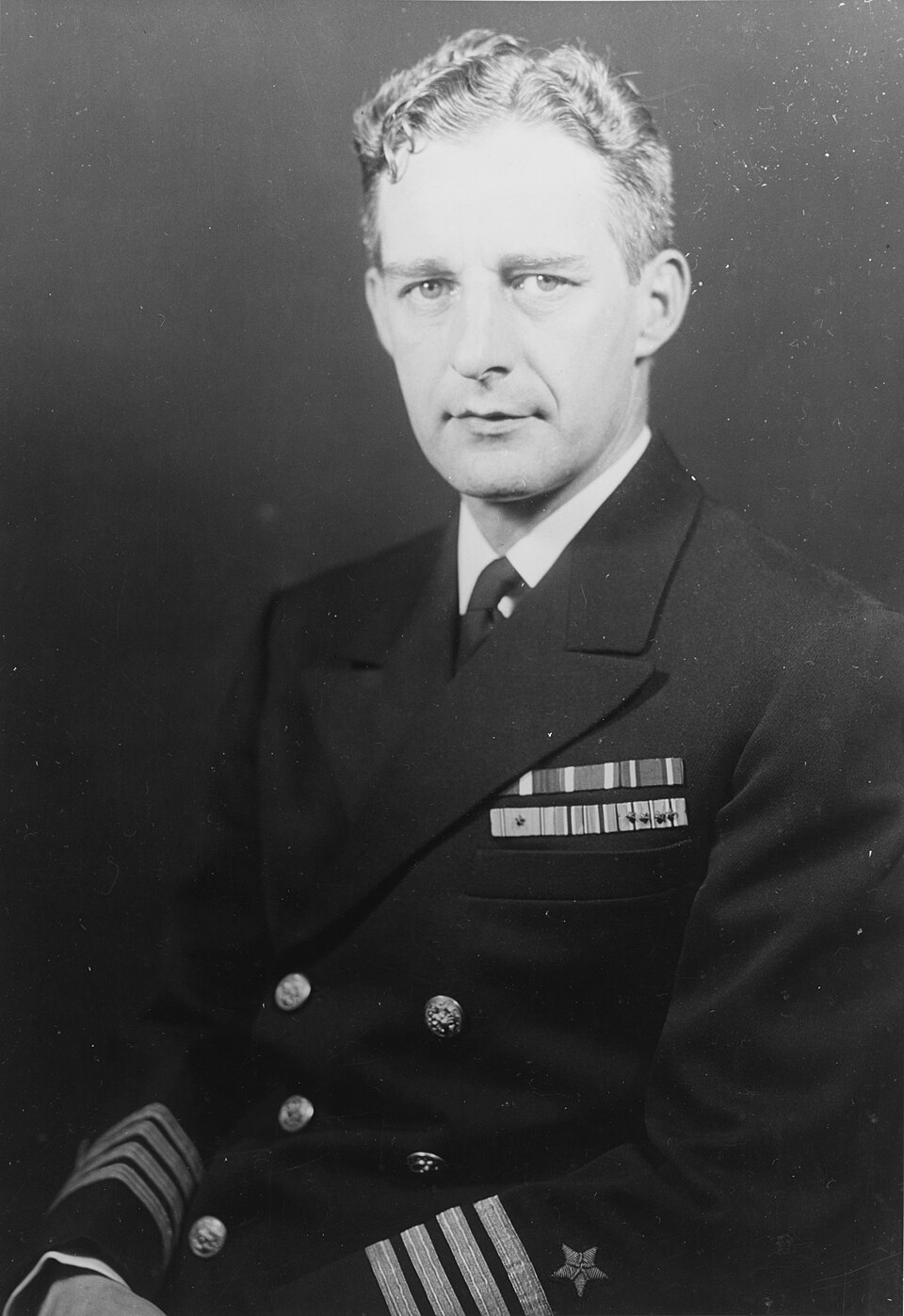
Frederick Moosbrugger (9 October 1900 – 1 October 1974) was a United States Navy officer, a destroyer man, and the commander who broke the Tokyo Express at Vella Gulf. The Navy called him Moose. He retired a vice admiral. A Spruance-class destroyer carried his name.
Philadelphia to the Yangtze
He was born in Philadelphia on 9 October 1900, the son of Jacob Moosbrugger and Rosina Maier Ritzer. He entered the Naval Academy on 25 June 1919 and graduated on 8 June 1923.
His first sea duty was in the battleship Nevada, then the destroyer Truxtun. In 1926 and 1927 Truxtun was on the Yangtze. He also served in the oiler Brazos. Between sea tours he taught ordnance and gunnery at Annapolis, twice, for three years each time. Gunnery was the trade he kept.
On 1 June 1934 he joined the heavy cruiser Houston. President Franklin Roosevelt rode her. On 28 May 1937 Houston was at the opening of the Golden Gate Bridge. In January 1932 he had married Dorothy E. Britt of Rydal, Pennsylvania. They had three sons: Frederick Britt, Edward Arthur, and David B.
In June 1939 he went to the battleship Tennessee as gunnery officer. On 28 April 1941 he took command of the destroyer McCall.
Pearl Harbor and the early raids
McCall was at Pearl Harbor on 7 December 1941. Moosbrugger then took her out with a carrier group covering the reinforcement of Samoa, the raids on Wake and Marcus (Minami Torishima), and the screening work that filled the first months of the Pacific war.
From May 1942 to September 1943 he commanded Destroyer Division 11, then Destroyer Division 12. The work was the Solomons: escorts into Guadalcanal and the Russells, gunfire at New Georgia, Rendova, and Vangunu, and night patrols against the Tokyo Express. The Express was the Japanese destroyer run that put troops and supplies onto the islands after dark. Cruisers had tried to stop it and had been badly handled. On the night of 1–2 August 1943, PT boats tried off Kolombangara. The only result was PT-109, cut in two by the destroyer Amagiri.
Vella Gulf, 6–7 August 1943
Four nights later Moosbrugger got the chance the PT boats had missed. Coastwatchers and intelligence had a Japanese run to Vila, on Kolombangara. Captain Kaju Sugiura was bringing four destroyers down the Slot: Hagikaze, Arashi, Kawakaze, and Shigure, with about 950 soldiers and their stores. Shigure was Tameichi Hara’s ship.
Task Group 31.2 was six destroyers, and it was allowed to fight without a cruiser in company. That was new in the Pacific. Moosbrugger rode Dunlap, with Craven and Maury in his own division. Commander Rodger Simpson had the second group: Lang, Sterett, and Stack. They waited in Vella Gulf, between Vella Lavella and Kolombangara.
Radar picked up the Japanese before the Japanese saw anything. Moosbrugger held fire, closed, and launched torpedoes first. Only then did the guns open. All four Japanese ships were hit. Hagikaze, Arashi, and Kawakaze blew up or were finished by gunfire and sank. The torpedo that hit Shigure was a dud. It passed through the rudder without exploding, and Hara got her out into the dark. More than 1,200 Japanese sailors and soldiers died. Not one American ship was scratched.
It was the first clean American destroyer night action of the Solomons, and the model for the next one. Arleigh Burke used the same torpedo-first ambush off Cape St. George on 25 November and sank three destroyers out of five. Nimitz called Vella Gulf a little classic of naval warfare. On 10 September Halsey gave Moosbrugger the Navy Cross. Dunlap’s captain, Clifton Iverson, and Sterett’s captain, Frank Gardner Gould, received it too. The citation overstates the Japanese force as a cruiser and three destroyers. It was four destroyers.
After the Slot
He left the Solomons that September. He was a temporary commodore from 6 April 1945 to 5 April 1946, then, as a captain, took the Naval School of the General Line at Newport on 5 April 1946. From June 1949 to January 1950 he commanded the light cruiser Springfield, and after that Destroyer Flotilla One.
He made rear admiral on 1 June 1951. In 1952 he commanded the Military Sea Transportation Service, Pacific, from San Francisco, the supply line of the Korean War. In December 1952 he became superintendent of the Naval Postgraduate School at Monterey. In December 1955 he took Training Command, Pacific Fleet. He went on the retired list on 1 October 1956 and was advanced to vice admiral.
Besides the Navy Cross he held the Distinguished Service Medal, the Legion of Merit with Combat “V,” and a Commendation Ribbon, with the Yangtze Service Medal from the China cruise and the usual campaign medals through Korea.
He died in a San Diego hospital on 1 October 1974, eight days short of his seventy-fourth birthday, and is buried at Fort Rosecrans, plot OS-187. In 1978 the Navy named the destroyer Moosbrugger (DD-980) for him.