Ships
- USS Benham (DD-397) Captain from 2 February 1939
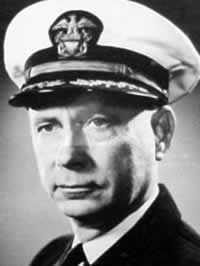
Thomas Francis Darden, Jr. (1900–1961) was a regular officer of the United States Navy, a member of the Naval Academy class of 1921 who came to Annapolis from Wilmington, North Carolina, and was graduated a year ahead of his class's nominal date, in June 1920. He put the new destroyer Benham into commission in February 1939 and commanded her through the first year and more of the war in Europe, on the Neutrality Patrol in the Atlantic and the Gulf of Mexico, where in December 1939 she trailed the German liner Columbus out of Veracruz, and then in the Pacific Fleet at Pearl Harbor. He was made captain in June 1942. In the middle years of the war he was in Washington, in the Plans and Operations Section of the Bureau of Naval Personnel, where the officers who carried the business of the Navy's small office for Black enlisted men to its civilian leadership worked under him. In the last year of the war he brought the torpedoed anti-aircraft cruiser Reno home from the western Pacific for repairs, and then took command of the light cruiser Denver in the southern Philippines and off Borneo. After the war he was Assistant Chief of Naval Personnel, and from 1949 to 1951 he was the last naval governor of American Samoa, the man who handed the islands over to civilian rule after fifty-one years of Navy administration. He retired, went to work in the aircraft industry in southern California, and died there at sixty. He should not be confused with Colgate Whitehead Darden, Jr., a Marine Corps Reserve officer of the same years who became Governor of Virginia and president of the University of Virginia, nor with William H. Darden, Jr., a midshipman of the early 1920s, nor with the reserve ensigns William E. and Woodrow J. Darden who appear in the Navy Directory of 1941.
The Navy's registers give his birth date as 8 September 1900 and the day he entered the Naval Academy as 16 June 1917. His obituary in the Los Angeles Times calls him "Brooklyn-born," and the same birthplace, Brooklyn, New York, is given by later compiled sources that probably draw on it. Every record of his youth, however, places him in North Carolina. Both the 1920 and the 1921 Lucky Bag, the Naval Academy's yearbook, list his home as Wilmington, and when he died in 1961 his mother, his sister, and his brother were all still living in Wilmington. How and when the family moved from New York to the North Carolina port was not established. The "Jr." that he carried on every Navy list for more than thirty years says that his father was also named Thomas Francis Darden, but no source read for this article gives his parents' names in full, their occupations, or the name of his sister or his brother.
He entered the Academy ten weeks after the United States declared war on Germany. He was sixteen.
The yearbook sketch is the one surviving portrait of him as a young man, and it is not a flattering one, which may be why it rings true. His classmates called him "Tommy" and "Tom." "Every time we see Tommy," it begins, "we always feel tempted to ask him what time he turned in last night, for the boy always wears a horribly dissipated expression as if he had been up all the night, and several preceding that." They teased him for the gap between his stories and his performance. "Listen for a while to Tommy's tales of the North Carolina coast, and of sailing his tiny boat among the mountainous billows of Albemarle Sound and you would say that our Thomas was a highly sea-going person." But on the youngster cruise, roused out of his hammock, he was heard to ask "very innocently why those boatswain's mate guys always wore their safety razors around their necks," presumably mistaking the boatswain's pipe on its lanyard for a razor.
His diversions, the sketch says, were few: reading the hometown paper, which his classmates called "the Wilmington Daily Blast," and "pulling venerable wheezes on his long suffering roommates." In the classroom he was the class comedian without meaning to be. "He is one of those rare characters who are constantly committing social errors in the section room. Every time Thomas gets up to recite the boys stand by for their usual amusement, and are never disappointed." The sketch credits him with a record of exactly one month, in his first-class year, in which he was "sat," satisfactory, in every subject. Under his name the yearbook records that he was a "Buzzard," a midshipman petty officer, and, from his plebe year, a member of the "Reina Squad," the name midshipmen gave to those serving punishment aboard the old station ship Reina Mercedes. Whatever the plebe had done, it did not keep him from graduating, or from rising.
The class of 1921 was graduated in June 1920, a year ahead of schedule, and the registers date his commission as ensign to 5 June 1920. He was nineteen. His first assignments after graduation were not traced, but in 1925 and 1926 he was a lieutenant (junior grade) in the destroyer Preston, one of the flush-deck four-stackers of the postwar fleet. By 1928 he was back at Annapolis for the Postgraduate School's course in general line duties, and the next year he was at the Naval War College in Newport for the junior course. The registers mark both courses after his name in code for the rest of his career. He was now a lieutenant.
The schooling led to staff work, and to the habits of a man who could write a clean letter for an admiral. From 1930 through 1933 the Navy Directory lists him as aide and flag secretary on the staff of the commander of the fleet's Base Force, the auxiliaries, tenders, oilers and supply ships that kept the battle fleet at sea. He served three admirals in turn. In 1930 the commander was Rear Admiral Thomas P. Magruder, flying his flag in Procyon, and his chief of staff was Captain MacGillivray Milne. In 1931 it was Rear Admiral W. D. MacDougall in Argonne, with Captain Isaac C. Kidd as chief of staff; Kidd would die on the bridge of Arizona at Pearl Harbor ten years later. In 1932 and 1933 it was Rear Admiral Henry H. Hough. A flag secretary handled the admiral's correspondence, orders and confidential papers, and the post was a sign of trust rather than of seagoing distinction.
Washington followed. In 1934 the directory places him with the Federal Emergency Administration of Public Works, the New Deal agency better known as the Public Works Administration, one of the officers lent by the services to Harold Ickes's building program in the depths of the Depression. Later that year and into 1935 he was in the Navy's Hydrographic Office, which made the charts. Then he went to the other side of the world. The directories of 1937 and 1938 list Lieutenant Commander T. F. Darden, Jr., at the United States Naval Station, Tutuila, American Samoa, whose commandant was also the governor of the territory. The governor was the same MacGillivray Milne under whom he had served on the Base Force staff six years before. The directories do not say what his duties were. He could not have known that he would come back to the same harbor at Pago Pago thirteen years later as governor himself.
He came home from Samoa to a ship of his own, and a new one. The Dictionary of American Naval Fighting Ships, the Navy's official ship history, records that the destroyer Benham (DD-397) was commissioned at the New York Navy Yard on 2 February 1939, "Lt. Comdr. Thomas F. Darden in command." He was thirty-eight. She had been meant to take a shakedown cruise to European waters, but the German occupation of Czechoslovakia in March and the Italian invasion of Albania in April made Europe no place for an American destroyer's training voyage, and the cruise was canceled. Instead Benham went to New York in April for the opening celebrations of the World's Fair, then south to Guantanamo, Corpus Christi and New Orleans. She completed her acceptance trials on 11 August and reported to Destroyer Division 18 at Newport on 1 September 1939, the day Germany invaded Poland.
Four days later she was at sea on the Neutrality Patrol, working the Grand Banks southeast of Newfoundland with the destroyer Davis to keep the war away from American shores. In early October a warning reached Washington, by way of the naval attaché in Berlin, that the American liner Iroquois, homeward bound from Ireland with 566 Americans aboard, might be sunk at sea in circumstances meant to recall the torpedoing of the British liner Athenia. President Roosevelt announced that she would be escorted, and on 8 October Benham and Davis joined the Coast Guard cutter Campbell and brought her safely into New York. In November Benham went south to Galveston, and between December 1939 and February 1940 she made five patrols in the western Gulf of Mexico, mostly off Veracruz, where German merchant ships had taken refuge from the British.
The most dramatic day of his command came there, on 14 December 1939, and the ship's official history tells it in some detail. In the early morning Benham found the North German Lloyd liner Columbus, the second-largest ship in the German merchant marine, lying off Veracruz, and also saw the German freighter Arauca slipping out to sea through the low cloud. Benham followed the freighter into the afternoon. At 1240 the liner herself got under way, making a run for the open sea, and the division commander ordered Benham to leave the freighter and trail the bigger prize. At 1245 she rang up full speed, took station 3,000 yards off Columbus's quarter, and held it through the evening and into the night, joined by her sister Lang. At 0200 on the 15th Jouett came up to relieve her, and Darden turned back to hunt for Arauca through heavy rain that cut visibility below a thousand yards. He did not find her. Benham put into Galveston on the 16th. The freighter eventually ran into Port Everglades to escape a British cruiser; Columbus, passed from one American ship to another up the coast, was trapped by a British destroyer off the coast of New Jersey and scuttled by her own crew. For a destroyer captain of a neutral navy, it was an odd and delicate kind of work: to shadow a belligerent's ship without stopping her, and to keep station on her through a December night without provoking an incident.
In February 1940 Benham was ordered to the Pacific. She passed through the Panama Canal on 29 February, reached San Diego on 11 March, and arrived in Hawaiian waters in April for Fleet Problem XXI, the last of the great prewar fleet maneuvers. When the fleet was ordered to stay at Pearl Harbor as a warning to Japan, Benham stayed with it. She joined Destroyer Division 12 in May, had her sonar improved and her hull wrapped in degaussing cable against magnetic mines, and spent the rest of 1940 in what her history calls "intensive training for war operations": gunnery, antisubmarine exercises against friendly submarines, depth-charge practice, torpedo drills and fueling at sea. She went to the West Coast for a yard period that autumn and returned to Pearl Harbor on 6 December 1940. Compiled tables of commanding officers end his command on 10 March 1941, although the Navy Directory published in the spring of that year still showed him in her. He had commanded Benham for two years. Nine months after he left her she was at sea with the carrier Enterprise when the Japanese struck Pearl Harbor. Those were other captains' days.
Where he went in the spring of 1941 is not recorded in any source found. The register for that year lists him as a commander, the rank given in compiled sources as dating from 1 July 1941, and the registers of the 1940s and 1950s date his rank of captain from 20 June 1942. The wartime registers no longer printed duty stations, so for 1942 his whereabouts are a blank.
By 1943 or 1944 he was in Washington, in the Bureau of Naval Personnel, and here he crossed one of the more consequential stories of the Navy's war. After the racial disturbances of 1943 the bureau set up a small Special Programs Unit, just three officers when it was established in August of that year, to oversee the enlistment, training and assignment of the Black sailors whom the Navy was then taking in large numbers and mostly keeping in segregated labor and messman billets. Morris MacGregor's official history of the integration of the armed forces records that the two lieutenant commanders who carried the unit's business to the Navy's civilian leadership, Donald O. Van Ness and Charles E. Dillon, "worked under Capt. Thomas F. Darden in the Plans and Operations Section of the Bureau of Naval Personnel." The moving spirit behind them was a young reserve officer, Christopher S. Sargent, a former lawyer in Dean Acheson's firm, whom a superior remembered as "a philosopher who could not tolerate segregation." Over the next two years, out of that office came the Black shore patrol units, the remedial training school at Camp Robert Smalls, the pressure on the naval districts to use trained Black specialists in the ratings they had been trained for, and in time, in MacGregor's words, "the plans that brought about the integration of the Navy."
What Darden himself thought of the work is not recorded in the sources found. MacGregor does not describe his views; he places him only as the officer under whom the unit's two liaison officers worked, a position in which the proposals of more junior men passed across his desk on their way up. In the early 1950s, when the journalist Lee Nichols was gathering material for Breakthrough on the Color Front (1954), his book on the integration of the services, Darden was among the former bureau officials he interviewed. MacGregor cites that interview among his sources for the period; what Darden said in it was not seen.
He went back to sea in the last winter of the war, and his first ship was a cripple. The anti-aircraft cruiser Reno (CL-96) had been torpedoed by the Japanese submarine I-41 on the night of 3 November 1944 off San Bernardino Strait, while steaming with the fast carriers. Two torpedoes struck her port side. With a typhoon nearby and the ship listing sixteen degrees, dead in the water, her crew saved her, and the fleet tug Zuni towed her 1,500 miles to Ulithi for temporary repairs. From Ulithi, according to her official history, she "steamed under her own power to Charleston, S.C., where she entered the Navy Yard on 22 March 1945." The compiled tables give her to Darden from 13 February to 26 March 1945, which would mean that the long passage home, across the Pacific with a patched hull and on to the Atlantic coast, was his. His obituary in 1961 remembered exactly that: that he had commanded Reno, "which he brought to the United States for refitting after it suffered severe battle damage." It is not a glamorous kind of command, and it leaves no battle record, but a captain taking a holed cruiser across the Pacific and on to the Atlantic coast carries the whole weight of the ship and her people without the distraction of an enemy to fight. Four days after she reached Charleston he was relieved.
Eleven days after that, according to the same compiled tables, he took command of the light cruiser Denver (CL-58) in the Philippines, relieving Captain Albert M. Bledsoe on 6 April 1945. The speed of it suggests he flew out, though no record of the journey was seen. Denver was a veteran, and her great battles, at Empress Augusta Bay in 1943 and in Surigao Strait in October 1944, had been fought under the captains before him. He came to her in the last phase of the Philippine campaign, the clearing of the southern islands.
Samuel Eliot Morison's history of the Navy's war names him once, and the passage shows the kind of fighting it now was. On Mindanao, the Army's 24th Division had reached Davao Gulf, and the Navy was moving troops and supplies along the coast to keep up with it. On 3 and 4 May 1945, Morison writes, a task group escorted a group of landing ships carrying 1,000 troops and 1,500 tons of supplies from Parang to Digos. "Cruiser Denver (Captain Thomas F. Darden) and three destroyers cover this movement. En route Denver shells and destroys a Japanese observation post on Balut Island, off the southern coast. When well inside Davao Gulf, she gets in touch with a shore fire control party and lobs 99 rounds of 6-inch shell into enemy positions in the hills behind the city." It was the first of the Army's "administrative movements" up the gulf, and Denver's guns were firing on Japanese soldiers dug into the ridges a few miles from the beach.
In June the war moved to Borneo, where Australian troops were to take the oil coast. Denver sailed from Subic Bay on 7 June, and from 15 June she and Montpelier, with destroyers, covered the minesweepers working off Balikpapan, where, Morison notes, Allied airmen had dropped more magnetic and acoustic mines than anywhere else in the Southwest Pacific, on top of prewar Dutch fields and suspected Japanese ones. Morison describes those two weeks as a daily game of "hide-and-seek" with Japanese shore batteries that fired on the sweepers and fell silent as soon as the cruisers answered; three motor minesweepers were blown up, and the underwater demolition teams went in under the cover of the cruisers' guns to blow gaps in the log barriers on the beaches. The Australian 7th Division landed on 1 July. Denver's history then takes her back to Leyte on 4 July, to Okinawa on 13 July, and into the East China Sea with Task Force 95, hunting Japanese shipping off the China coast until 7 August. After the surrender she covered the evacuation of Allied prisoners of war from the camps in the Wakayama area of Japan and the landing of occupation troops at Wakanoura Wan from late September, and on 20 October she sailed for home. She reached Norfolk on 21 November 1945. No change of captain is recorded in the compiled tables before January 1946, so it is likely, though it was not confirmed, that he was still on her bridge for all of this.
No action report in his hand, and no personal decoration for these commands, was found.
After the war he was back in Washington, and back in personnel work. The Navy's register of 1947 lists Captain Thomas F. Darden as Assistant Chief of Naval Personnel, third in the bureau's leadership after Rear Admiral Thomas L. Sprague and his deputy. This was the bureau that was demobilizing the wartime Navy, and that was also, in these same years, carrying out the integration of the general service, planned in part by the small office whose liaison officers had once worked under him. His obituary also places him at some point on the staff of an admiral it calls Donald Berry; that assignment was not identified.
In the summer of 1949 he went back to Samoa. He became governor of American Samoa on 7 July 1949, succeeding Captain Vernon Huber. The decision to end Navy rule had already been made. President Truman had declared in 1948 that the island territories should pass to civilian administration, and on 23 September 1949, eleven weeks after Darden took office, the President approved an agreement between the Secretaries of the Navy and the Interior fixing 1 July 1951 as the date of transfer. His task was to close a fifty-year chapter without breaking anything: to hand over a government that the Navy had run since 1900, in which the governor made the laws as well as carried them out, to people who had never run it, while reassuring Samoan chiefs who feared, above all, for their land and for the matai system of family chiefs on which Samoan society rested.
His governorship ended on 23 February 1951, when the first civilian governor, Phelps Phelps, took office. (The official history gives that date for the ceremony in one place and 28 February for the inauguration in another.) The Fono, the territorial legislature, printed a program for the occasion, and its words are the nearest thing on record to a public verdict on him and on the long administration he closed: "Turning its head to the past, Samoa is sorrowful to bid farewell to a good and loyal friend, the Navy. At the same time, turning its head to the future, Samoa bids welcome to the new administration." According to a history of the territory's notable figures, as cited in compiled sources, he and his wife sailed from Pago Pago on 1 March 1951 aboard the liner Sonoma. He retired from the Navy in 1951.
He was not quite finished with Samoa. In 1952 the Government Printing Office published a Historical Sketch of the Naval Administration of the Government of American Samoa, April 17, 1900–July 1, 1951, under his name. Its foreword says that it was written by "Capt. T. F. Darden, U.S.N. (Ret.), the last Naval Governor, and by Lt. A. M. MacQuarrie, U.S.N.R.," so its words cannot all be assumed to be his, but it is the only extended writing that carries his name, and it has a voice. It is proud and defensive. Its closing chapter, "Temporary Duty Completed," thanks the serious investigators who had studied Samoa over half a century and then turns on "a host of pseudo-scientists, do-gooders-for-a-salary, reformers, professional agitators, and the merely curious, many of whom recorded the observers' preconceived ideas." It sets out the criticisms of Navy rule in a series of contradictory pairs, that the Navy had protected the Samoans too much or too little, had propped up the chiefs or undermined them, had been too paternalistic or too autocratic, as though to let the critics cancel one another out. Then it offers its own measure: that more than 99 percent of the land remained in Samoan hands, that the population had nearly doubled every twenty-five years, that most government posts were held by trained Samoans, and that "a reward could safely be offered for the detection of any Samoan, including the aged and infirm, who does not have food, shelter, and clothing sufficient to his daily needs." Elsewhere the sketch concedes what a lawyer might have said first, that a governor exercising "legislative functions unguided and unrestricted by a constitutional instrument" presented "an unusual principle of government," and answers it in the voice of a man who had held that power: "In practice, however, every Naval Governor has leaned heavily on the Samoan people in the exercise of his powers." It is the judgment of an officer who believed in the institution he served and had been its last representative, and who was writing its epitaph.
In 1952 he became educational and training director of Northrop Aircraft, in the Los Angeles area, and he made his home at 1533 Addison Road in Palos Verdes Estates, above the Pacific. The registers carry him on the retired list as a captain through the middle of the decade. He died of a heart attack at home late on Saturday, 17 June 1961, at the age of sixty. He was survived by his wife, Mabel Hutchinson Darden, and by his mother, his sister and his brother in Wilmington. No child is mentioned in the obituary. He is buried in Fort Rosecrans National Cemetery, on Point Loma above San Diego Bay.
The sixteen-year-old who arrived at Annapolis in June 1917, whose classmates laughed every time he stood up to recite, left behind a destroyer's commissioning entry in the Navy's official history, a December night spent shadowing a German liner across the Gulf of Mexico, a single sentence in Morison, a line in the official history of the integration of the services, and a book about Samoa that defends, point by point, the administration he had been the last to lead.