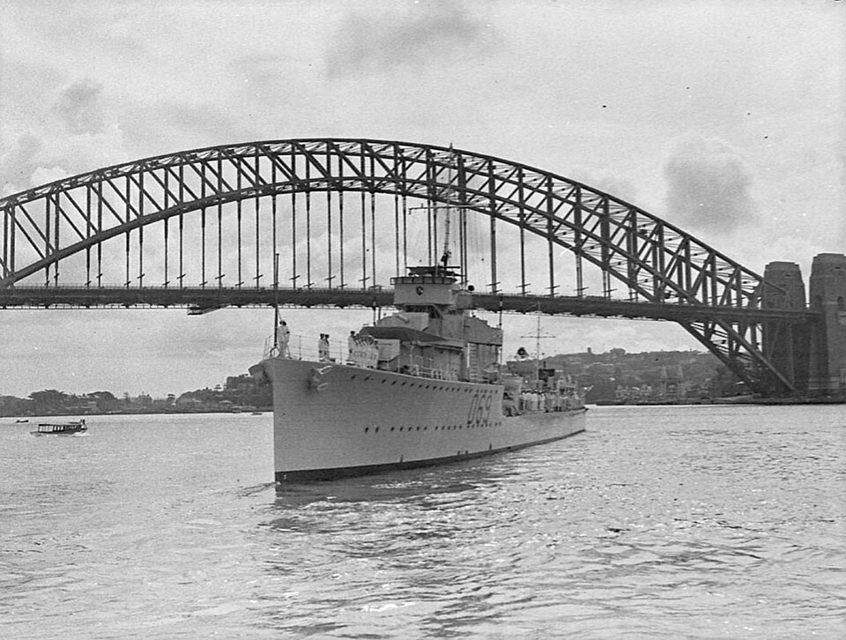
HMAS Vendetta (D69) was a V-class destroyer. In the Royal Navy she joined the 13th Destroyer Flotilla after commissioning. Once the First World War was over she towed surrendered German ships away from Scapa Flow for breaking up, and from May to August 1919 she kept the Irish patrol. During 1923 she operated in the Baltic with the Estonian Navy. She remained in the Mediterranean from 1924 until 1933, and in March 1925 she escorted the royal yacht Victoria and Albert on a royal tour of that sea.
In 1933 the Admiralty decided to replace five S-class destroyers on loan to Australia with five slightly older ships of greater capability, and Vendetta was one of those chosen. She was commissioned into the Royal Australian Navy at Portsmouth on 11 October 1933. The ships reached Australia at the end of the year, and she was placed in reserve on 31 January 1934. Returned to service on 10 October that same year, she carried out routine peacetime duties until 1 June 1938, when she went back into reserve. With a new war threatening she was recommissioned on 29 September 1938, and Glen Loftus Cant became her captain that day. In April 1939 she was given the duty of carrying the body of Prime Minister Joseph Lyons from Sydney to his resting place at Devonport, Tasmania.
After the Second World War began, Vendetta and the other four Australian destroyers deployed to the Mediterranean in October 1939. German propagandists were soon calling the group the Scrap Iron Flotilla. She docked at Malta for repairs in May 1940, and engine trouble put her in the Malta dockyard again from 11 October to 9 November. On 20 October 1941 she ended her Mediterranean service and sailed for a refit at Singapore. W. G. Whitting was in command on 8 December 1941. When Japanese air attacks on Singapore began that day, her anti-aircraft weapons were taken off the ship and used to strengthen the dockyard defences.
On 2 February 1942 the tug St Just towed the stripped-down destroyer out of the dockyard. Over the rest of the month HMS Stronghold, then HMAS Yarra, then HMAS Ping Wo towed her on toward Fremantle, which she reached on 3 March. She still had to be taken across the Great Australian Bight to Williamstown Naval Dockyard. Ping Wo started that tow and got as far as Cape Leeuwin before her engines failed. A British Phosphate Commission freighter took over the tow, with the corvette HMAS Whyalla as escort. Weather snapped three towlines, and at times the ships made only 1.5 knots, but they arrived at Melbourne on 15 April.
Most of the refit was finished at Williamstown. Vendetta sailed on 29 September 1942 for Sydney, where the remaining work was completed in December, and C. J. Stephenson became captain on the day she left Williamstown. Across that long refit she was altered into a dedicated escort, with a reduced main armament and a heavier anti-aircraft fit. From 1943 through 1945 she performed convoy escort and transport work in Australian and New Guinea waters, the Pacific service of her later war years. David Logan held temporary command from 31 March 1943, John Plunkett-Cole became captain on 18 May 1943, Jack Mesley on 9 December 1943, William Cook on 26 September 1944, Gilbert Gordon on 9 November 1944, and William Tapp on 31 May 1945. Vendetta survived the war. She was paid off on 27 November 1945.