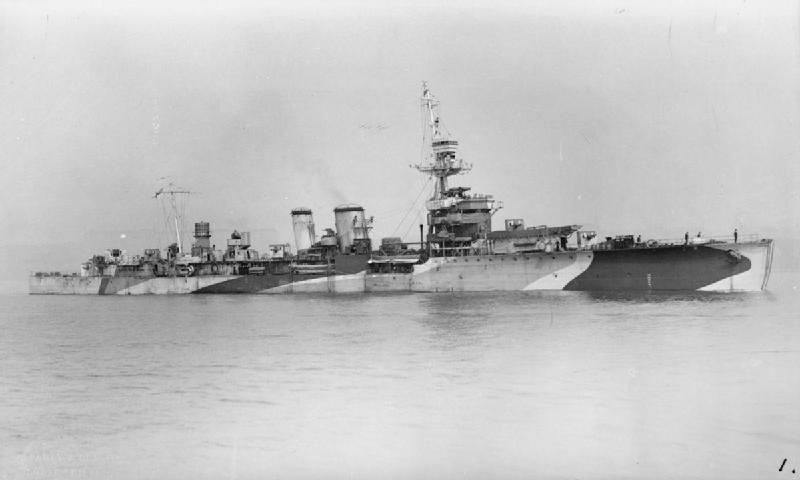
HMS Danae, pennant D44, was a Danae-class light cruiser, completed while the previous war was still being fought. She was ordered from the Armstrong yard at Elswick, Newcastle, in September 1916, laid down on 11 December that year, launched on 26 January 1918, and completed on 18 July 1918. In February 1942 the people of Chesterfield adopted her. Acting Captain Francis John Butler had been in command since 27 November 1940. He still had her on 7 December 1941.
She was already an East Indies ship. Through 1941 she had patrolled the South China Sea, the Malacca Strait and the eastern islands, with a docking at Singapore and a refit in the dockyard there. On 8 November she sailed for Manila. On the 14th she left Manila with the Canadian armed merchant cruiser Prince Robert as escort for the troopship Awatea, carrying Canadian troops to Hong Kong, and she entered on the 17th. She was back at Singapore on the 22nd. On 6 December she sailed to escort a convoy toward Negapatam, called at Penang on the 7th, and was at sea when the war with Japan began on the 8th. She reached Trincomalee on the 11th, sailed again on the 16th in a new camouflage scheme, and was at Singapore on the 19th. On the 26th she was allocated to the Western Striking Force at Batavia. On the 29th she was at Tanjong Priok and went out to meet the Dutch cruiser Java. On the 31st she joined convoy BM9B, six ships, as ocean escort in place of Glasgow.
January and the first days of February were a shuttle of troop convoys into a harbour under air attack. She reached Singapore with BM9B on 6 January, sailed with Dragon for Batavia on the 11th, and on the 18th joined convoy BM10 with Enterprise (D52), Exeter and the Indian sloop Sutlej. She was in Singapore again on the 26th, embarked stores, and came under air attack leaving. On the 31st she joined Emerald and Java to take convoy DM2 in. On 4 February, still under air attack, Exeter in particular fought the aircraft off. On the 5th the attacks went on. Empress of Asia was set on fire and Felix Roussell was hit. Machine-gun fire from the aircraft wounded two of Danae's company. The chronology says Empress of Asia later sank, with 27 killed and 93 wounded on that ship. Danae went into Singapore, then sailed on the 6th with Yarra and Sutlej as escort for convoy EM11 toward Batavia. On the 9th she was at Tanjong Priok for a boiler clean, and two 20 mm Oerlikon guns were fitted on the flag deck.
She was not in the Battle of the Java Sea. On 19 February she left Tanjong Priok for Padang to collect soldiers who had got across to Sumatra. On the 21st she was diverted to Tjilatjap, on the south coast of Java, and was transferred to the Western Striking Force with the Australian cruiser Hobart, Dragon, and the destroyers Tenedos and Scout, to intercept invasion convoys. On the 23rd she grounded leaving Tjilatjap and was pulled off by tugs, with the condenser inlets choked. On the 26th she entered Tanjong Priok only after Exeter and Perth had sailed to join the Allied squadron that was going out against the invasion ships. On the 28th she was sent with the striking force toward a Japanese convoy at Muntok, on Banka. Landings were already being made at Batavia and Surabaya. The search failed, and she was turned to the evacuation of civilians at Emmerhaven, on Sumatra, with Tenedos and Scout. On 2 March Scout put 309 people aboard, including 15 nurses, and the chronology notes that 250 others went to Dragon. She took the auxiliary Kedah in tow, with Hobart in company, after Kedah broke down while evacuating Tjilatjap. Hobart parted company on the 5th. Danae arrived at Colombo that day with Kedah still in tow.
She was not held for the defence of Ceylon. On 18 March she sailed for Bombay, and from the 22nd she was on guardship duty in the Persian Gulf. In May she was withdrawn from the East Indies Station and sent home around the Cape to refit. Captain Matthew Sausse Slattery relieved Butler on 2 May 1942 and had her until 3 June. Captain Harold Fielding Nalder had her from 3 June to 24 August, the passage home and the start of the dockyard period. Lieutenant-Commander Duncan Hamish Harper, on the retired list, had her from 24 August to 15 October, and Acting Commander Noel Charles Mansfeldt Findlay, also retired, from 15 October 1942 to 8 June 1943. The refit on the Tyne replaced No. 3 and both forward 6-inch mountings with quadruple 2-pounder pom-poms and added eight Oerlikons and radar. She worked up at Scapa Flow in the summer of 1943.
Captain John Robert Sutherland Haines took her on 8 June 1943 and took her back to the East. In October she joined the 4th Cruiser Squadron at Trincomalee. From November 1943 into March 1944 she was on Indian Ocean convoy defence. In April she was withdrawn again, nominated for Normandy, and refitted at Rosyth for Bombarding Force D and Sword Beach. On 21 May she was in the Clyde with Warspite, Ramillies, Roberts, Mauritius, Arethusa, Frobisher and the Polish cruiser Dragon. On 6 June she fired in support of the Sword landing. From the 7th she was depot ship at Gooseberry 5, north of Ouistreham, and she was still there when Operation Neptune ended on the 24th. On 6 July she was with Belfast, Emerald and Roberts for gunfire in the Juno sector. She left the assault area in August and was depot ship at Plymouth into September. Haines left her on 7 August 1944. Acting Captain Stephen Barry, retired, had her from that day until the ship changed flags.
On 4 October 1944 she was transferred to the Polish Navy to replace Dragon, which had been lost off Normandy on 8 July. The Polish company joined at Portsmouth on the 16th, and she was renamed Conrad. Commander Stanislaw Tytus Dzienisiewicz, a Polish officer, had her from 4 October 1944 until 26 July 1945. She refitted at Southampton from 8 December, worked up at Scapa, and through the last months of the European war escorted military convoys in the southern North Sea and the Channel. On 6 February 1945 she narrowly avoided the landing ship Princess Josephine Charlotte off Harwich. She was under repair at Chatham in May and June, then went back to Home Fleet duty for the reoccupation work in July and August. Commander Romuald Nalecz-Tyminski relieved Dzienisiewicz on 27 July 1945 and still had her when the war against Japan ended. As Conrad she visited Oslo in September 1945. She stayed in home waters with the 10th Cruiser Squadron until she was reduced to reserve in 1946, reverted to the Royal Navy as Danae in September 1946, and was laid up at Portsmouth. She was sold to T. W. Ward at Barrow on 22 January 1948 and arrived at the yard on 27 March. She was not sunk.
A note on sources. The East Indies movements, the two wounded on 5 February 1942, the Java Sea absence, the Polish transfer and the 1948 sale are from Geoffrey Mason's service history on naval-history.net, saved as a digitized copy. Uboat.net's pages for Danae and for Conrad, saved with it, give pennant D44, the commanding officers, and the Polish names and ranks. Mason dates the laying down to 11 December 1916 and completion to 18 July 1918. Uboat.net prints 1 December 1916 and commissioning on 18 June 1918, and gives the builder as Armstrong at Newcastle and Wallsend. Mason's Elswick yard, December laying down and July completion are the dates used. Uboat.net dates the sale to 26 January 1948. Mason's 22 January is the date used. Both pages give the arrival at Barrow on 27 March 1948. Uboat.net ends the Polish service on 28 September 1946. Mason says September 1946. The English ranks for the Polish officers are the ranks uboat.net prints in parentheses after Kmdr.por. and Kmdr. Enterprise is named with the pennant D52 from the uboat.net page for that cruiser, so the sentence is not read as the American carrier.