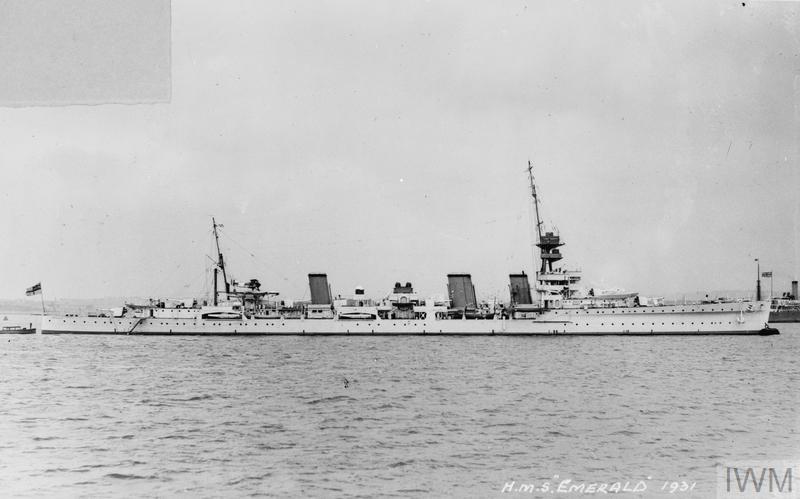
Emerald, pennant D 66, was an Emerald-class light cruiser ordered from the Armstrong shipyard at High Walker, Newcastle, on 7 March 1918. She was laid down on 23 September that year, launched on 19 May 1920, and towed to Chatham, where the build was completed on 14 January 1926. Geoffrey Mason's chronology records that, apart from refits, her peacetime service from 1927 was on the East Indies Station until she paid off at Chatham in July 1938.
She was on that station when the war with Japan opened. On 15 June 1941 she had collided with Dauntless in the Malacca Straits. The forward engine room was partly flooded, the structure amidships was damaged, fourteen of the ship's company were killed or missing, and five were injured. She reached Singapore the next day and was repaired there. Captain Francis Cyril Flynn had been in command since 18 June 1940. In January 1942 she escorted the transport Mount Vernon from Mombasa into military convoy BM1, and on 13 January she arrived at Singapore with Durban and the destroyers Encounter, Jupiter and Vampire as escort for DM1. On 16 January she embarked Admiral Layton at Batavia. Mason records that Layton had just been appointed Commander-in-Chief, Eastern Fleet, after the death of Admiral Phillips, and that she was taking him to Trincomalee to set up the fleet headquarters. She arrived on 21 January.
On 12 March 1942, on passage in the Indian Ocean, she rescued nine survivors of the British vessel Lakshima Govinda, which a Japanese submarine had sunk in the Bay of Bengal on 10 March, and she took them to Karachi. On 23 March she was nominated for the Eastern Fleet. On 28 March she was named for Force A with Warspite, the carriers Indomitable and Formidable, the cruisers Cornwall, Dorsetshire and Enterprise, and the destroyers Napier, Nestor, Paladin, Panther, Hotspur and Foxhound. On 30 March she sailed from Trincomalee with the Dutch cruiser Heemskerck to join Force A south of Ceylon. On 31 March she was with Force A, searching for Japanese warships reported on passage toward Ceylon. On 4 April she resumed the search after refuelling at Addu Atoll. Dorsetshire and Cornwall, detached from Force A, were sunk on 5 April after Japanese aircraft sighted them. The operation was then abandoned. She went on to Bombay with the ships of Force A, and then toward the Seychelles with Resolution when the Eastern Fleet moved to Mombasa because Ceylon was open to Japanese air attack.
Flynn left her on 25 August 1942. Commander Richard Graham Stewart had her until 3 November 1942, and Acting Commander John Frederick Denman, on the retired list, from that day until 13 March 1943, while she was refitting in Britain. She recommissioned on 7 April 1943 for the 4th Cruiser Squadron, Eastern Fleet, worked up at Scapa Flow, and on 20 August arrived at Kilindini for the 5th Cruiser Squadron, for trade defence and convoy escort in the Indian Ocean. Captain Francis James Wylie had been in command since 13 March. In January 1944 she moved to Colombo for fleet duties with the 4th Cruiser Squadron. Mason notes that by February the fleet at Trincomalee, which then included Renown, Queen Elizabeth and Valiant, was preparing for operations against positions in Sumatra and the Andaman Islands. He does not record a bombardment by Emerald herself. On 3 March 1944 she sailed from Trincomalee for home. On 22 March she rescued 32 survivors of the British freighter Nancy Moller, sunk by a Japanese submarine on 18 March, and landed them at Durban.
She was nominated for Bombarding Force K in the Normandy landings. On 6 June 1944 she reached her bombardment position and fired on batteries off Gold Beach. On 7 June she was under air attack and took slight damage from a near miss, and she gave naval gunfire support for a Royal Marine Commando attack on Port en Besin, the spelling in Mason's chronology. Wylie left on 28 September 1944. Denman had her again until 5 October. Captain Robin Wynell Mayow Lloyd, retired, had her from 5 October 1944 until 9 March 1945. She had been withdrawn from operational use and paid off in September 1944, and on 3 November she was accepted into Reserve Category B at Rosyth. From March 1945 she was Senior Officer's Ship of the Reserve Fleet at Rosyth. Captain Wilfrid Pearse Gandell, whom uboat.net spells Wilfred, took her on 9 March 1945 and held her into late 1945. She went into Category C Reserve in December 1945 and was beached at Rosyth. Mason records that she was sold for demolition on 23 June 1948 and arrived in tow at Troon on 23 July 1948. She was not sunk.
A note on sources. The dates, the Malacca Straits collision, the convoys, Force A, the rescues, the return to the Eastern Fleet, Normandy, and the sale follow Geoffrey Mason's naval-history.net chronology for Emerald, revised in 2005 and saved as a digitized copy. Uboat.net's ship page agrees the build was completed on 14 January 1926 and prints pennant D 66. It gives the sale as 23 July 1948 and the arrival at Troon, for Arnott Young, as 5 July 1948, which cannot both be right. Mason's sale on 23 June 1948 and arrival on 23 July 1948 are the dates used here. Commanding officers and their dates are the wartime list on that uboat.net page. Unithistories.com gives Flynn command of Emerald from 1 June 1940, which overlaps Augustus Agar's uboat.net dates, so Flynn is kept from 18 June 1940. The same site spells Gandell Wilfrid and carries his command through October 1945, against uboat.net's Wilfred and an end in late 1945.