Mikuma (三隈) took her name from the Mikuma River in Oita. She was the second of the four Mogami-class cruisers, after Mogami and before Suzuya and Kumano. Mitsubishi laid her down at Nagasaki on 24 December 1931, launched her on 31 May 1934, and commissioned her on 29 August 1935. She was finished as a light cruiser, five triple turrets of 155-millimeter guns, because a cruiser was not supposed to carry anything heavier. The hull had been laid out to take a heavier battery once that limit was lifted.
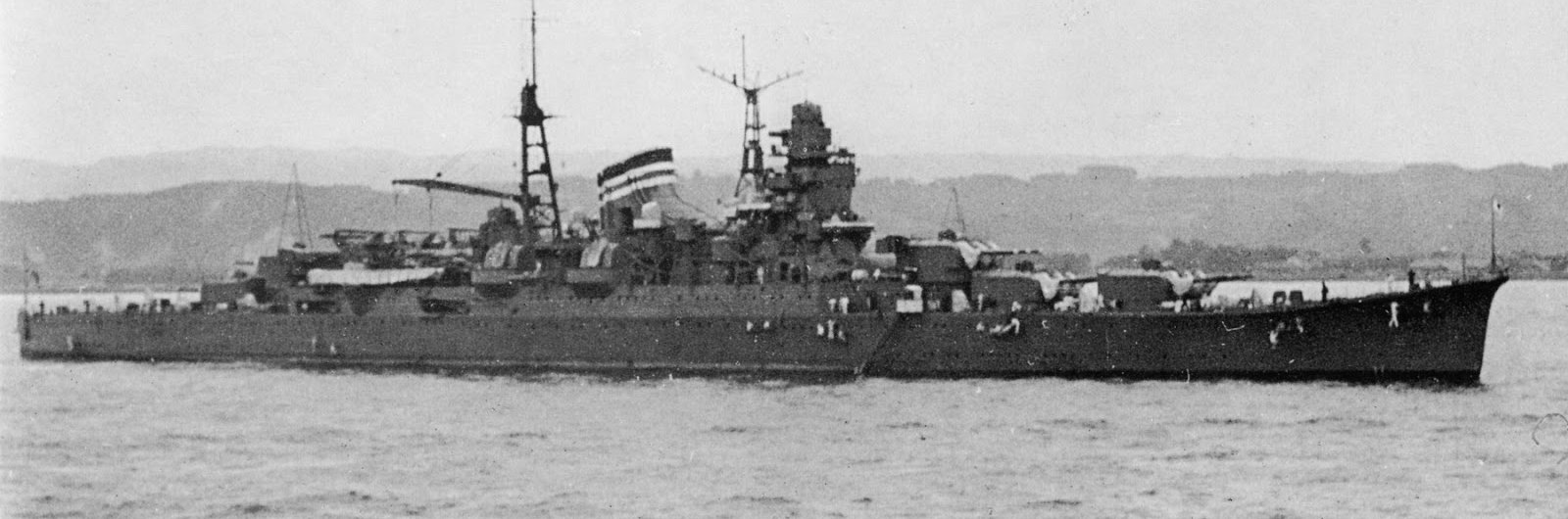
She had been in commission a few weeks when the typhoon of September 1935 caught the Fourth Fleet. Seams in the welded hull opened. She went back into the yard to be strengthened, and bulges were worked into the hull. By April 1939 the triple turrets were gone and twin 8-inch guns were in their place. A photograph made at Kagoshima on the 12th, from the submarine tender Tsurugizaki, shows the ship she took to war: ten 8-inch guns.
In the first months of the war she and Mogami covered the landings in Malaya and Java with Cruiser Division 7. On the night of 28 February-1 March 1942, in Sunda Strait, the two of them were in the Japanese force when Houston and Perth were sunk. That sinking is not credited to one Japanese ship.
At Midway she was in Kurita's division, with Kumano, Suzuya, and Mogami. The destroyers Asashio and Arashio were with them. They had been sent in to shell the island after the carriers were lost. On the night of 5 June the submarine Tambor sighted the cruisers. The flagship ordered a turn. The line did not turn together. Mogami, last in the column, drove her bow into Mikuma's port side, under the bridge. Mogami's bow was crushed. Mikuma's oil tanks split, and a slick spread out behind her on the sea.
The collision did not sink her. Tambor did not hit either ship. Kumano and Suzuya went on. Captain Shakao Sakiyama kept Mikuma with the damaged Mogami. Asashio and Arashio stayed.
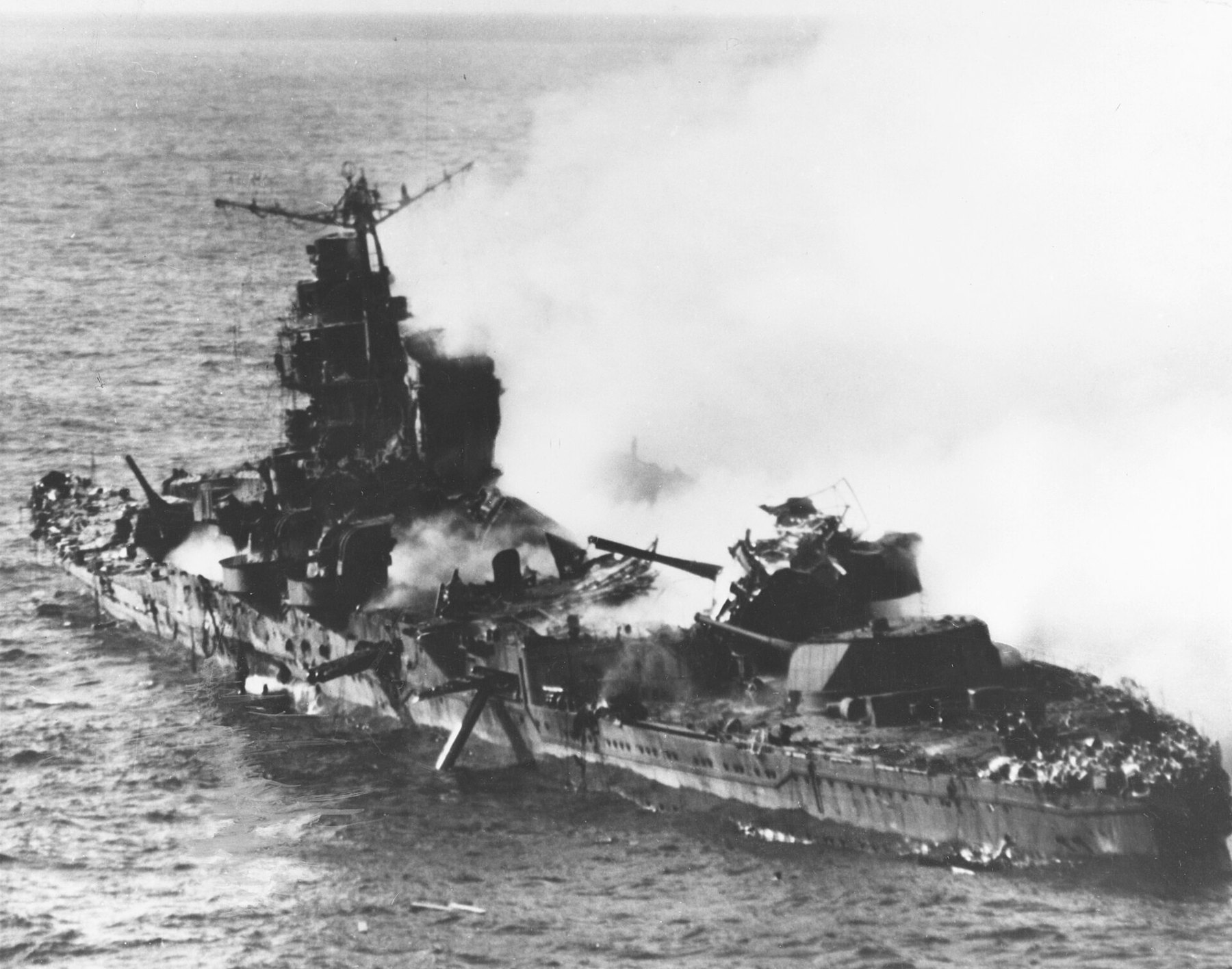
On 6 June the oil did what the submarine had not. Dive bombers from Enterprise found the slick and left Mikuma dead in the water. The torpedoes still in her hull exploded. A later strike from Hornet hit the burning ship again. She capsized that evening. The sinking belongs to the American carrier aircraft, not to one carrier and not to Mogami. Mogami, her bow still wrecked, got away. Asashio and Arashio were hit and were not sunk that day. Asashio was sent back to make sure of Mikuma and to look for men. The cruiser was already gone.
Sakiyama was badly hurt in the bombing. He was taken off, and he died of those wounds aboard Suzuya on 13 June. Mogami and Arashio had taken about 240 men off Mikuma before she went down. Some of those men were killed when a bomb hit Arashio. On 9 June the submarine Trout found two of her sailors on wreckage in the oil.
In the battle photograph, made that afternoon from an Enterprise dive bomber, she is dead in the water and burning, her midships blown open. The wreckage on the after turret is not an American airplane. A story that a pilot crashed his plane into her is not what that picture shows.