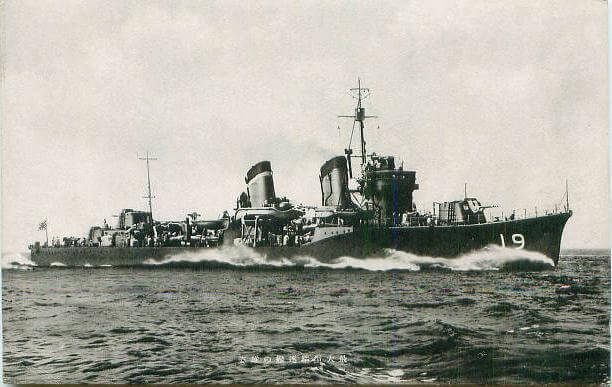
Uranami (浦波, "shore wave") was the tenth of the twenty-four Fubuki-class Special Type destroyers. The class was authorized in the fiscal 1923 program to give Japan a qualitative edge after the Washington Treaty. They were large, fast, and heavily armed enough that other navies treated them almost as light cruisers. Uraga Dock built her as Destroyer No. 44. She was laid down on 28 April 1927, launched on 29 November 1928, and commissioned on 30 June 1929. She was renamed Uranami in 1935.
As completed she displaced about 1,750 tons standard, about 2,050 after the 1930s rebuild. She was 388 feet overall, with four Kampon boilers and two geared turbines on two shafts, 50,000 horsepower, and 38 knots. Range was about 5,000 nautical miles at 14 knots. Armament was six 127 mm guns in three twin mounts, nine 610 mm torpedo tubes, and depth charges. Wartime fits added up to 22 of the 25 mm guns. Complement was about 219. The rebuild cut top speed slightly, to about 34 knots.
On completion she joined Destroyer Division 11 in the 2nd Fleet. In the Second Sino-Japanese War she covered the landings at Shanghai in 1937 and later landings at Hangzhou. At the start of the Pacific War she was in Destroyer Division 19, Squadron 3, of the 1st Fleet, having deployed from Kure to Samah on Hainan. From 4 December she covered the invasions of Malaya and British Borneo, and on 7 December captured the Norwegian merchant Hafthor.
On 19 December 1941, off Kota Bharu, Ayanami and Yūgiri depth-charged the Dutch submarine O 20 without success. Low on battery, O 20 surfaced and was spotted by Uranami, still on patrol. Uranami hit her repeatedly with gunfire and sank her. She stayed on the scene overnight, dropping depth charges to keep sharks off the men in the water, and the next morning picked up 32 survivors. O 20 was the sister of O 19.
She then escorted the heavy cruisers Suzuya, Kumano, Mogami, and Mikuma out of Samah and Cam Ranh Bay for the invasions of Bangka, Palembang, the Anambas Islands, Java, and northern Sumatra. On 23 March 1942 she covered the Andaman Islands landing and patrolled from Port Blair during the Indian Ocean raid. From 13 to 22 April she returned via Singapore and Cam Ranh Bay to Kure for maintenance.
At Midway, 4–5 June 1942, she screened Admiral Yamamoto's Main Body. After the battle she collided with her sister Isonami and went back to Kure for repairs. She then escorted the armed merchant cruiser Kiyozumi Maru toward Singapore and went on to Mergui for a planned second Indian Ocean raid. Guadalcanal cancelled that operation, and she was sent to the Solomons instead. During the Battle of the Eastern Solomons on 24 August she escorted the fleet supply group. Through September and October she ran a long series of Tokyo Express trips to Guadalcanal.
On the night of 14–15 November, in the Second Naval Battle of Guadalcanal, she was with Rear Admiral Shintarō Hashimoto's scouting force in the light cruiser Sendai. When Lee's Task Force 64 was found near Savo Island, Uranami joined Ayanami and the light cruiser Nagara against four American destroyers, Walke (DD-416), Benham (DD-397), Preston (DD-379), and Gwin. Accounts name Ayanami for the torpedo that sank Walke, Nagara's gunfire for Preston, and a torpedo usually credited to Uranami for the hit that cut off everything forward of Benham's bridge and forced her scuttling. Uranami and Ayanami together are named for the damage to Gwin. Those four are not pinned to one ship. Washington then wrecked Ayanami. Uranami took off Ayanami's crew, and Ayanami was scuttled.
After the battle she escorted the carrier Chūyō from Truk to Yokosuka, then returned to Rabaul in mid-February 1943. On 25 February she was reassigned to the Southwest Area Fleet. In the Battle of the Bismarck Sea, 1–4 March, she took repeated air attacks without damage and helped pick up survivors. Shikinami was one of the other destroyers that got away. On 2 April she struck a reef near Makassar and was badly damaged. Repairs at Surabaya lasted until the end of August. From September she escorted convoys to Singapore.
In January 1944 she left Singapore with the cruiser Kuma on a troop run to Mergui and Penang, then returned alone with survivors after HMS Tally-Ho sank Kuma on 11 January. From 27 February to 25 March she escorted Aoba, Tone, and Chikuma on a commerce raid in the Indian Ocean.
Her last mission was Convoy TA 1, the first large troop lift to Leyte, beginning 21 October 1944: heavy cruiser Aoba, light cruiser Kinu, Uranami, and five new transports, under Rear Admiral Naomasa Sakonju, carrying the 41st Regiment from Manila toward Ormoc. On 23 October USS Bream torpedoed Aoba, and Sakonju shifted to Kinu. The next day Uranami and Kinu were strafed by Task Force 38 aircraft: four men killed and nine wounded on Uranami, and a punctured fuel tank. The troops were landed at Ormoc on 25 October.
On the morning of 26 October, crossing the Jintotolo Channel between Masbate and Panay, the convoy was hit by about 80 aircraft from the escort carriers of Taffy 2: Manila Bay, Marcus Island, Natoma Bay, and Petrof Bay. Uranami took two bombs and several rockets. She sank around noon at about 11°50′ N, 123°00′ E, 12 miles southeast of Masbate. Of her crew, 103 were killed, including her captain, Lieutenant Commander Masuhide Sako. 94 were picked up that afternoon by transports that had lagged behind. She was struck on 10 December 1944. The loss is not credited to one ship. The wreck has not been found. Kinu, sunk nearby, lies in about 150 feet.