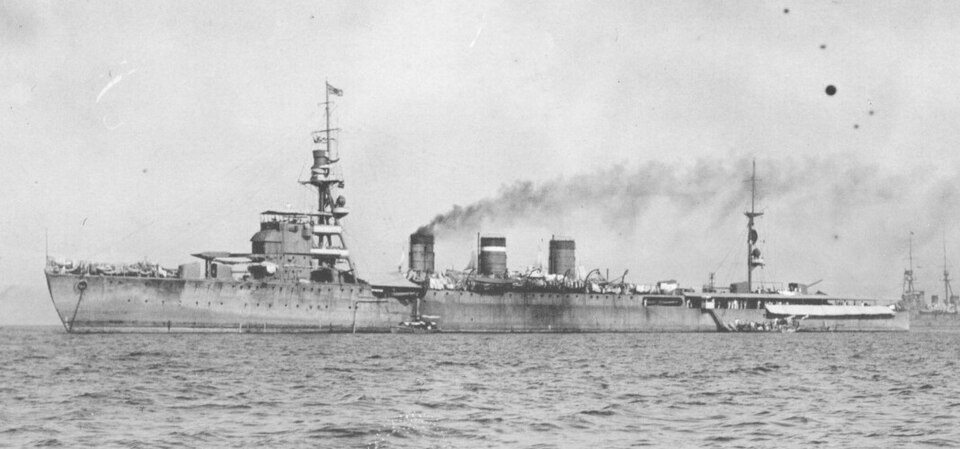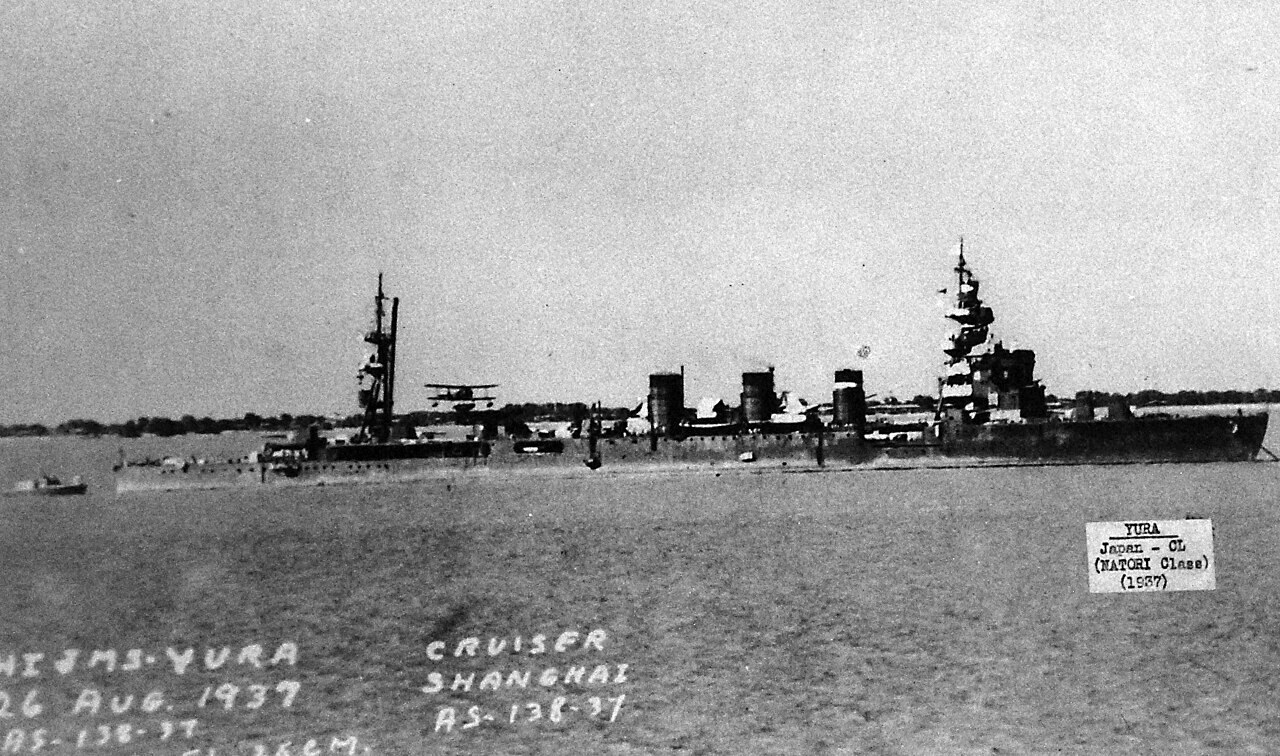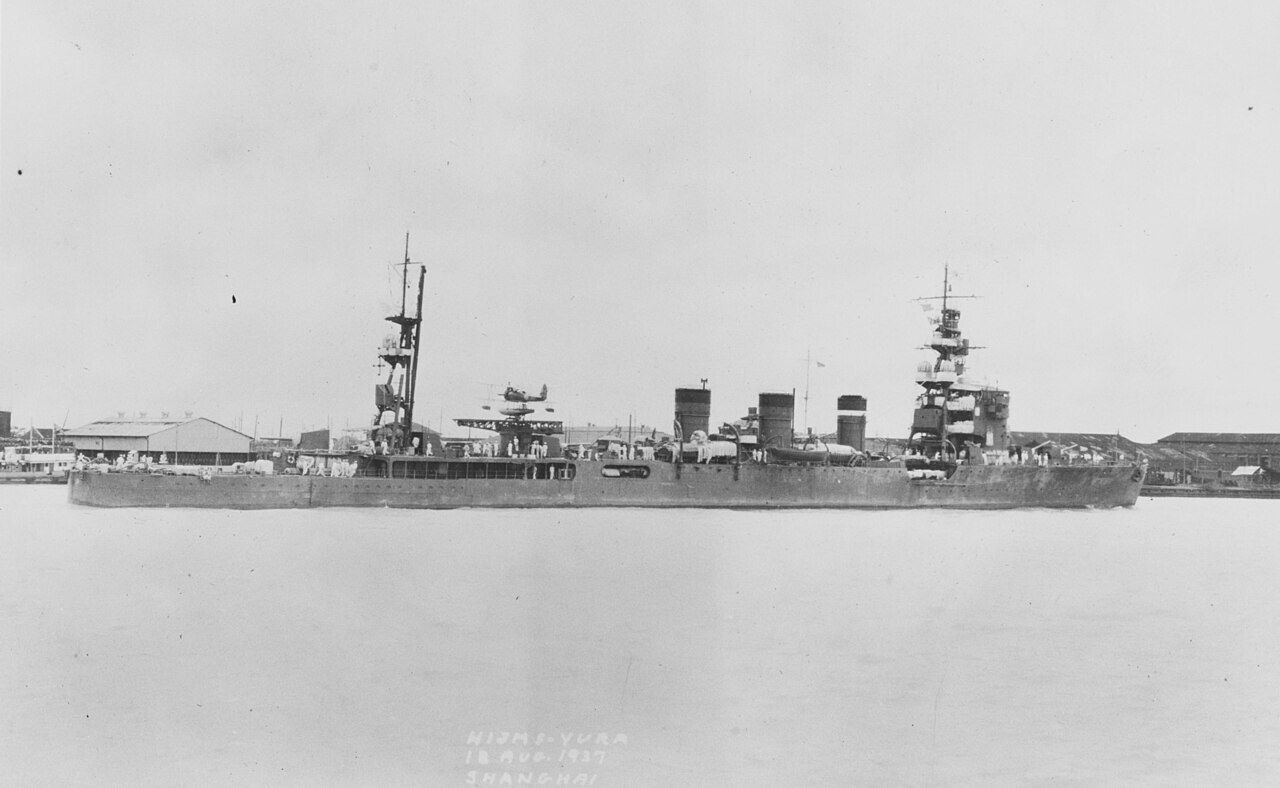
Yura was a Nagara-class light cruiser, named for the Yura River near Kyoto. The Sasebo Navy Yard laid her down in 1921, launched her on 15 February 1922 and completed her on 20 March 1923. In August 1927, during the night exercise off Mihonoseki in which Jintsu and Naka collided with destroyers, she helped rescue survivors of the sunken destroyer Warabi.
Captain Teruhiko Miyoshi took command on 1 September 1941. She was flagship of Rear Admiral Tadashige Daigo's Submarine Squadron 5 in the South China Sea. On 9 December 1941 the squadron's I-65 reported two British capital ships southeast of Indochina, the first Japanese sighting of Force Z, which land-based bombers sank the next day. She then covered the landings at Miri and Kuching in British Borneo in December, and in February 1942 the landings at Palembang and Bangka in Sumatra and in western Java. On 4 March she rescued the crew of the oiler Erimo, sunk by the submarine S-39. She escorted the landings in northern Sumatra in March and covered the occupation of Port Blair in the Andamans on 23 March. In early April she was with Vice Admiral Jisaburo Ozawa's central group in the raid into the Bay of Bengal, while Nagumo's carriers struck Ceylon. Captain Shiro Sato took command on 20 April 1942.
In mid-1942 she became flagship of Destroyer Squadron 4. She went to Truk in August and was with the main body of Admiral Kondo's Support Force at the Battle of the Eastern Solomons on 24 August. Through September and October she ran supplies and troops into Guadalcanal from Shortland. On 25 September a B-17's small bomb damaged her slightly. On 14 October she, Sendai and other ships landed 1,129 troops, guns and supplies at Cape Esperance. On 18 October the submarine Grampus hit her with a torpedo that did not explode and left only a dent.
On 24 October 1942 she left Shortland with the destroyers Akizuki, Harusame, Murasame and Yudachi to bombard Guadalcanal in support of the Army's offensive against Henderson Field. At 1300 on 25 October, at the northern entrance to Indispensable Strait, five SBD dive-bombers led by Lieutenant Commander John Eldridge hit her aft with two bombs near the engine room. She flooded and settled by the stern, and the bombardment was called off. Army P-39s and Marine SBDs attacked through the afternoon without further hits. At 1700 Captain Sato was trying to beach her on Fara Island when Eldridge came back with SBDs, Wildcats and P-39s, and six B-17s followed, and her fires flared up again. At 1830, after her crew was taken off, Harusame and Yudachi torpedoed her. She broke in two. The bow sank, and at 1900 Yudachi sank the stern with gunfire. 135 of her crew were killed or wounded. She was struck from the Navy List on 20 November 1942.
A note on sources. This history follows the Tabular Record of Movement for Yura by Bob Hackett and Sander Kingsepp at combinedfleet.com and the Japanese Wikipedia article on Yura. The two differ on when she was laid down. The record gives 21 May 1920, and the Japanese article gives 21 May 1921, which is used here only as the year. The account of the Mihonoseki collision of August 1927 comes from the Japanese article. The record gives the casualties only as 135 killed or wounded together. Captain Sato's command is dated from the Japanese list; the record names him only on the day of her loss.