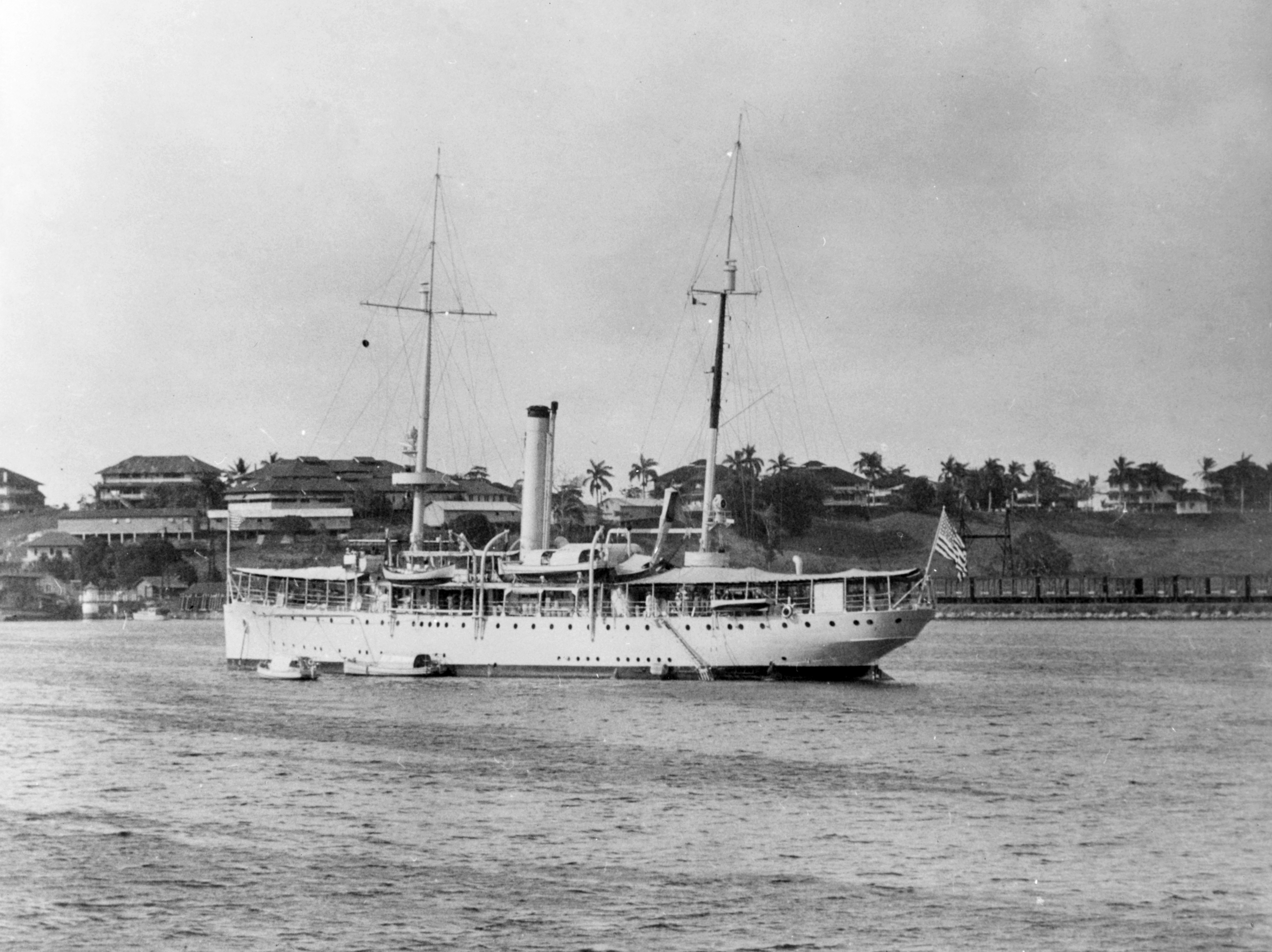
Asheville was a steel gunboat, the name ship of her class, built for the Asiatic station. The Charleston Navy Yard laid her down on 9 June 1918. She was launched on 4 July 1918. Miss Alyne J. Reynolds sponsored her. She was commissioned on 6 July 1920. Lieutenant Commander Elliott Buckmaster had her for the first week, in temporary command. On 13 July Commander Jesse B. Gay relieved him. On 17 July she was designated PG-21.
She was 241 feet 2 inches long, with a beam of 41 feet 3 inches and a draft of 12 feet 9 inches. She was given as 1,575 tons, with a speed of 12 knots and a complement of 162. She carried three 4-inch guns, two 3-pounders, two 1-pounders, four .30-caliber machine guns, and two 3-inch field guns. She was a single-screw ship.
On 5 June 1922, Commander James O. Richardson in command, she left Charleston for the Asiatic Fleet and reached Cavite on 11 September. She spent the years between the wars on the China coast. On 5 July 1941 she sailed from Amoy for Manila, broke her single shaft in a typhoon off Swatow, and was brought in by the light cruiser Marblehead on 11 July. Admiral Hart then kept her, with the gunboat Tulsa, on the Manila inshore patrol.
On 8 December 1941 she was at anchor in Manila Bay. A priority dispatch reached her at 0340. For the next two days she patrolled off Corregidor. At 1300 on 10 December, on patrol station Cast, her men saw the bombs falling on the Cavite Navy Yard. She was not in the yard. Half an hour into the mid watch on 11 December she stood out of Manila Bay. She went by the Celebes Sea and Balikpapan and reached Surabaya three days after Christmas. Captain Kenneth M. Hoeffel had her into December, when he was sent to command the inshore patrol. Lieutenant Jacob W. Britt relieved him.
She was based at Tjilatjap, on the south coast of Java. On 27 February 1942 she was one of the ships sent toward the damaged seaplane tender Langley, and she returned to port, the survivors having been taken off by other ships. On 1 March, Britt in command, she cleared Tjilatjap for Fremantle. At 0615 on 2 March, Tulsa sighted her. It was probably the last time a friendly ship saw her. During the forenoon watch on 3 March, about 300 miles south of Java, she radioed that she was being attacked. The minesweeper Whippoorwill heard the call, about ninety miles away, and turned toward her. A second report said the attacker was a surface ship. Whippoorwill's captain judged that a ship able to attack Asheville was too much for a minesweeper, and he resumed his course for Australia.
She was struck on 8 May 1942. After the war the end of the fight was told by a survivor of the heavy cruiser Houston, who had met Fireman First Class Fred L. Brown in a prison camp. Brown, eighteen, had been in the fireroom when a Japanese force under Vice Admiral Nobutake Kondo overtook her on 3 March. The destroyers Arashi and Nowaki overwhelmed her, hitting the forecastle and the bridge. Brown was hauled aboard one of the destroyers. He was her only known survivor. He died in a prisoner-of-war camp on 18 March 1945.
A note on sources. The career, the 1,575-ton figures, the temporary command by Buckmaster, the broken shaft, station Cast, the 11 December sailing, Britt's name on 1 March, and Brown's account are the Navy's ship history. That history spells Buckmaster's first name Elliot in the commissioning sentence. His name elsewhere is Elliott. A second account dates the keel on 9 June 1917 rather than 1918. The combat narrative puts her in a second group, with Tulsa, Lark, and Whippoorwill, sailing on the evening of 10 December and reaching Borneo without meeting an enemy ship. The ship history has her leave half an hour into the mid watch on 11 December and reach Surabaya three days after Christmas. The combat narrative says Hoeffel was relieved in December so that he could take the inshore patrol, and that Lieutenant Commander Jacob W. Britt relieved him. The ship history calls Britt a lieutenant on 1 March. The destroyers are Arashi, Commander Yasumasa Watanabe, and Nowaki, Commander Magatarou Koga, in the ship history's rendering of the names. This is PG-21. It is not a later ship of the name.