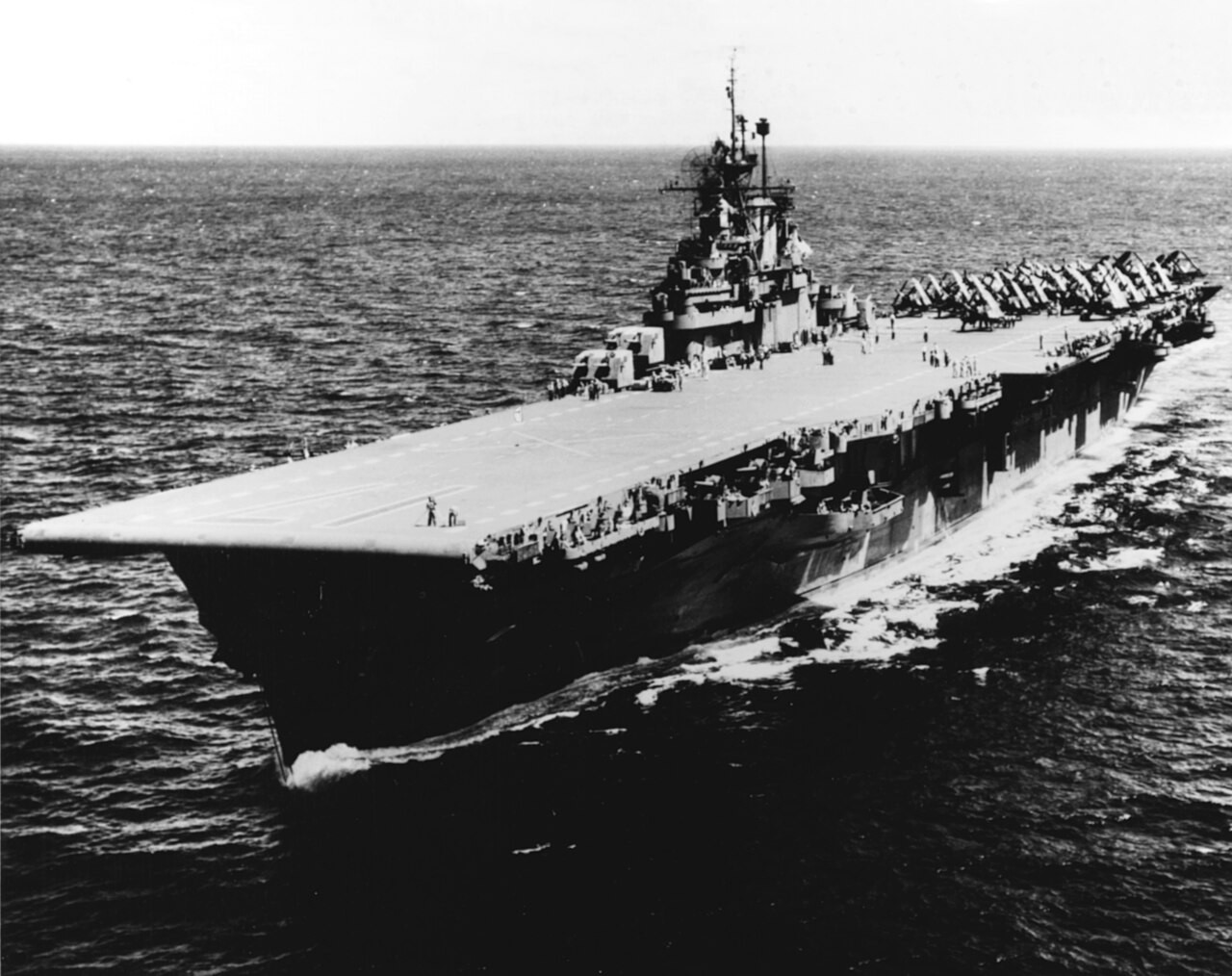
Building
Bunker Hill was the first Navy ship named for the 1775 Battle of Bunker Hill. Bethlehem Steel's Fore River Shipyard at Quincy, Massachusetts, laid her down as hull 1509 on 15 September 1941. She was launched on 7 December 1942, the first anniversary of Pearl Harbor, sponsored by Mrs. Donald Boynton. She was commissioned on 25 May 1943 with Captain John J. Ballentine in command. She took her air group aboard at Norfolk at the end of June, shook down off Trinidad, and on 4 September sailed for the Pacific by way of Panama.
The Corsair squadron
She trained with Fighting Squadron 17 (VF-17), a new squadron flying F4U Corsairs. On the way to Pearl Harbor the pilots learned the Navy had decided not to operate Corsairs from carriers yet. VF-17 went ashore to the Solomons, and VF-18's Hellcats replaced it. During the strike on Rabaul on 11 November 1943, flown with Essex and Independence, VF-17's land-based Corsairs had their tailhooks put back, and they landed and refueled on their old ship while covering the task force.
1943–1944
She covered the Tarawa landings, struck Kavieng on 25 December 1943 and on 1 and 4 January 1944, and hit the Marshalls from 29 January to 8 February. She took part in the great raid on Truk on 17–18 February, when eight Japanese warships were sunk, and struck the Marianas on 23 February. She then raided Palau, Yap, Ulithi and Woleai (30 March – 1 April), supported the Hollandia landings (21–28 April), and struck Truk, Satawan and Ponape (29 April – 1 May). From 12 June to 10 August she supported the Saipan and Guam landings. On 19 June, the first day of the Battle of the Philippine Sea, a Japanese bomb burst close aboard and sprayed her with fragments, killing two men and wounding about eighty. In the battle about 476 Japanese aircraft were destroyed, nearly all by Hellcats. In September she struck the western Carolines, and then Luzon, Formosa and Okinawa through early November. On 6 November 1944 she left for overhaul at Bremerton.
Mitscher's flagship
She sailed again on 24 January 1945 with Air Group 84. Its VF-84 had been built around veterans of VF-17, and Marine squadron VMF-221 was also aboard. She became the flagship of Vice Admiral Marc A. Mitscher's Task Force 58, with Commodore Arleigh Burke as chief of staff. She supported Iwo Jima, the raids on Honshū and the Nansei Shotō (15 February – 4 March), and the Okinawa campaign. On 7 April her planes helped sink the battleship Yamato, the light cruiser Yahagi, and four destroyers in the East China Sea.
11 May 1945
On the morning of 11 May 1945, off Okinawa, a Zero flown by Lieutenant (jg) Seizō Yasunori came out of low cloud on her starboard quarter. His 550-pound bomb went through the flight deck and out the side before exploding, and his plane crashed among fueled and armed aircraft parked on deck. Thirty seconds later Ensign Kiyoshi Ogawa's Zero dove through flak, released its bomb, and hit near the island. That bomb burst in the pilots' ready room, killing 22 men of VF-84. Gasoline fires and explosions followed. In all, 396 men were killed or missing (43 never found) and 264 were wounded. Among the dead were three officers and eleven men of Mitscher's staff. Mitscher's flag cabin was destroyed. He shifted by breeches buoy to English and then to Enterprise. These were the second-heaviest losses of any carrier that survived the war, after Franklin. Bunker Hill still made 20 knots to Ulithi, returned home by way of Pearl Harbor, and was under repair at Bremerton when the war ended.
Fate
She made Magic Carpet voyages from 27 September 1945 and was opened to visitors at Seattle on Navy Day. She was decommissioned on 9 January 1947. In reserve she was redesignated CVA-17 (1951), CVS-17 (1953) and AVT-9 (1959). She and Franklin were the only Essex-class carriers never recommissioned after the war. She was stricken in 1966 and served for years as an electronics test hulk in San Diego Bay. A 1972 effort to save her as a museum failed, and on 2 July 1973 she was sold for scrap to Zidell Explorations. Her bell went to the guided-missile cruiser Bunker Hill in 1986. She received the Presidential Unit Citation and battle stars for her World War II service.
Sources
Wikipedia, "USS Bunker Hill (CV-17)" (citing DANFS; Sheftall, Blossoms in the Wind).
NHHC/DANFS, "Bunker Hill I."
Flag: Ballentine's command start is given as 24 or 25 May 1943. See the Ballentine bio. The Yahagi name comes from the general record. The extract says only "the cruiser."