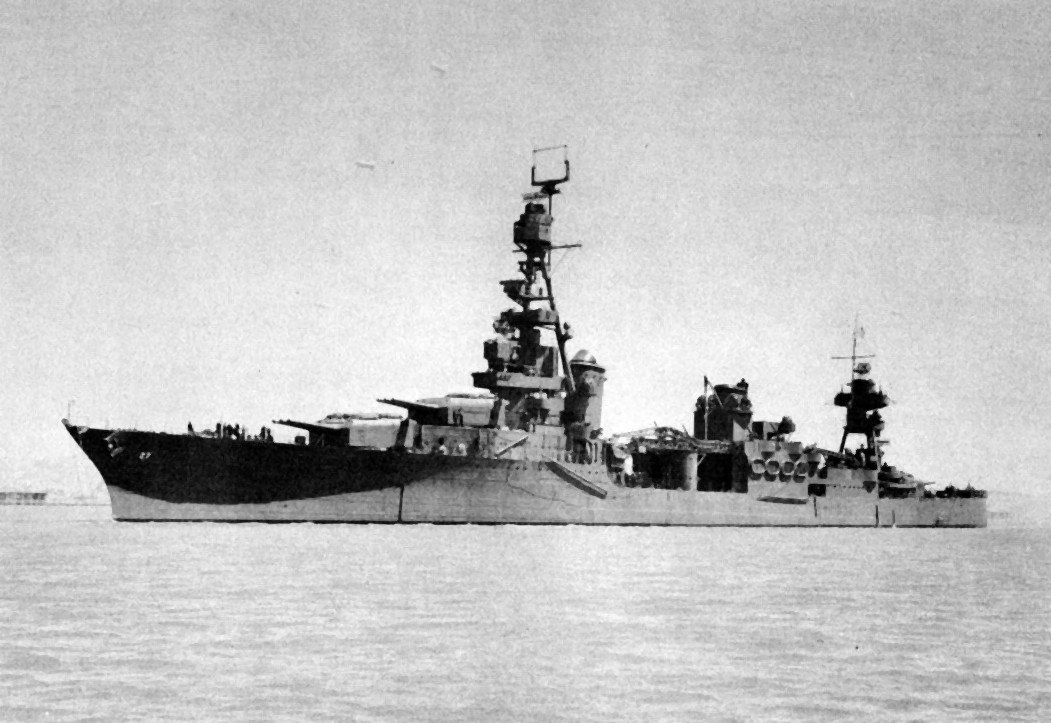
Building
Chester was a Northampton-class cruiser and the second Navy ship named for Chester, Pennsylvania. New York Shipbuilding Corporation launched her at Camden, New Jersey, on 3 July 1929, sponsored by Miss J. Blain. She was commissioned on 24 June 1930. She was classed as light cruiser CL-27 because of her thin armor and became heavy cruiser CA-27 on 1 July 1931 under the London Treaty because of her nine 8-inch guns.
Between the wars
She sailed from Newport on 13 August 1930 for an extended cruise in Europe and then became flagship of the Scouting Fleet's light cruiser divisions. On 6 March 1931 she carried the Secretary of the Navy to the Canal Zone to watch the fleet problem. In 1932 she moved to the West Coast. In 1934, as flagship of the Special Service Squadron, she steamed to New York for the Presidential Naval Review on 31 May. Ensign Richard O'Kane, later the Medal of Honor submarine captain of Tang, served in her for a year after he graduated from the Naval Academy in 1934. On 25 September 1935 she sailed with the Secretary of War and his party for the inauguration of the Philippine Commonwealth's president on 15 November. In November 1936 she escorted Indianapolis, carrying President Franklin Roosevelt, on his goodwill visit to Buenos Aires and Montevideo. In 1940 she was one of six ships to receive the new RCA CXAM radar. She was based at Pearl Harbor from 3 February 1941.
1942
On 7 December 1941 she was at sea with Northampton and Enterprise, returning from Wake. She covered the reinforcement of Samoa from 18 to 24 January 1942. In Halsey's Marshalls raid on 1 February she bombarded Taroa, and while retiring under heavy air attack she took a bomb in her well deck that killed eight men and wounded 38. With Task Force 17 she took part in the Tulagi raid on 4 May and the strike on Misima on 7 May. On 8 May, at the Coral Sea, her steady antiaircraft fire helped protect the carriers whose planes turned back the Port Moresby invasion force. After a West Coast overhaul she reached Nouméa on 21 September 1942 and covered the occupation of Funafuti from 2 to 4 October. On 20 October, north of the New Hebrides, I-176 torpedoed her amidships to starboard, killing 11 and wounding 12. Days later the transport President Coolidge struck a mine off Espiritu Santo, and Chester sent fire and rescue parties and took 440 survivors off the fleet tug Navajo.
1943–1944
After repairs she returned to San Francisco on 13 September 1943 and escorted ships to Pearl Harbor. She sailed on 8 November 1943 for the Gilberts and shelled Abemama, then bombarded Taroa, Wotje and Maloelap for the Marshalls landings. She patrolled off Majuro until 25 April 1944 and was overhauled at San Francisco from 6 to 22 May. She shelled Wake on 3 September and Marcus on 9 October, and then joined Task Force 38.
1945 and fate
From 8 November 1944 to 21 February 1945 she bombarded Iwo Jima and the Bonins from Ulithi and Saipan, through the landings of 19 February. After a West Coast overhaul she returned to Ulithi on 21 June and from 27 June patrolled off Okinawa and covered minesweeping west of the island. In August she went to the Aleutians, and on 31 August she sailed to cover the occupation landings at Ōminato, Aomori, Hakodate and Otaru in September and October 1945. After a Magic Carpet run to Guam she reached Philadelphia on 30 January 1946. She was placed in reserve there and sold for scrap on 11 August 1959. She earned 11 battle stars.
Sources
Wikipedia, "USS Chester (CA-27)" (citing DANFS).
NHHC/DANFS, "Chester II."