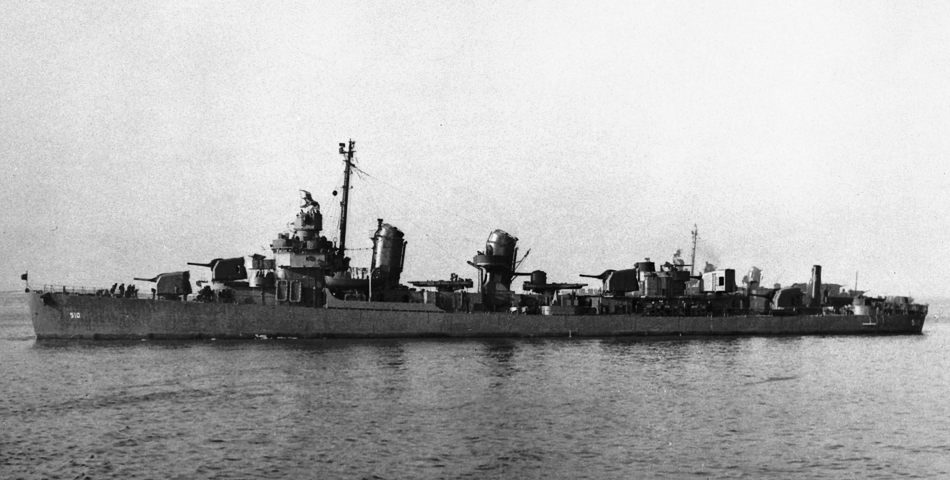
USS Eaton (DD-510) was a Fletcher-class destroyer. Her name honored William Eaton, an American soldier of the First Barbary War, who lived from 1764 to 1811. She was put into the water on 20 September 1942 at Bath Iron Works in Bath, Maine. Mrs. Mary Eaton Phillips, a great-great-granddaughter of General Eaton, sponsored her. The ship was commissioned on 4 December 1942.
Command of Eaton, as the dates are recorded, passed through Edward Louis Beck from commissioning until 3 September 1943, Edward Frank Jackson from 3 September 1943 until 27 March 1944, Fritz Gleim from 27 March 1943 until 23 December 1944, Chesford Brown from 23 December 1944 until 5 September 1945, and James Louis May from 5 September 1945 onward.
On 6 February 1943 she left Casco Bay, Maine, for duty in the Pacific, and on 7 March she reached Efate in the New Hebrides. Patrol work with Cruiser Division 12 covered the waters from Efate down toward the Solomons, and she also guarded convoys bound out of Espiritu Santo and Nouméa for Guadalcanal. After 10 August, from a fresh base at Port Purvis on Florida Island, she backed landings at Rendova, Vella Lavella, and Baracoma. In September she was back with Cruiser Division 12, sweeping Japanese shipping in the Slot, where a great many barges were sent under. On 1 October 1943, off Vella Lavella, the Japanese Type-C submarine I-20 was sunk while still on the surface.
A quick run to Auckland came next. On 26 October she took aboard Rear Admiral G. H. Fort and his staff, and the following day she flew his flag for the landing on Treasury Island. Before troops went in at Empress Augusta Bay, on the night of 1–2 November, Eaton led the fast minelayers Tracy (DM-19) and Pruitt (DM-22) through Bougainville Straits and closed the eastern approach. Patrols then ran from Port Purvis out toward Bougainville. On 13 November she hurried to help screen Denver (CL-58), hurt in the fighting at Empress Augusta Bay, and Dyson (DD-572) took that duty the next day. Eaton kept escorting supply ships to Bougainville, Treasury, and Vella Lavella, shelled batteries along the coast, and searched for Japanese vessels.
She was in the Green Island landing on 15 February 1944 and the Emirau landing on 20 March. Sailing on 4 May, she reached Majuro in the Marshalls on 7 May. From 29 May through 2 June she worked with Greiner (DE-37) and Sanders (DE-40), scouting Kusaie in the eastern Carolines and shelling it. She left Kwajalein on 11 June for Saipan, where the invasion opened four days later, and her guns covered both Saipan and Tinian with harassing fire and illumination. Three Japanese aviators were taken off a raft. On 12 August she headed from Saipan to Mare Island for overhaul. On 25 November 1944 she joined the covering force in Leyte Gulf for the Leyte operation. An enemy freighter was sunk by her on 1 December, and she shelled Ormoc Bay while shifting to cover the December landings on Mindoro.
Manus saw her again two days before Christmas. On 9 January 1945 she was in Lingayen Gulf, Luzon, on screen and patrol. The night after the assault her crew destroyed an enemy suicide boat barely twenty-five yards off the side. The blast killed one of her men and wounded fourteen. In January she took transports riding in ballast from Lingayen to Leyte, bombarded Corregidor in February, and was back in Leyte Gulf on 1 March. Through May she stayed with the freeing of the Philippines, including the landings at Mangarin Bay on Mindoro, on Panay, and on Mindanao. Leaving Subic Bay on 7 June 1945, she covered the 10 June landing at Brunei Bay, Borneo, stood by the minesweepers, and gave gunfire to the Australian assault troops and the underwater demolition teams. On 1 and 2 July she rendered the same help against Balikpapan’s great oil harbor, then arrived at San Pedro Bay on 5 July and used that anchorage as her base until the fighting stopped. Over the war, eight enemy aircraft were brought down by the ship.
On 28 August 1945 she went north to cover sweepers in the Yellow Sea near Jinsen, later called Inchon, ahead of landings the next month. From 6 September through the end of October she directed sweeping on the approaches to the Yangtze and, at Shanghai, controlled traffic at the harbor mouth for the Yangtze River Patrol Force. On 9 September an Eaton boarding party stopped five Japanese vessels trying to leave the port, and a prize crew remained with Medium Landing Ship No. 5 for close to a month. With the South China Force, based at Hong Kong, she called along some two thousand miles of Chinese coastline, from Haiphong in Indochina to Hulutao in Manchuria, until 29 December 1945. She also sailed with the French Indochina convoy that carried the 6th Chinese Army to Manchuria in merchant ships. New York received her on 8 February 1946. The next month she went to Charleston, South Carolina, and on 21 June 1946 she left commission for the reserve.
On 2 January 1951 she was reclassified DDE-510, and on 11 December 1951 she was recommissioned at the Boston Naval Shipyard. She joined Escort Division 22 at Norfolk, Virginia, on 29 May 1952, operated as far as the Caribbean, and in the summer of 1953 made two midshipman cruises, one to England, France, and Italy and another to Halifax, Nova Scotia. On 28 April 1954 she sailed for NATO drills off Derry, then visited harbors in Germany, Belgium, Denmark, England, and France on a goodwill trip, and afterward drilled in the Mediterranean with the 6th Fleet. In a practice defense of Turkey the same Turkish submarine, playing the opponent, was scored as sunk on two occasions. On the passage home she saved four survivors of the SS Mormackite and entered Norfolk on 10 October. In the early 1950s she struck a submarine that was surfacing. The destroyer next in line kept the accident from turning worse, her captain moving at once, and the submarine’s periscopes and conning tower were damaged. Early in 1956, during antisubmarine practice, Eaton collided with the destroyer Power (DD-839). On 6 May 1956, near the Virginia Capes, the battleship Wisconsin (BB-64) hit Eaton in thick fog while both were steaming in daylight at twenty knots. Each ship was badly damaged. The battleship’s bow met Eaton on the starboard side just ahead of the bridge, drove that side over to port, and broke the keel. The chief petty officers’ mess and the mess deck were wrecked. Her first lieutenant held her together by running anchor chain from the bow back to the stern. Eaton came through the war. On 27 March 1970 she was sunk as a target.