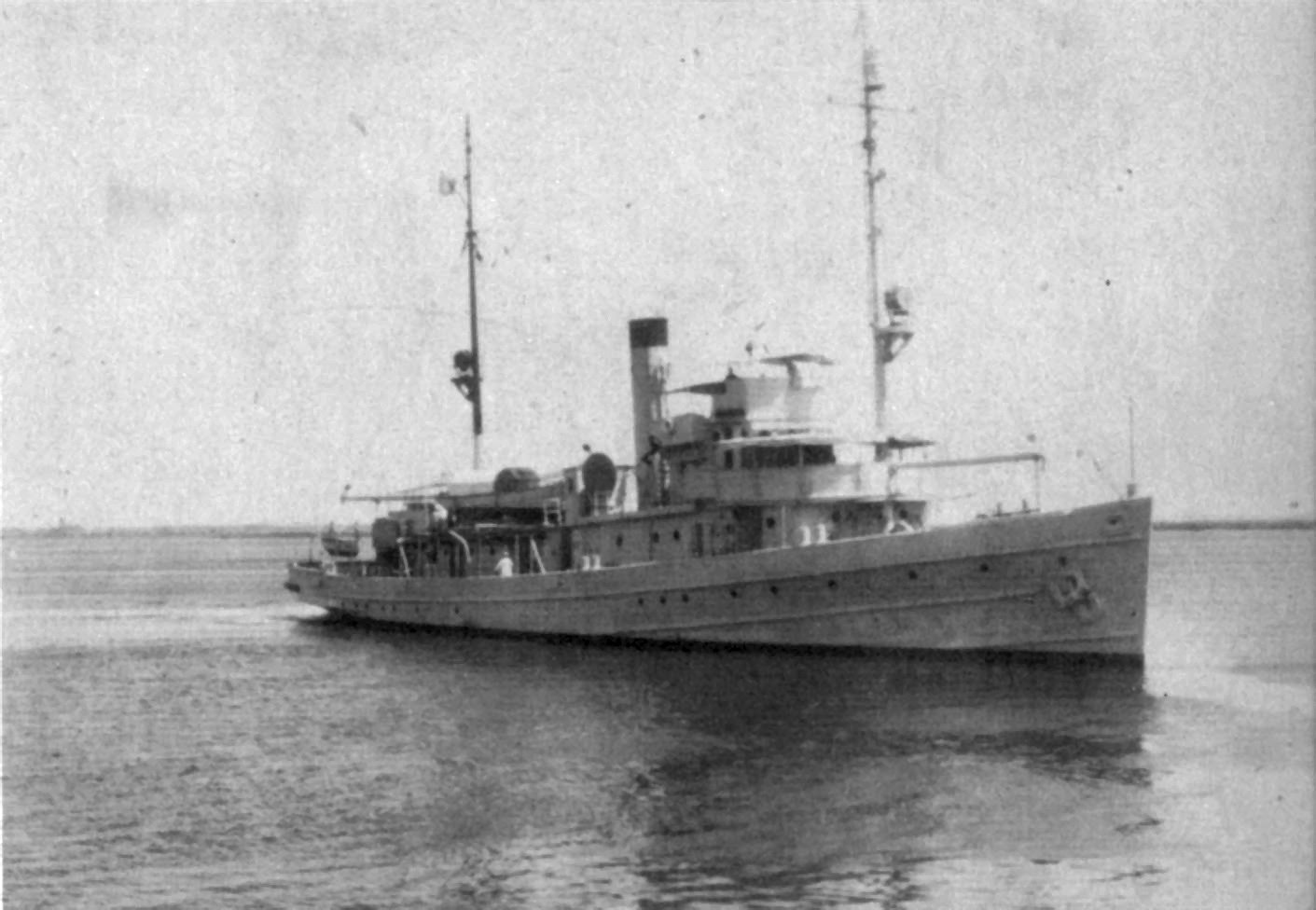
Grebe, Minesweeper No. 43, was a Lapwing-class minesweeper. The Dictionary of American Naval Fighting Ships entry preserved from 2007 gives her 950 tons, a length of 187 feet 10 inches, a beam of 35 feet 6 inches, a draft of 9 feet 9 inches, 14 knots, a complement of 59, and two 3-inch guns. The Staten Island Steam Boat Company built her. She was launched on 17 December 1918, sponsored by Miss Emma Youmans, and commissioned at the Brooklyn Navy Yard on 1 May 1919. DANFS names the commanding officer as Lieutenant Niels Dustrup. NavSource spells the name Niels Drunstrup and records a Medal of Honor for 1914, awarded in 1924, and a Navy Cross for 1919. He is not one of her wartime commanding officers. NavSource designates her AM-43 on 17 July 1920.
From 9 July 1919 until 1 October she was based at Kirkwall and helped clear the North Sea mine barrage. She reached Portsmouth, New Hampshire, on 28 November 1919 by way of Devonport, Brest, Lisbon, the Azores, Bermuda, and New York. DANFS prints the first of those ports as Davenport. After repairs she moved to the Boston Navy Yard on 4 November 1920 and worked the coast from Maine to New Jersey, calibrating radio compass stations and towing. On 29 April 1921 she rescued 139 passengers from the Portuguese steamer Mormugao, aground off the Massachusetts coast. On 2 June she went to Newport. DANFS says she escorted the submarine G-1 in diving trials until 23 June, when G-1 sank in 16 fathoms, and that Grebe then took part in the salvage. A later summary says she depth-charged G-1. The 2007 DANFS text says the submarine sank during the trials, and that is the sentence followed here. She was back at Boston on 22 July. From 1 December 1921 to 18 March 1922 she made a round trip to Norfolk, Guantanamo, and the Canal Zone, then returned to Portsmouth and was decommissioned on 12 May 1922.
She was recommissioned on 15 November 1922. DANFS names Chief Boatswain Albert C. Fraenzel. NavSource spells the surname Franzel. On 16 December she sailed for St. Thomas and served as station ship in the Virgin Islands until 1931, making about a trip a week among St. Thomas, St. Croix, and San Juan with stores and passengers, and towing coal barges and dredges to San Juan, Fort-de-France, and other Caribbean ports. She assisted ships aground on the reefs and searched for missing ships. Each year she spent about five weeks under repair at Charleston. In September 1930 a hurricane devastated parts of the Dominican Republic. DANFS says Grebe, carrying medical men and emergency supplies, was the first ship to reach Santo Domingo, and that she stayed two weeks helping to unload ships and clear debris. On 17 March 1931 she brought Dr. Paul M. Pearson, the governor-appointee, and his staff from San Juan to St. Thomas. She then returned to Boston. On 12 July 1931 she took the restored frigate Constitution in tow and spent the next three years as her tender, visiting major ports on both coasts. On 12 May 1934 she gave up that duty and entered the Philadelphia Navy Yard. After a short tour at Norfolk, from 21 August to 14 September, she went to Guantanamo to tow for gunnery practice until 12 October, then to San Pedro, arriving on 19 November. She stayed on the west coast until mid-1940, towing targets, joining fleet problems and minesweeping exercises, and doing harbor work, with a trip to Pearl Harbor from 6 to 31 May 1935 and a trip to Guantanamo and Norfolk from 26 December 1938 to 7 May 1939. DANFS prints the second of those dates inside the sentence as 26 December to 7 May 1939. She left San Pedro on 3 June 1940 and reached Pearl Harbor on 17 June. Two trips to the mainland, from 1 August to 9 September and from 27 September to 13 October 1941, both in company with Bobolink, interrupted the Hawaiian duty. Lieutenant Commander Ellsworth Dudley McEathron, Naval Academy class of 1920, had her from 16 June 1939.
On 7 December 1941 she was in yard availability at Pearl Harbor. There is no action report for her on the Navy's list of ships present. DANFS says her 3-inch guns had been dismantled for the overhaul, so she could fight only with rifles and pistols, and that she was credited with shooting down one of three unidentified planes flying low over the Navy Yard. That credit is DANFS's sentence. No report here gives a gun, a time, or a witness for it. She was not recorded as damaged.
On 24 January 1942 she left for Palmyra with YO-43 in tow and arrived five days later. She was back at Honolulu on 5 February and continued from there until autumn. NavSource reclassifies her as a fleet tug, AT-134, on 1 June 1942. The 2007 DANFS text prints the same change on 1 June 1941. The Navy's list of ships present on 7 December 1941 still carries her as AM-43, which agrees with the 1942 date and not with the 1941 date. On 30 September she joined a convoy for Johnston Island and returned on 9 October. On 9 November 1942 she got underway with YC-737 and YB-9 in tow, accompanying YO-44, for Canton Island. She called there on 25 November and reached Pago Pago on 28 November. On 6 December 1942 she grounded while trying to float the steamer Thomas A. Edison at Vuata Vatoa, in the Fiji Islands. NavSource spells the island Vuanta Vatoa. Salvage was broken up by a hurricane that destroyed both ships on 1 and 2 January 1943. Her name was struck from the Navy list on 28 July 1943. NavSource says she was decommissioned and struck on that day. She earned one battle star. Lieutenant Charles McMaster Lewis had her from 1 October 1942 to 6 December 1942, the day she grounded.
A note on sources. The career follows the 2007 DANFS text for Grebe, saved from the Naval Historical Center site as it stood on 5 May 2007, and NavSource's commanding-officer list and reclassification line. The current history.navy.mil address for that entry returned not found. No action report for 7 December was on the Navy's ships-present page, so the plane credit and the rifles and pistols are DANFS only. The spelling of her first commanding officer, the spelling of Fraenzel, the date of the tug reclassification, and the spelling of the Fijian island are left as each source prints them. The Medal of Honor on NavSource's line for Lieutenant Niels Drunstrup belongs to his entry there. He left the ship long before the war. McEathron's Silver Star of 1945 and his two Legions of Merit of 1944 and 1945, also on NavSource, fall after he left Grebe on 1 May 1942.