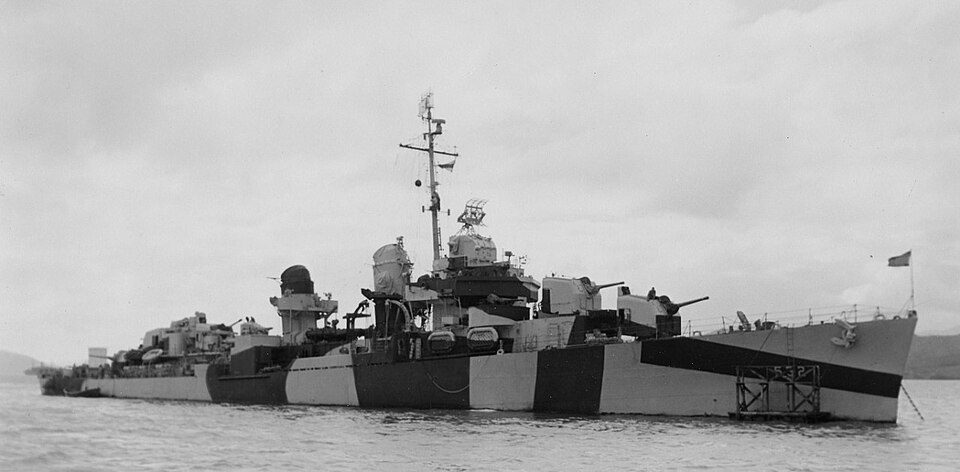
Heermann (DD-532) was a Fletcher-class destroyer, and the only one of Taffy 3's three destroyers to come out of the Battle off Samar. She was named for Lewis Heermann, a Navy surgeon born in 1770 who served from the Quasi-War into the 1830s and died in 1833. Bethlehem Steel at San Francisco laid her down on 8 May 1942, launched her on 5 December 1942, and commissioned her on 6 July 1943. The sponsor was Mrs. Edward B. Briggs. Her husband, a Coast Guard lieutenant, was Heermann's great-grandson. Commander Dwight M. Agnew had her. Shakedown was out of San Diego through late August 1943.
She joined the Pacific Fleet in October 1943 and screened the fast carriers and the invasion forces through the Gilberts (Tarawa, 20 November-2 December 1943), the Marshalls (Kwajalein and Majuro, then Eniwetok), and the Emirau landing in March-April 1944. Commander Amos T. Hathaway relieved Agnew on 1 May 1944 and had her through the rest of the war. In May 1944 she made a series of depth-charge attacks on a contact that went dead in the water, with a burst of flame after the last pattern. Postwar comparison of American and Japanese records never identified the submarine. It is not a kill. She was at the Palaus in September.
By October she was in the screen of Rear Admiral Clifton Sprague's Taffy 3, TU 77.4.3, six escort carriers, three destroyers, and four destroyer escorts. At about 0645 on 25 October, lookouts saw antiaircraft fire to the north. Within minutes Kurita's Center Force was in sight: Yamato, Nagato, Kongo, and Haruna, six heavy cruisers, two light cruisers, and eleven destroyers. The carriers launched what they had. The escorts made smoke and turned in.
Johnston had already gone in on her own. Hoel and Heermann followed, and the escorts with them. Hathaway closed to about 4,000 yards twice and fired torpedoes at the heavy ships. His Navy Cross citation says he scored one confirmed hit on a battleship. The torpedoes are not pinned to a sinking. The usual account is that Yamato had to comb the wakes and fell out of the formation for a time. Hoel fired all ten of hers and is not credited with a hit. The usual account of the bow blown off Kumano is Johnston's, not hers.
After the torpedoes were gone she fought with her 5-inch guns, including a duel with the heavy cruiser Chikuma. A shell came into the pilothouse and killed three men, and a fourth was mortally wounded. Hathaway counted red, yellow, green, and undyed splashes, so at least four ships were shooting at her. Two more shells hit forward and flooded compartments. Another burst near the keel. One of the later hits was likely from Kongo, whose red-dye shells he had watched walking in. She was down by the bow, about five feet at frame 42, and for a time making about 10 knots with the anchors dragging. Sprague ordered her back to the port bow of the carriers to make smoke. She was still there when the Japanese turned north. Gambier Bay, Hoel, Johnston, and Samuel B. Roberts were sunk by the Japanese guns. She was not.
Four of her crew were killed and seventeen wounded: Quartermaster Third Class Howard F. Doan, Soundman Second Class Thomas P. Evanowski, Machinist's Mate Second Class Althon L. Rossum, and Radioman Second Class Chester E. Warren. A man she had picked up the night before, Lieutenant (junior grade) Dahlan, also died. Hathaway received the Navy Cross. The ship shared the Presidential Unit Citation given to the Taffy 3 ships that made the charge.
She transferred her wounded and some St. Lo survivors to the hospital ship Bountiful, patched at Kossol Roads, and on 30 October sailed with Dennis for Seeadler Harbor. The floating dry dock there could not take the damage. She reached Mare Island on 26 November for a full overhaul. She was back with the fast carriers for Iwo Jima in February 1945, the raids on Honshu and the Nansei Shoto, and the Okinawa supporting raids from March into June. On 18 April 1945 she is one of the ships credited in some lists with a share of the submarine I-56 east of Okinawa. That credit is in the campaign record, not a single-ship kill. She stayed with the Third Fleet raids on Japan through 15 August 1945, entered Tokyo Bay on 16 September, and supported the occupation until 7 October. She was decommissioned at San Diego on 12 June 1946.
Recommissioned on 12 September 1951, she shifted to Newport and served in the Atlantic until she decommissioned at Boston on 20 December 1957. On 14 August 1961 she was transferred to Argentina and became ARA Almirante Brown (D-20). The United States struck her on 1 September 1975. Argentina struck her, and she was scrapped in 1982. Nine battle stars on the Asiatic-Pacific ribbon: the Gilberts, the Marshalls, a special operation in May-June 1944, the Palaus, Leyte, Iwo Jima, Okinawa, an antisubmarine action on 17 April 1945, and the Third Fleet raids on Japan. The Presidential Unit Citation sits on top of those.