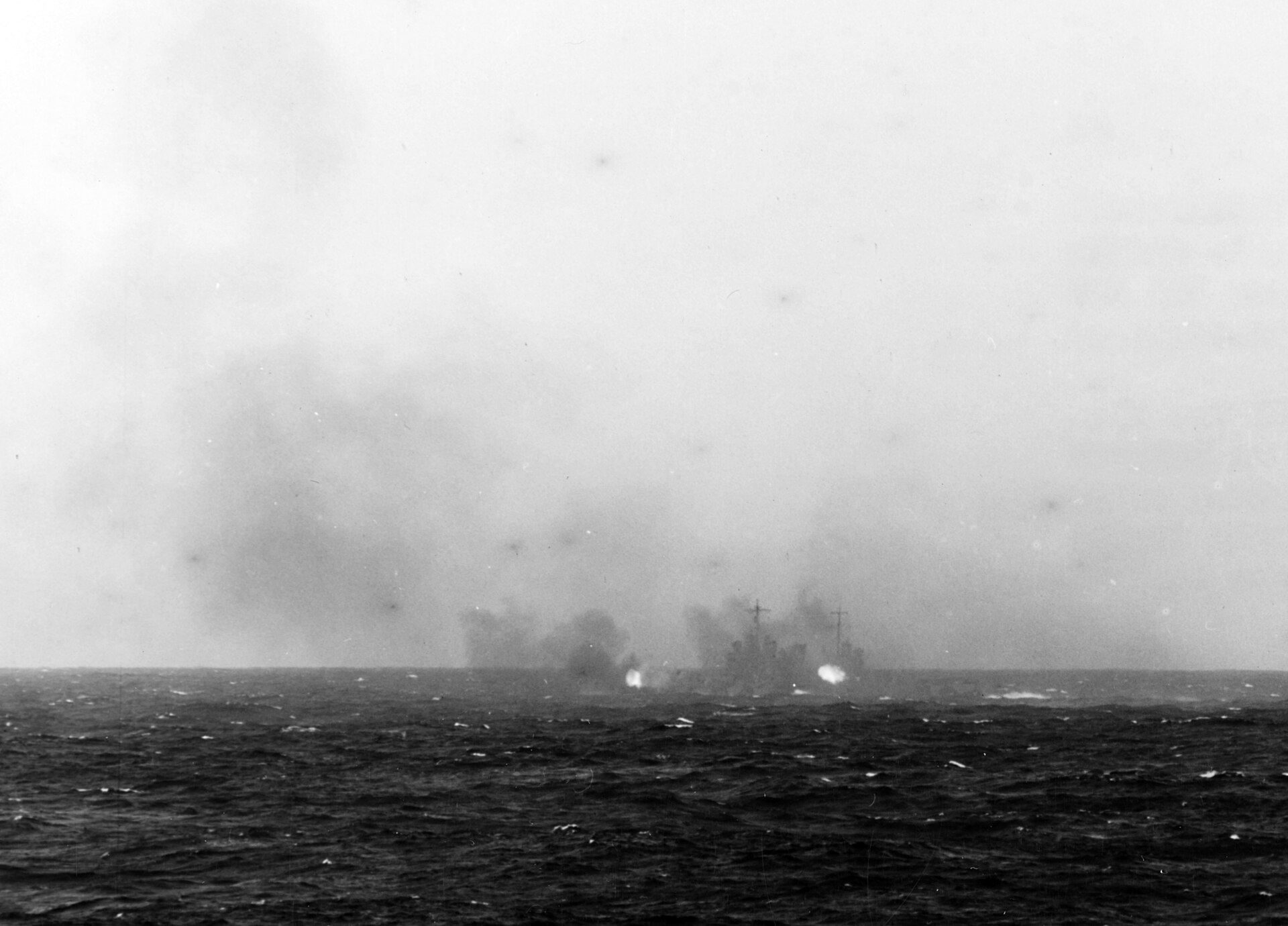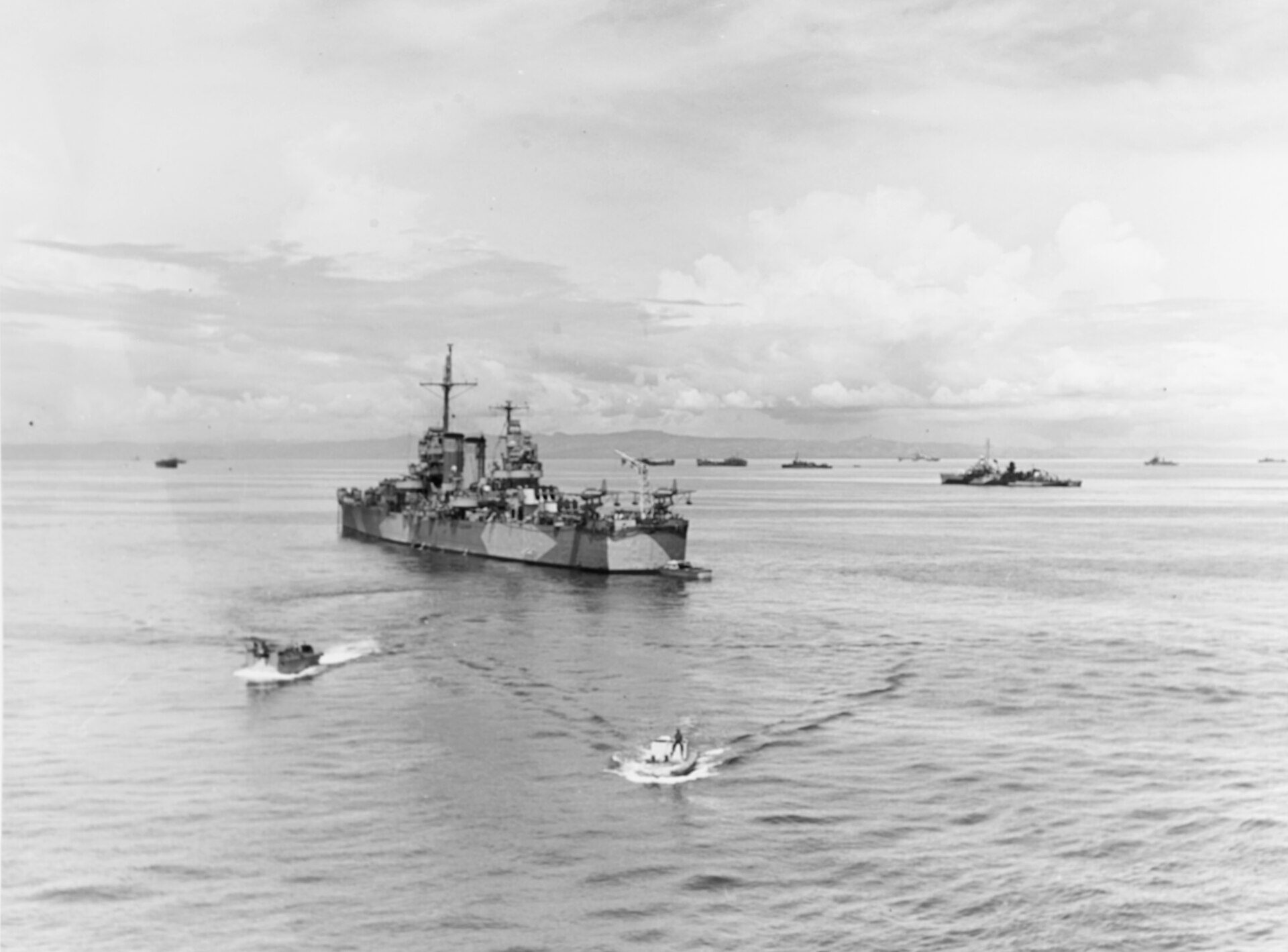
USS Nashville (CL-43) was the second ship of that name, for the capital of Tennessee. She was a Brooklyn-class light cruiser, with fifteen 6-inch guns in five triple turrets. New York Shipbuilding at Camden laid her down on 24 January 1935. Ann and Mildred Stahlman sponsored her when she went down the ways on 2 October 1937. The Philadelphia Navy Yard commissioned her on 6 June 1938, and Captain William W. Wilson had her.
She shook down in the Caribbean from Philadelphia, sailing on 19 July 1938, then crossed to Cherbourg and arrived on 24 August. On 21 September she left Portland, England, with $25 million in British gold aboard, put it ashore at the Brooklyn Navy Yard on 30 September, and was back at Philadelphia on 5 October. In the spring of 1939 she carried the American party to the Pan American Defense Conference at Rio and returned them to Annapolis on 20 June. On 23 June she left Norfolk, passed the Panama Canal, and reached San Pedro on 16 July. She stayed in the Pacific for two years. In February 1941 she was one of four cruisers that took Marines out to Wake. She left Pearl Harbor on 20 May, reached Boston on 19 June, and escorted Marines to Iceland. From August through December she patrolled from Bermuda.
After Pearl Harbor she worked from Casco Bay and took troops to Iceland, then escorted ships to Bermuda and Iceland into February 1942. On 4 March she met Hornet (CV-8) off the Virginia capes and took her through the canal to San Diego, arriving on 20 March. On 2 April she sailed with Hornet from San Diego. Sixteen Army B-25s under Lieutenant Colonel James H. Doolittle were on the carrier's deck. On 13 April they met Enterprise and the rest of Task Force 16 north of Midway. Captain Francis S. Craven had Nashville. Early on 18 April a Japanese picket boat sighted the force and got a warning off. One account says Nashville sank the picket boat No. 23 Nitto Maru with gunfire. Her own history says planes from Enterprise sank that boat, and that her 6-inch guns sank a second scout. She was not hit. The force was back at Pearl Harbor on 25 April.
On 14 May she left Hawaii as flagship of Task Force 8 and reached Dutch Harbor on 26 May. Fog on 3 and 4 June kept the force away from the Japanese carriers that struck the harbor. She patrolled the North Pacific through the summer and fall, and in August she bombarded Kiska. Pearl Harbor saw her again on 22 November, and Fiji on 24 December. At Espiritu Santo she was flagship of Task Force 67. On the night of 4 January 1943 she bombarded the airfield at Munda with Helena and St. Louis. Rear Admiral Walden L. Ainsworth flew his flag in her. He was not her captain.
On the night of 12 May 1943, while she was shelling the airfield at Vila on Kolombangara, powder charges exploded in a forward turret. Eighteen men were killed and seventeen were injured. She left Espiritu Santo on 22 May for Mare Island, and she was in the yard before the July night battle off Kolombangara. The yard repaired her and modernized her. She was at San Francisco on 6 August and at Pearl Harbor on 12 August. She covered carrier strikes on Marcus at the end of August and on Wake on 5 and 6 October, and she returned to Espiritu Santo on 25 October.
For the next seven months she fired in support of landings in New Guinea and the Admiralties, and at Bougainville and Cape Gloucester. On 21 and 22 April 1944 she was off Wadke. She carried General Douglas MacArthur for the landings at Hollandia, Tanahmerah Bay, and Aitape on 22 and 23 April. Off Biak on 4 June a near miss damaged her. She was not sunk. She carried MacArthur again at Morotai in the middle of September.
She sailed from Manus on 16 October 1944 with MacArthur aboard and stood at the mouth of Leyte Gulf from 20 to 25 October, covering the beachhead. On 28 November she left the Admiralties as flagship of the Visayan Attack Force, bound for Mindoro. On 13 December, off Negros, a kamikaze hit her port 5-inch mount. Both of the plane's bombs exploded about ten feet off the deck. Gasoline and ready ammunition burned. One hundred thirty-three men were killed and 190 were wounded. The guns that were left kept up the anti-aircraft fire. The flag moved to another ship. She went on to San Pedro Bay, then Pearl Harbor, then Puget Sound, and she arrived on 12 January 1945.
She was underway again on 12 March. After training she left San Diego on 15 April, reached Subic Bay on 16 May, and flew the flag of Task Force 74. She covered the Brunei Bay landings in Borneo and carriers working in Makassar Strait. On 29 July a sortie from Subic against a reported convoy off Indochina was called off. That was her last wartime operation. She entered Shanghai on 19 September with the commander of Task Force 73. The flag came down on 17 November. She took troops to the west coast, ninety more from Hawaii, and reached San Pedro on 3 December. Eniwetok and Kwajalein came after that.
On 3 January 1946, in heavy weather off the west coast, she took the transport St. Mary's in tow. St. Mary's had lost her engines, with about 1,800 men aboard. Nashville passed the tow to tugs at the San Francisco lightship on 6 January. She left San Francisco on 21 January for a pre-inactivation overhaul at Philadelphia. The Navy decommissioned her on 24 June 1946. She lay in reserve until she was sold to Chile on 9 January 1951. Chile commissioned her as Capitán Prat and later renamed her Chacabuco. She served into the 1980s. Ten battle stars.