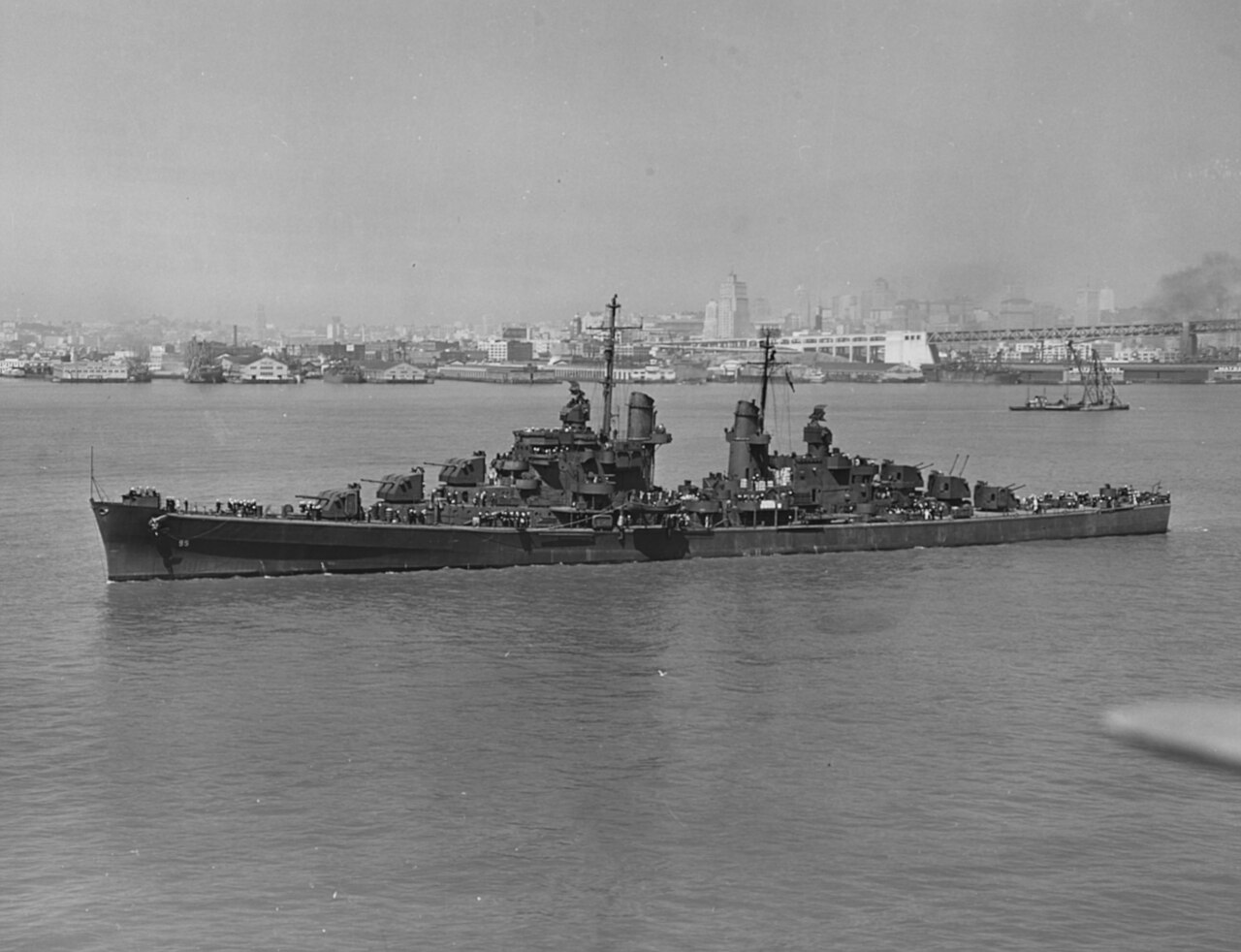
Oakland, CL-95, was an Oakland-class light cruiser, the second Navy ship of the name, for the city on the eastern shore of San Francisco Bay. Bethlehem Steel Company laid her down at San Francisco on 15 July 1941. She went down the ways on 23 October 1942, sponsored by Dr. Aurelia H. Reinhardt, and the Navy commissioned her on 17 July 1943 with Captain William K. Phillips in command. The DANFS line for the hull gives 6,000 tons, a length of 541 feet, a beam of 53 feet, a draft of 26.6 feet, 31.8 knots, a complement of 802, twelve 5-inch guns, eight 40 mm guns, sixteen 20 mm guns, and eight 21-inch torpedo tubes. NavSource dates Phillips from that commissioning day.
She shook down and trained off San Diego in the summer of 1943 and finished a yard period at Mare Island in September and October. She sailed for Hawaii the day before Halloween and reached Pearl Harbor on 3 November. With three heavy cruisers and two destroyers she joined carrier Task Group 50.3 near Funafuti, in the Ellice Islands, for Operation Galvanic, the landings in the Gilberts. The carriers launched their first strikes on 19 November. On the afternoon of the 20th a wave of Japanese torpedo bombers attacked the formation, and Oakland helped splash four of them. On 26 November she shifted to Task Group 50.1 and took over as screen commander for Yorktown (CV-10), Lexington, and Independence (CVL-22) in the raids on Kwajalein, Wotje, and Maloelap on 4 December. She coordinated the antiaircraft fire in the counterattacks. An aerial torpedo still hit Lexington and damaged her steering. In the same action the destroyer Taylor (DD-468) was hit by friendly fire from Oakland. The cruiser covered Lexington's slow withdrawal. Both ships were at Pearl Harbor on 9 December.
She left Pearl Harbor on 16 January 1944 with the carriers of Task Group 58.1. Strikes on Maloelap on 29 January sank the Japanese netlayer Uji Maru. Strikes on Kwajalein followed on the 30th, and the next day the group supported the landings at Kwajalein and Majuro. She stayed with the carriers until the ships anchored in Majuro lagoon on 4 February. On 12 February the group sailed south. Nine carriers struck Truk on 17 and 18 February and sank two cruisers, three destroyers, and more than thirty patrol craft and auxiliaries. Task Force 58 then raided the Marianas and returned to Majuro. Oakland sortied again with the group on 7 March for Espiritu Santo. The ships skirted the Solomons, covered the occupation of Emirau on 20 March, and a few days later went on into the western Carolines. The carriers pounded Palau on 30 March, Yap on the 31st, and Woleai on 1 April, and the group was back at Majuro on 6 April. The strikes sank more than forty auxiliaries and small craft, and the aircraft mined the channels and approaches to the Palaus. On 21 and 22 April the carriers hit Wake and Sawar in New Guinea. After Manus on the 26th the group hammered Truk again at the end of the month and retired to Kwajalein on 4 May.
On 6 June she sailed with Task Group 58.1 for the Marianas, covered the strikes on Guam on 11-13 June, and then went north for a sweep of the Volcano and Bonin airfields on the 14th. When word came of a Japanese counterattack the carriers rushed west of Saipan and fought the Battle of the Philippine Sea on 19 and 20 June. DANFS calls it the Marianas Turkey Shoot and counts almost 400 Japanese carrier aircraft lost, one fleet carrier sunk and three damaged, and 130 American planes and 76 crews lost. It says the losses would have been higher had Admiral Marc A. Mitscher not ordered the task force to turn on its spotlights so the strike groups could land after dark. The group hit Pagan on 23 June and Iwo Jima on the 24th, replenished at Eniwetok, and bombarded Iwo Jima and Chichi Jima on 3 and 4 July. It then worked Guam and Rota. On 9 July Oakland and Helm (DD-388) recovered downed pilots off Guam and fired at targets on Orote Peninsula. Late in the month the group hit Yap and Ulithi, then returned to Saipan.
About 0800 on 4 August, while she was covering strikes on Iwo Jima, search planes reported a Japanese convoy leaving Chichi Jima. Air strikes damaged and slowed it. A surface group was formed from Oakland, Santa Fe (CL-60), Mobile (CL-63), Biloxi (CL-80), and seven destroyers, and ran northwest at 30 knots. Off Muko Jima around 1730 the ships sank the escort destroyer Matsu and the collier Ryuko Maru and finished the damaged cargo ship Hokkai Maru. At 2145 they turned south and raked Chichi Jima. Oakland made three bombardment runs against shipping in Funtami Ko, damaged the seaplane base, and started fires among the wharves and warehouses. Phillips left her on 8 August 1944. Captain Kendall Sturtevant Reed took command the same day.
After upkeep at Eniwetok the task group hit Peleliu and the western Carolines on 6 and 7 September, then spent two weeks on Japanese airfields in the Philippines, from Mindanao through the Visayan Sea to Luzon, and retired to Ulithi on 2 October. On 6 October she sailed with Task Group 38.2 for the Ryukyus. Strikes on the 10th sank more than two dozen auxiliaries and small craft. On the 12th the group hit Formosa and helped sink more than a dozen cargo ships and tankers there and off the Pescadores. The raid drew a heavy counterattack. An aerial torpedo badly damaged Canberra (CA-70) on 13 October. Oakland shifted back to Task Group 38.1 to cover the damaged cruiser's withdrawal and helped fight off repeated attacks the next day. She was in the heavy strikes on airfields near Manila on 19 October and covered the Leyte landings on the 20th. On the way to Ulithi to refit, the group was ordered to turn back and help stop the Japanese ships converging on Leyte Gulf. By the time she arrived, the engagements of 23-26 October that DANFS calls the Battle for Leyte Gulf were mostly over.
Through November and December she operated with task groups of Task Force 38 in the Philippine campaign, covering fleet and escort carriers against Luzon and the Visayan Sea. On 18 December, after what the history calls the bottom dropping out of the barometer, she rode out a typhoon in the Philippine Sea. She was then ordered home for a yard overhaul. She reached San Francisco on 11 January 1945 and went into the Bethlehem Steel yard there for engine repairs, new antiaircraft guns, and a new coat of paint. She left California on 4 March, stopped at Pearl Harbor, and went on to Ulithi.
She sailed for the Ryukyus on 31 March and arrived off Okinawa on 3 April. For a week she covered Task Force 58's air strikes. On the 11th her guns drove off a raid. Two sailors were killed, by strafing or by friendly antiaircraft fire. DANFS calls them her only battle casualties of the war. On 15 April she went north with other groups for strikes on airfields on Kyushu. Enemy planes tried to get through the fighter cover, and twice her guns cut loose, helping destroy a twin-engine bomber and driving off another. She was back off Okinawa on the 17th. In May the group drew off to the east to replenish and to strike the island from farther out. Early on 11 May snooper planes put the crew at general quarters, but the attack did not come then. When it did, two kamikazes hit the flight deck of Bunker Hill (CV-17), 2,000 yards from the cruiser. Oakland cut loose three life rafts for the survivors. The force struck Kyushu again on 13 May, and the reply the next day kept her gunners busy. She stayed off Okinawa until the 29th, shifted to Task Group 38.1, and anchored in San Pedro Bay, Leyte, on 1 June.
On 10 July Task Group 38.1 began the series DANFS calls the Month of Fire, first against Honshu and then to the north. Naval aircraft hit Tokyo on 17-20 July, Kure and Kobe on 24-27 July, and Tokyo again on the 30th along with Nagoya. On 7 August the ships turned north a second time. Poor weather and talk of an armistice after the atomic bombing of Hiroshima and Nagasaki limited the strikes. On 15 August the order came to cease offensive operations. Oakland took station off Kyushu for the occupation. Reed was relieved on 27 August 1945 by Captain Allen Philip Calvert. She moved to Tokyo Bay on 30 August and, anchored near the Yokosuka naval base, watched the signing on 2 September.
She lay in Tokyo Bay until 1 October, then sailed for Okinawa to embark men for a Magic Carpet voyage. She left Okinawa on the 3rd and reached San Francisco on the 20th. In November and December she went back twice, first to Eniwetok and then to Kwajalein, and was then ordered to an inactivation area at Bremerton. The orders changed. Instead of laying up, she was kept in service and given an overhaul at the Puget Sound Navy Yard in the first half of 1946. Calvert left her on 19 May 1946. Captain Thomas Joseph Casey took her the same day. She shifted to San Diego and served there as a fleet gunnery training ship through the end of the year.
On 6 January 1947 she sailed for the Far East, stopped at Pearl Harbor on the 14th, and spent two months in a fleet exercise in the Marianas and Marshalls, calling at Guam, Saipan, and Kwajalein before returning to Pearl Harbor on 11 March. She was then ordered to China. She arrived at Tsing-tao on 30 March and became flagship of Captain Sherman R. Clark, Commander, Destroyer Flotilla Three. For three months she worked from Tsing-tao and Shanghai and made almost a dozen patrols in the East China Sea. In May, with communist forces threatening the consulate at Peking, American forces in China went on high alert, and Oakland put a small landing force of sailors ashore to help the Marines at Tsing-tao. Casey was relieved on 26 April 1947 by Captain John Newton Opie III, so the last part of that cruise was Opie's. Tensions eased in June. She left China on 20 July, stopped at Yokosuka and Pearl Harbor, and reached San Diego on 8 August.
After maintenance and an overhaul early in 1948 she made a second voyage in support of the Nationalist government. Captain Hugh Jack Martin relieved Opie on 12 March 1948 and had her for both of the long cruises in Chinese waters, 26 April to 10 July and 27 September to 9 November. By the end of the second patrol DANFS says the Nationalist government had virtually collapsed. She was back on the west coast before the end of the year and reported to the Pacific Reserve Fleet for inactivation on 28 February 1949. She was redesignated CLAA-95 that day. NavSource gives her last captain, Ernest Bradford Ellsworth Jr., from May 1949. She was decommissioned at San Francisco on 1 July 1949, the day his command on that list ends. She saw no active service under the new designation. Her name was struck on 1 March 1959. She was sold to Louis Simons Inc. on 1 December 1959 for scrapping, and the work was finished by the end of 1962. She earned nine battle stars for World War II. She was not sunk.
A note on sources. The narrative follows the Naval History and Heritage Command's Dictionary of American Naval Fighting Ships entry for Oakland II (CL-95), the page on history.navy.mil, for dates, places, ships sunk, the two men lost off Okinawa, the China cruises, and the disposal. That page heads her class as Oakland and prints Lexington as Lexington (16), the destroyer Matsu as an "esort destroyer," Hokkaido as "Hokaido," the harbor at Chichi Jima as Funtami Ko, and the suddenness of the 11 May attack as "a bolt of lightening." Those are given here in ordinary spelling except Funtami Ko, which is left as printed. The commanding officers and their dates are NavSource's list for CL-95. DANFS names only Phillips, as William K. Phillips, at the commissioning. NavSource gives Ellsworth's start as May 1949, with no day. A Navy biography already used for him dates the start of his command to March 1949, while he was still executive officer. The command line follows NavSource. Uboat.net dates Phillips as a temporary rear admiral from 23 September 1943. DANFS and the citations issued for his time in Oakland call him captain through 8 August 1944, and that is how the story names him. A digitized copy on the HyperWar site disagrees with the NHHC page on several points, and the NHHC page is followed here. HyperWar gives six 21-inch torpedo tubes rather than eight, dates the February 1944 Truk strikes to 16 and 17 February rather than 17 and 18, and says that on 20 November 1943 she scored two kills and two assists rather than helping to splash four aircraft. It places a torpedo-plane fight on 26 November, which the NHHC page uses for her transfer to Task Group 50.1, and it does not mention Taylor being hit by Oakland's fire on 4 December. It gives her two planes and two assists in night attacks on 21-22 February 1944, which the NHHC page does not describe, and it has her own 36-inch searchlights turned on at the end of the Philippine Sea battle. The NHHC page says only that Mitscher ordered the task force to turn on its spotlights. HyperWar also says Houston (CL-81) was torpedoed on 14 October 1944 and that Oakland covered both Houston and Canberra. The NHHC page names only Canberra, torpedoed on 13 October, and the withdrawal the next day. HyperWar has her, on 24 October, ordered back from the route to Ulithi and arriving after the Japanese had been repulsed, with the carriers then making long-range strikes. The NHHC page says that by the time she arrived the engagements of 23-26 October were mostly over. She is not entered for Sibuyan Sea, Surigao Strait, Samar, or Cape Engaño. HyperWar adds claims off Okinawa, a tanker that struck her bow in Tokyo Bay on 27 September 1945, Navy Day at Oakland, and a reclassification on 18 March with no year. None of those are in the NHHC entry. The NHHC page redesignates her CLAA-95 on 28 February 1949 and says the scrapping was finished by the end of 1962. The July 1944 bombardment of Iwo Jima is not the February 1945 landing, and it is not entered as that battle. The October 1944 strikes on Okinawa are not the April 1945 battle either.