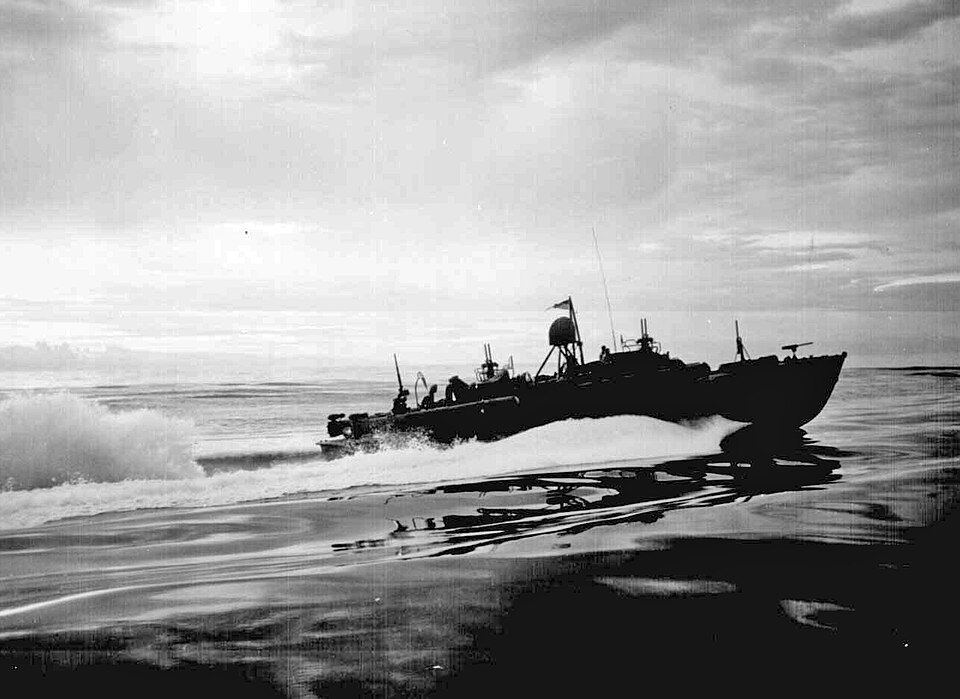
PT-124 was an 80-foot Elco motor torpedo boat, built at the Elco works of Electric Boat in Bayonne. She was laid down on 6 May 1942, launched on 3 August, and placed in service on 20 August. She went to Motor Torpedo Boat Squadron 6. On 29 August she lay alongside PT-117 and the destroyer Saufley in New York, the day Saufley was commissioned. Men called her Hogan's Goat, and later Who Me.
On the night of 1 February 1943 Clark W. Faulkner had her. She and PT-123 were about three miles south of Savo, on the patrol against the destroyers taking the last men off Guadalcanal. She fired three torpedoes at a destroyer. They missed. The destroyer was Makigumo. While that ship turned away she struck a mine, and before dawn Yugumo scuttled her. The boat reported hits. The Japanese record of that night is a miss, a mine, and one torpedo from Yugumo. The sinking is not this boat's. The Navy later awarded Faulkner the Navy Cross. The citation counts this night with an earlier night when he had PT-40.
On 22 August Leighton C. Wood had her on a daylight run from Lever Harbor toward Kolombangara, with air cover. She stayed at the mouth of Webster Cove while PT-108 and PT-125 went in. Shore guns hit those two boats. She was the boat outside. On 4 September Japanese planes damaged her off Meresu Cove, on the west side of Kolombangara.
At dawn on 30 September, after a night against barges near Ropa Point with PT-126 and PT-116, three Corsairs came over the boats. A call went out not to fire. One Corsair fired anyway. The boats shot it down. PT-124 took wounded men back to Lever Harbor. In October, on patrol with PT-125, two Japanese men in a canoe between Kolombangara and Choiseul were shot when they resisted being taken.
On the morning of 3 November she was one of eight boats that came in with Commander Henry Farrow to open a base on Puruata Island, off Cape Torokina. On the night of 18 December a Japanese bomb slightly damaged her and PT-187 while they were moored off that island. Both boats went out the next night.
On 29 May 1944 Squadron 6 was broken up and she moved to Squadron 10. In July she carried two men of an air intelligence unit out to Nuguria Atoll, where a Betty bomber lay in shallow water, and waited while they went in by dinghy. She was not lost in a fight. On 11 November 1945 U.S. forces stripped her and burned her at Samar.