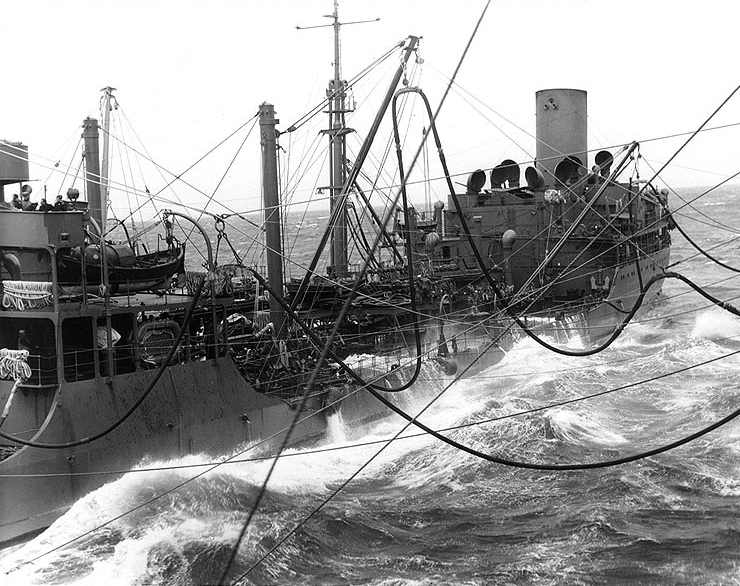
USS Sabine (AO-25) was the second ship of that name, for the river on the Texas-Louisiana line. Bethlehem laid her down at Sparrows Point, Maryland, on 18 September 1939 as the tanker Esso Albany, Maritime Commission hull 10. Miss Ellen Klitgaard sponsored her when she was launched on 27 April 1940. The Navy renamed her Sabine on 19 September, bought her on 25 September, and commissioned her on 5 December 1940. Commander Edmund W. Strother had her. She was a fast fleet oiler, 553 feet long. This is AO-25.
After shakedown she passed the Panama Canal and joined the Pacific Fleet's base force. Through 1941 she ran oil between California and Pearl Harbor.
Early in 1942 she fueled the carriers that raided Wake and the Gilberts. On 10 April she joined the force built around Hornet and Enterprise. By the Tokyo raid Commander Houston L. Maples had her, and he kept her until 14 December 1942. On 17 April, in a rough sea, she fueled Enterprise. A spare anchor was stowed on her after bulkhead. That afternoon she and Cimarron withdrew east with the destroyers, before the bombers flew. She was not attacked.
In May she fueled ships at sea in the South Pacific, off New Guinea and Australia. In June she serviced destroyers and cruisers on patrol off Kodiak. In August she was south again with Saratoga while the carriers fought the Battle of the Eastern Solomons. She fueled that force. She was not in the air fight. In September she supported ships around New Caledonia, the Solomons, and the New Hebrides. In October she fueled the ships engaged at Santa Cruz.
She was home for short spells in January and July 1943. Until November the rest of her time went to fueling in the South and Central Pacific. When the Gilberts assault opened on 19 November she was topping off the carriers, battleships, cruisers, and destroyers with the landing force. On that operation the oilers waited on station and single ships came alongside on a schedule, instead of a whole group losing hours in a queue. Other oilers ran between those stations and Pearl Harbor.
In January, February, and March 1944 she was with Task Force 58 for the carrier raids on the Palaus, the Carolines, and the Marshalls. She left the force on 22 April, called at Pearl Harbor, and was at Majuro on 18 May. The force sailed on 6 June. She supported the landings on Saipan and Guam and the rest of the Marianas work, and she was back at Pearl Harbor on 14 August. In September she was in the Palau invasion. In October she fueled the assault ships at Leyte and the follow-up work in the Philippines. From March through June 1945 she was in the Okinawa campaign. In July and August she fueled Third Fleet strikes on Japan. She anchored in Tokyo Bay on 18 September. Ten battle stars. She was not sunk.
After the surrender she went from Tokyo to the Yangtze and stayed from 19 November 1945 until 22 April 1946. She worked from Hawaii and the west coast, made several Far East cruises, and shifted to the Atlantic Fleet on 13 June 1949. East-coast fueling, training, and Mediterranean deployments followed until she went out of commission in reserve on 14 February 1955.
The Military Sea Transportation Service activated her at San Diego on 15 November 1956, and she was commissioned on 10 December. She went out of commission again on 13 November 1957 and lay in the reserve fleet at Beaumont. She was struck on 14 January 1959. The Navy took her back in 1961, towed her to New York to refit, and recommissioned her on 14 December 1961 for the Atlantic Fleet, with Mayport as her home port. Late in 1962 she was in the quarantine of Cuba. In the middle of 1965 she took part in the Dominican Republic crisis. The rest of those years she trained, worked locally, and deployed to the North Atlantic and the Mediterranean. In October 1968 she was ordered to Philadelphia to inactivate. She was decommissioned on 20 February 1969 and joined the Atlantic Reserve Fleet there. On 22 January 1970 the Maritime Administration took her into the James River reserve fleet. The history written in 1974 still has her there.